
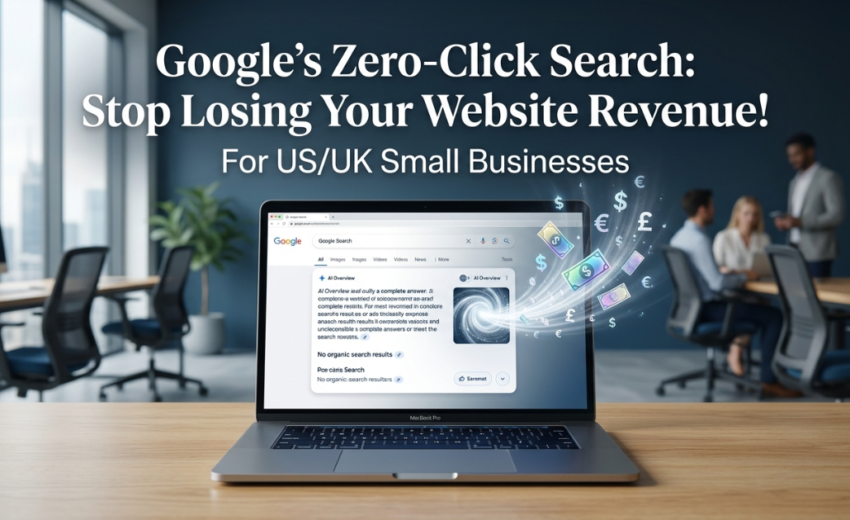
Discover effective strategies to combat zero-click searches. Learn how to optimize your content for featured snippets and boost your website revenue today!
Understanding Zero-Click Searches
Google just answered your potential customer’s question — and they never visited your site. That’s the brutal reality of zero-click search, and it’s hitting high-ticket service businesses harder than anyone wants to admit.
According to data tracked across billions of searches, over 58% of Google searches now end without a single click. No visit. No lead. No revenue.
The search engine has become the destination. Featured snippets, AI Overviews, and knowledge panels deliver answers instantly, eliminating the need for users to dig deeper. For businesses where one conversion can mean thousands of dollars, that traffic loss isn’t a vanity metric problem — it’s a revenue problem.
The instinct is to chase more clicks. The smarter move is to rethink what visibility actually converts into when clicks do arrive. That shift in thinking — from raw traffic to qualified intent — is exactly what separates businesses surviving this landscape from those quietly bleeding revenue.
The Framework: Shifting from Clicks to Visibility
Zero-click searches have fundamentally changed the competitive game — but the businesses winning right now aren’t fighting Google’s AI. They’re reframing success entirely.
The old model was straightforward: rank high, get clicks, convert visitors. That pipeline is increasingly broken. What happens when no one clicks anymore becomes the central question every high-ticket service business must answer strategically.
The smarter framework prioritizes brand visibility and conversion quality over raw traffic volume. In practice, this means measuring whether your target audience recognizes you — not just whether they clicked. Businesses that convert at a higher rate from fewer, higher-intent visits consistently outperform competitors chasing volume.
This visibility-first approach sets the foundation for understanding why being seen — even without the click — is now your most valuable competitive asset.
Why Visibility Matters More Than Ever
Google’s zero-click environment has flipped the traditional traffic playbook — but here’s what most businesses miss: visibility and clicks are no longer the same thing. Your brand can still win even when users don’t visit your site, provided you’re the name Google surfaces repeatedly.
Consider the math. According to data from ClickVision’s research, over 58% of mobile searches now end without a click. That’s not a trend to wait out — it’s the new baseline. Brand authority becomes the real currency here. When Google’s AI consistently cites or references your business in AI Overviews, users begin to associate your name with credibility — long before they ever land on your site.
Sustained visibility drives downstream conversions. A prospect who sees your brand answer three separate questions is far more likely to convert when they finally reach a high-intent buying stage. Knowing how to maintain organic visibility becomes a direct revenue lever, not just a vanity metric.
That shift in thinking — from click volume to branded impression frequency — sets the foundation for the content strategy that actually works in this landscape.
Optimizing for Answer-First Content
The businesses capturing visibility in today’s zero-click landscape share one common strategy: they structure content to answer questions before Google has to extract the answer for them. This is the core logic behind winning featured snippets — Google’s formatted answer boxes that now appear in roughly 12.3% of all search queries, according to clickvision’s zero-click research.
Answer-first content doesn’t just chase snippet placement. It signals to Google’s algorithm that your page is the authoritative source — which builds brand authority that compounds over time. In practice, this means leading with a direct, concise answer (40–60 words works well), then expanding with depth that justifies the click.
For high-ticket small businesses, this approach directly supports Conversion Rate Optimization (CRO) — because users who click through after seeing your snippet are already pre-qualified. They’ve sampled your expertise and want more. That’s a fundamentally different visitor than a cold traffic click.
The real competitive edge lies in targeting high-intent keywords — queries where searchers are ready to act, not just browse. Those SERP features are exactly where this strategy plays out next.
Utilizing SERP Features to Your Advantage
The answer-first content strategy covered earlier sets the foundation — but the real leverage comes from owning the SERP real estate that Google actively surfaces. Google’s zero-click searches have trained users to scan featured snippets, People Also Ask boxes, knowledge panels, and local packs before ever considering a click. For high-ticket small businesses, appearing in these features isn’t a consolation prize. It’s a brand authority multiplier.
According to rocket.net, businesses that consistently appear in SERP features build stronger top-of-mind awareness — which directly influences high-intent purchasing decisions made offline or through direct navigation later.
Practical SERP feature targets worth prioritizing:
- Featured snippets — concise, structured answers that position your brand as the definitive source
- Local packs — critical for service-area businesses competing for nearby buyers
- People Also Ask — captures secondary intent and extends your content’s visible footprint
Winning these placements requires deliberate schema markup, tightly structured content, and consistent brand signals across your digital presence. The businesses that treat SERP features as conversion touchpoints — not just visibility wins — are the ones turning impressions into revenue. How you respond operationally to zero-click’s impact determines whether that visibility actually pays off.
Responding to Zero-Click Search Impacts
The strategies covered in previous sections — answer-first content and owning SERP features — are critical. But adapting to zero-click search requires a broader operational mindset, not just tactical tweaks.
High-ticket service businesses need to shift how they measure success. Organic impressions and brand exposure now carry real commercial weight, even without a click. What typically happens is that businesses doubling down on brand authority see downstream conversion gains — prospects arrive pre-sold after repeated SERP exposure.
According to ABM Agency, zero-click visibility still builds familiarity that shortens sales cycles considerably.
Practical response priorities:
- Redirect SEO KPIs toward revenue attribution, not just traffic volume
- Invest in Conversion Rate Optimization (CRO) so every visitor who does land converts at a higher rate
- Build email and retargeting lists aggressively — owned channels are zero-click-proof
Before shifting focus entirely, it’s worth challenging some widely held assumptions about what zero-click actually costs you — assumptions that may be costing more than the trend itself.
Common Misconceptions About Zero-Click Searches
Zero-click SEO gets misread constantly — and those misreadings cost small businesses real revenue. The biggest myth? That zero-click search is purely a traffic killer. In practice, it’s more nuanced than that.
Misconception #1: All zero-click searches represent lost opportunity. Many zero-click queries were never going to convert. Someone searching “what time is it in Denver” wasn’t booking your consulting call. The actual threat targets high-intent keywords — queries where buyers are close to a decision.
Misconception #2: Ranking #1 still guarantees clicks. Falling website traffic analysis confirms that AI Overviews now absorb clicks even from top-ranking pages. Position alone no longer protects revenue.
Misconception #3: Brand visibility doesn’t matter if users don’t click. Wrong. Consistent SERP presence builds brand authority even without the click — priming future conversions through recognition.
The businesses that struggle most are those fighting the symptom rather than rethinking strategy entirely. That reframing sets up a more uncomfortable question worth exploring next.
Conventional Wisdom vs. Reality: A Contrarian View
The prevailing narrative says zero-click search is a catastrophe. The reality is more nuanced — and more actionable for high-ticket small businesses willing to think differently.
Conventional wisdom treats “People Also Ask” boxes as traffic thieves. In practice, they’re a brand visibility engine. Appearing in PAA repeatedly trains searchers to recognize your business name before they’re even ready to buy. That recognition directly influences CTR recovery when high-intent, bottom-of-funnel queries finally surface.
The contrarian truth: zero-click search filters out tire-kickers. The visitors who still click through after seeing a featured snippet? They’re more qualified. With AI Search and Zero-Click Results, Why CRO is Critical makes the case that Conversion Rate Optimization (CRO) matters more now precisely because traffic volumes are leaner — every session carries higher revenue potential.
Treating zero-click as purely a loss ignores the brand authority compounding happening beneath the surface. Seeing those real-world patterns play out across different business types makes the framework far clearer — which is exactly what the next section breaks down with concrete scenarios.
Example Scenarios: Applying the Framework
Knowing the theory is one thing. Seeing how zero-click strategy plays out for actual small businesses makes the strategy click. Here are two concrete scenarios that illustrate how high-ticket operators can turn the zero-click landscape into a competitive edge.
Example scenario: A boutique estate planning law firm notices organic traffic dropping despite strong rankings. Rather than chasing clicks, they optimize their Google Business Profile, publish detailed FAQ content that earns featured snippets, and redirect CRO energy toward their contact form. Result? Fewer visitors, stronger conversion rate — revenue holds steady.
Example scenario: A premium home remodeling contractor targets high-intent keywords like “kitchen remodel cost [city].” Their content surfaces in AI Overviews, building brand authority before prospects ever visit the site. When those buyers do click, they’re already pre-sold — dramatically shortening the sales cycle.
The pattern across both scenarios is consistent: visibility in zero-click results functions as top-of-funnel warming, not a dead end. The businesses that adapt stop measuring success purely by traffic volume and start tracking qualified leads and revenue per visitor instead.
These real-world applications point toward a set of principles worth codifying — which brings us to the core takeaways every high-ticket small business should internalize.
Key Takeaways
The zero-click era isn’t a death sentence — it’s a mandate to compete differently. AI Overviews have fundamentally shifted how search delivers value, compressing the buyer’s journey and filtering out passive browsers. What remains is a smaller, sharper audience that’s genuinely ready to act.
The businesses that survive aren’t clinging to vanity traffic metrics. They’re doubling down on high-intent keywords, strengthening brand authority, and converting the visitors who do arrive. Traffic volume matters far less than traffic quality.
As patterns shift across industries, one question keeps surfacing — and it’s worth examining directly: what does declining Google traffic actually signal about your business health?
Are You Noticing a Drop in Google Search Traffic, But Your Business Is Still Getting Leads?
That’s actually a signal worth paying attention to — not panicking over. In the zero-click search era, raw traffic numbers are increasingly a vanity metric. What matters is whether the right people are finding you and converting.
A common pattern is that businesses with strong brand authority and well-optimized conversion funnels maintain — or even grow — revenue despite losing informational clicks to AI Overviews. Google is surfacing your brand name in answers; users arrive pre-sold.
The disconnect to diagnose: falling sessions with stable or rising revenue means your high-intent keywords are still doing their job. Falling sessions and falling leads? That’s a Conversion Rate Optimization (CRO) problem, not just a traffic problem. Check your Google Search Console performance data to separate branded query trends from non-branded ones before drawing conclusions.
Traffic drops sting. But chasing click volume back to 2021 levels isn’t the goal anymore — qualified conversions are.
What’s Google’s Plan for Eliminating Websites That Depend on Search Traffic?
Bluntly? There isn’t one — but that doesn’t mean websites are safe. In the zero-click landscape, Google’s commercial incentive is to keep users on Google properties longer. That’s a business decision, not a declared war on publishers. However, the structural outcome is the same: organic traffic to content-dependent sites continues to compress.
What’s actually happening is a gradual redefinition of what “search” delivers. Google surfaces answers. Websites must now earn the click — not expect it.
That shift should prompt a harder internal question: Are clients and stakeholders fully grasping what this means for revenue? That conversation is worth preparing for.
How to Respond to Client Claims That Zero-Click Searches Are Killing Their Business
When a client walks in convinced that zero-click search has destroyed their revenue, the conversation requires facts — not reassurance. The SparkToro zero-click research is your strongest starting point. Data shows that a significant share of Google searches never result in a click, but the more important question is which searches. Informational queries lose clicks. High-intent, commercial queries — the kind your high-ticket clients depend on — still drive meaningful traffic.
Redirect the conversation from raw traffic numbers to Conversion Rate Optimization (CRO) and qualified lead flow. A client seeing fewer visits but stable revenue isn’t losing — they’re filtering. That’s worth explaining clearly, and it’s a signal to double down on brand authority rather than chase vanity metrics. What Google takes in clicks, strong brands recover through direct searches and referrals.
Does Google Deliberately Throttle Traffic to Websites? Here’s the Honest Answer
The short answer is: not deliberately, but the outcome is functionally the same. Google’s product decisions — AI Overviews, featured snippets, knowledge panels — serve Google’s business model first. Becoming a zero-click company isn’t Google’s stated goal, but it’s an accelerating side effect.
There’s no algorithm switch labeled “suppress this domain.” What exists instead is a structural design that satisfies user intent within the SERP. When Google answers the question, the click simply doesn’t happen.
That distinction matters less than what comes next — which is how you actually reclaim that lost ground through smarter content positioning.
What Strategies Can Be Used to Optimize Content for Zero-Click Searches?
As the industry shifts toward what many are calling “goodbye clicks, hello AI zero-click,” smart businesses aren’t retreating — they’re restructuring. The goal isn’t to fight Google’s interface; it’s to make your brand the source AI Overviews quote, and to ensure the traffic that does arrive converts at a higher rate.
Practical optimization approaches include:
- Target high-intent, transactional keywords where users still need to click to complete an action
- Structure content with clear Q&A formatting to increase featured snippet capture
- Build brand signals across authoritative third-party platforms so AI references your business by name
According to Zero-Click Search: The SEO Crisis Nobody’s Talking About, businesses that survive this shift focus relentlessly on bottom-funnel visibility rather than chasing top-of-funnel impressions. That’s a fundamental reorientation.
The businesses that win zero-click aren’t the ones getting the most impressions — they’re the ones converting the fewer clicks they receive at a dramatically higher rate.
Understanding which metrics to track — branded search volume, direct traffic lift, and assisted conversions — is the real frontier now. That measurement challenge deserves its own careful examination.
How Can Businesses Measure the Impact of Zero-Click Searches on Their Brand Visibility?
The real test of any zero-click strategy isn’t ranking — it’s revenue protection. Track branded search volume in Google Search Console monthly; rising brand queries signal that AI Overviews are building awareness even without clicks. Monitor direct traffic and Conversion Rate Optimization (CRO) metrics as secondary validation. Watch impression share alongside CTR to separate visibility gains from actual engagement.
Key takeaways for high-ticket small businesses:
- Prioritize high-intent keywords where buyers still click through to convert
- Treat Search Generative Experience (SGE) (SGE) as a brand awareness channel, not just a traffic source
- Measure CTR recovery on navigational and transactional queries separately
- Build brand authority so your business becomes the named source AI cites
The landscape has shifted permanently. Businesses that obsess over raw traffic numbers will keep losing ground. Those who redefine success around qualified conversions, brand recall, and multi-channel visibility will outlast the disruption. Zero-click isn’t a crisis to survive — it’s a filter separating businesses with genuine authority from those riding algorithmic luck. Start measuring what actually drives revenue, and build your entire digital presence around that signal.
April 4, 2026