
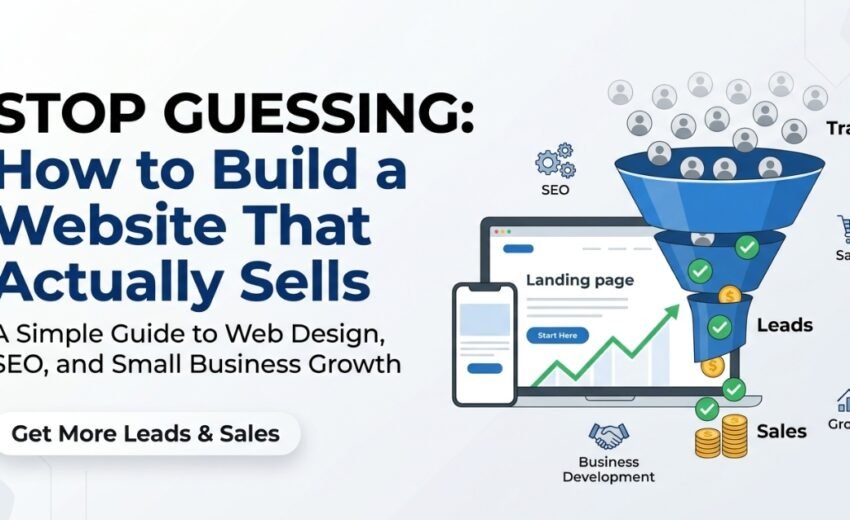
Learning how to build a website that operates as a 24/7 sales engine—rather than just a digital brochure gathering dust—is a game-changer for any small business. Many owners invest in web design only to find that traffic doesn’t turn into leads. The truth is, a beautiful site isn’t enough if it isn’t optimized to sell. To grow your business, you need more than just pixels; you need a strategic blend of SEO, conversion-focused design, and business development. In this guide, we’ll show you how to stop guessing and start building a high-performing website that attracts the right audience and turns browsers into paying customers.
The Guessing Trap: Why Most Websites Are Just Expensive Business Cards
Most businesses pour thousands of dollars into a website, launch it with excitement, and then wonder why the phone isn’t ringing. The uncomfortable truth? A beautiful website and an effective website are not the same thing — and confusing the two is costing companies real money every single day.
There’s a critical difference between a digital brochure and a conversion engine. A brochure tells people you exist. A conversion engine guides visitors toward a specific action — a purchase, a call, a sign-up — with every design decision made intentionally. Most websites, despite their polished visuals, fall firmly into the first category.
Pretty design often masks poor functionality. A site can win awards for aesthetics while silently hemorrhaging leads because its navigation is confusing, its calls-to-action are buried, or its mobile experience is broken. Looks create first impressions; structure creates results. To move beyond this trap, you need to stop losing money and build a high-converting website for your business.
The cost of guessing compounds fast. Wasted ad spend driving traffic to underperforming pages, lost leads from friction-filled forms, and missed revenue from unclear messaging add up to a serious strategic liability.
A data-driven approach to website conversion optimization minimizes guesswork — replacing assumptions with evidence. As content strategists increasingly recognize, moving decisions upstream with actual data is what separates high-performing digital assets from expensive placeholders.
The 7 C’s of a Website: A Framework for Strategic Web Development
Moving beyond the “build it and hope” mentality requires a structured way of thinking about what your website actually needs to accomplish. That’s where the 7 C’s framework becomes invaluable. Rather than designing pages around aesthetics, this model forces you to design around outcomes — which is exactly what professional web development services should be doing from day one.
Context, Content, and Community
Context is the foundation. Every visitor arrives with a specific intent — comparing options, solving a problem, or ready to buy. A website that doesn’t immediately signal relevance loses that visitor in seconds. Understanding context means mapping your pages to user intent, not to your internal org chart.
Content is where you earn trust. It answers the questions your visitors are already asking before they ever reach your contact form. Weak, generic copy kills conversions; precise, value-driven content accelerates them.
Community transforms passive browsers into engaged prospects. Social proof — customer reviews, case studies, user-generated content — works because people trust people. A common pattern is that adding verified testimonials to a landing page can meaningfully lift conversion rates without changing anything else on the page.
Customization, Communication, and Connection
Customization acknowledges that not every visitor is the same. A first-time visitor needs orientation; a returning prospect needs reassurance. Segmenting experiences — even through simple personalization — dramatically improves relevance.
Communication means removing friction from the conversation. Clear CTAs, live chat options, and accessible support channels signal that a real business is behind the website.
Connection ties your site into the platforms your customers already use — CRMs, email tools, booking systems. A disconnected website creates operational blind spots.
Commerce: Where It All Converts
Commerce is the culmination of every other C. The checkout or conversion path must be frictionless, logical, and free of unnecessary steps. A website that fails at commerce struggles significantly — regardless of how strong the other elements are.
Getting these seven pillars right sets the stage for everything downstream, including one factor that quietly undermines even the best-designed sites: page performance.
The Performance Tax: How 0.1 Seconds Costs You 8% in Revenue
Here’s a number worth tattooing somewhere visible: a 0.1-second improvement in page load time can lift conversion rates by up to 8%. That’s not a marketing claim — that’s a performance tax you’re paying every single day your site runs slow.
Most businesses treat speed as a technical afterthought. In practice, it’s a revenue lever.
Load Time and the Bounce Rate Spiral
The correlation between page speed and bounce rates is significant and well-documented. Users don’t wait. When a page takes longer than three seconds to load, a significant portion of visitors abandon it entirely — taking their potential revenue with them. Every additional second of delay compounds the damage, creating a spiral where slow performance drives away the exact visitors your lead generation website design was built to attract.
What makes this particularly costly is that paid traffic — the visitors you’re spending real money to acquire — is just as likely to bounce as organic traffic. Slow load times don’t discriminate.
Mobile Is the Real Battleground
For startups especially, mobile performance isn’t optional. Mobile devices now account for the majority of web traffic globally, and mobile users are demonstrably less patient than desktop users. If your site wasn’t built with a mobile-first mindset, you’re likely losing conversions on the device most of your audience is actually using.
The Frictionless UX Mandate
Every unnecessary click, every confusing form, every buried call-to-action is friction — and friction kills momentum. Reducing user effort at each step of the journey isn’t a nice-to-have; it’s a measurable revenue decision.
The ROI calculation here is clear: identify your current conversion rate, estimate the traffic volume losing patience, and model what even a modest speed improvement recovers. The numbers tend to be convincing.
Understanding why users abandon certain patterns, however, requires looking deeper at human psychology — which is exactly where the next piece of this framework begins.
The Psychology of the Sale: Jakob’s Law and User Expectations
Speed and structure matter, but there’s a third force shaping whether visitors stay or leave: psychology. Specifically, the mental models users carry with them before they even land on your page.
Jakob’s Law, coined by UX pioneer Jakob Nielsen, states a simple but uncomfortable truth: users spend most of their time on other websites. That means they arrive at yours with pre-built expectations about where the navigation lives, where the logo links, and what happens when they click a button. Fight those expectations, and you’re not being innovative — you’re creating friction.
This is one of the most underestimated risks in strategic web development for startups. Founders naturally want their site to stand out, which sometimes leads to “creative” navigation structures or unconventional layouts that leave users confused. In practice, confusion and conversion are mutually exclusive. A visitor who can’t find your pricing page in three seconds isn’t intrigued — they’re gone. If you want to understand why your visitors are leaving, you must learn why is your website failing to sell and how to explode your revenue.
The goal isn’t a website that looks unique in every aspect; it’s a website that feels instantly familiar in structure but unmistakably yours in voice.
Standard UI patterns — persistent top navigation, clear CTAs, footer contact info — aren’t creative limitations. They’re trust signals. They tell users, subconsciously, that your business understands them.
The practical balance is straightforward: be conventional in functionality, bold in brand personality. Reserve your originality for copy, color, and storytelling — not the placement of your menu. That trust-building foundation becomes even more powerful when it’s paired with how search engines discover and reward your site — which brings us to the long-term engine of sustainable growth.
Organic Growth: Why SEO Outperforms Outbound by 800%
Speed and psychology get visitors to stay. But first, they have to find you — and how they arrive matters enormously.
SEO leads close at roughly 14.6%, compared to just 1.7% for cold outbound tactics like direct mail or paid cold lists. That’s not a marginal difference; it’s a structural advantage. When someone searches for what you offer and lands on your site, they’re already pre-qualified. They’ve self-selected. The work of generating intent has already happened before you’ve spent a single dollar on persuasion. To truly scale your business, you need the proven small business ROI blueprint to understand why this strategy is the high-yield alternative to generic digital agencies.
Compound interest for websites. Unlike a paid ad that stops performing the moment your budget runs dry, strategic web development builds an asset that appreciates over time. A well-optimized page published today can generate traffic for years. That’s the compounding value most small business owners underestimate when they’re focused on short-term social media metrics.
Which brings up a critical shift happening across industries: businesses are moving away from rented audiences on social platforms toward owned web assets they fully control. Algorithm changes, platform fees, and reach restrictions have made “build your following here” a risky strategy. Your website is the one digital property nobody can take from you.
The mechanism that ties it all together is what practitioners call the Golden Thread of SEO — aligning every piece of content with genuine searcher intent. High-converting website design isn’t just about aesthetics; it’s about answering exactly what your visitor was searching for the moment they clicked. Content that matches intent doesn’t just rank — it converts.
Getting this alignment right depends heavily on the tools and approach you choose to build with — which is exactly what the next section addresses.
Implementation: The Best and Cheapest Ways to Build in 2026
Understanding psychology and SEO tells you what your site needs to do. The next question is more practical: how do you actually build it without burning through your budget?
The ‘Lazy Way’ vs. The ‘Premium Way’
In practice, two paths dominate the conversation. No-code and low-code platforms — think drag-and-drop website builders with built-in templates — let small businesses launch in days rather than months. They’re fast, affordable, and increasingly capable. For businesses focused on speed-to-market, this is often the smarter first move.
Custom professional development, on the other hand, delivers precision. When your revenue model demands complex integrations, unique user flows, or enterprise-scale performance, a professional build pays for itself over time.
When to Hire vs. DIY
A common pattern is this: businesses with under $10K in projected monthly online revenue benefit most from no-code solutions. Beyond that threshold — or when conversion optimization becomes a serious priority — professional development earns its cost back quickly.
The 2026 Outlook
AI-assisted design tools are narrowing the gap between these two options. Platforms now generate layout recommendations, analyze user behavior, and suggest structural changes automatically. Data-first design is no longer a luxury reserved for large teams.
The build decision ultimately becomes less about budget and more about your growth stage. Getting that choice right sets the foundation for everything the conclusion will pull together — turning all seven principles into a repeatable, revenue-focused system.
Conclusion: Stop Guessing and Start Building for Revenue
Your website isn’t a digital brochure — it’s a revenue engine that either works or costs you money every day it underperforms.
The blueprint covered here is deliberate: trust signals that convert skeptics, psychology-backed design, mobile-first performance, SEO that compounds over time, and tools that make execution affordable. Every layer is connected, and decisions should be grounded in data rather than instinct.
The shift from aesthetic guessing to data-driven decision-making is what separates businesses that grow from businesses that wonder why traffic never converts.
Treat your website as a living business asset — test it, measure it, and improve it continuously.
Key Takeaways:
- Design for behavior, not just beauty
- Speed, trust, and SEO are non-negotiable foundations
- Affordable tools make data-driven building accessible to any budget
Start with one improvement today, and momentum will build from there.
April 23, 2026
30-Day Content Calendar: Why Quality Blogging Daily is...

April 23, 2026