

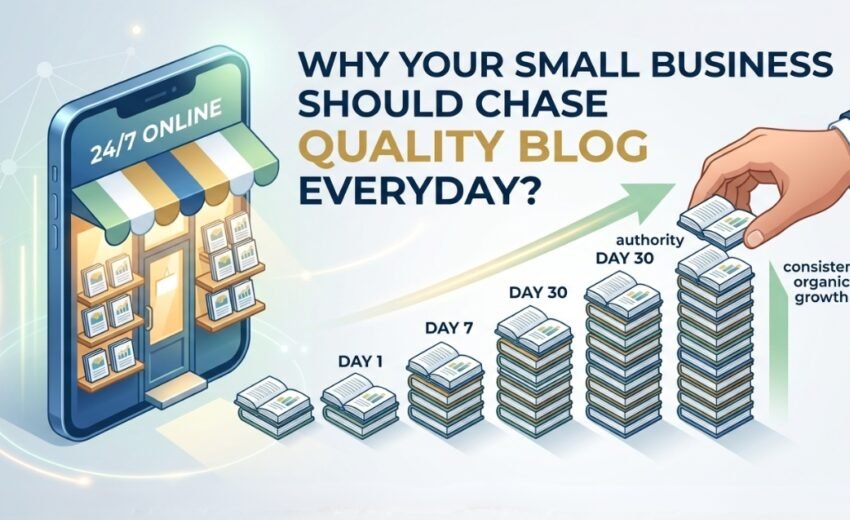
Are you struggling to implement a daily content strategy, or are you just trapped in the ‘blog-a-day’ cycle, churning out content that gains little traction? Many small business owners believe that quantity is the key to SEO, but in today’s search landscape, it’s a trap. Consistently publishing high-quality, expert-driven content is the true engine of organic growth. In this post, we break down why chasing quality—not just volume—is the most effective way to build authority, earn customer trust, and drive sustainable ROI for your small business.
The 600% Reach Opportunity: Why ‘Once a Week’ is a Recipe for Invisibility
Small businesses often treat content marketing like a chore — something to check off the list on a quiet Friday afternoon. Post once a week, stay consistent, and watch the audience grow. It sounds reasonable. The math, however, tells a brutally different story.
Weekly posting generates 52 annual touchpoints with your audience. Daily posting generates 365. That’s not a modest improvement — it’s a 600% increase in the raw number of opportunities your brand has to be discovered, shared, recommended, and remembered. For a small business operating without a national advertising budget, those extra 313 opportunities aren’t a luxury. They’re the competitive edge.
Surface Area and the Viral Equation
Every piece of content you publish is a lottery ticket. Most won’t go viral. But the more tickets you hold, the better your odds. Frequency dramatically increases the surface area for breakout moments — the post that gets shared by a local influencer, the how-to video that lands on a regional Facebook group, the tip that gets screenshotted and passed around. Weekly publishing caps your chances; daily publishing multiplies them.
What ‘High-Quality’ Actually Means for Small Businesses
Effective content marketing for small businesses doesn’t require Hollywood production values. High-quality means locally relevant, expertise-driven content — the kind only you can produce because it reflects genuine knowledge of your trade, your customers, and your community.
Algorithmic Momentum Is Real
Platforms reward active publishers. Post consistently, and algorithms begin to treat your account as a reliable source worth amplifying. Miss days, and that momentum stalls quickly.
The question, then, isn’t whether to post daily — it’s how daily posting systematically builds your lead pipeline around the clock.
The Lead Generation Engine: How Active Blogging Drives 68% More Prospects
If the previous section made the case for posting frequency, this one answers the natural follow-up question: where does all that content actually go? The answer is compounding digital equity — and it starts with your blog.
Companies that maintain an active blog generate 67% more leads per month than those that don’t. That number isn’t a coincidence. It reflects a straightforward mechanism: every published post becomes a permanent, indexed page that search engines can surface to potential customers at any hour of the day.
Indexed Pages as Digital Real Estate
Think of each blog post as a storefront on a busy street — except this street runs 24 hours a day, seven days a week, with no rent. SEO for small businesses depends heavily on this concept. A business with 50 indexed blog posts has 50 separate opportunities to appear in search results. One with five posts has five. The math is unforgiving, but it’s also an enormous opportunity for smaller operators willing to put in the work.
Trust as a Conversion Catalyst
Active blogging doesn’t just generate traffic — it earns credibility. A common pattern is that buyers who engage with three or more pieces of a brand’s content before purchasing are significantly more likely to convert and stay loyal. Content signals expertise before a single sales conversation happens.
The Compounding Effect
Unlike paid ads that vanish the moment your budget runs out, organic traffic builds on itself. A post published today can drive leads twelve months from now. That’s the compounding advantage — and it’s precisely the kind of leverage that feeds directly into your sales process, which is where a structured approach like the 3-3-3 rule becomes essential.
The 3-3-3 Rule: Integrating Daily Content into Your Sales Funnel
So you’re generating more traffic and pulling in more leads — but what happens when those prospects actually enter your sales pipeline? This is where daily content shifts from a marketing asset to a genuine sales tool.
The 3-3-3 Rule offers a practical framework for small business sales conversations: spend 3 minutes researching a prospect before any outreach, identify 3 points of personalization to anchor your pitch, and execute 3 follow-ups using fresh, relevant material. Simple enough in theory. The challenge most small businesses hit is step two — where do those personalization points actually come from?
Daily content solves that problem directly. A consistent publishing cadence means your sales team always has current, high-quality content to reference — a recent blog post addressing a pain point, a how-to guide, a timely industry take. Instead of sending a generic “just checking in” email, a salesperson can share a piece that speaks directly to what a prospect mentioned last week. That shift from transactional to relevant is often the difference between a closed deal and a dead thread.
Content also reduces friction throughout the funnel. Prospects who’ve already consumed multiple articles arrive at a sales call pre-educated. They ask better questions, raise fewer basic objections, and move through the process faster. In practice, marketing output becomes sales input — each published piece functioning as a quiet advance on the conversation.
That naturally raises a follow-up question: does publishing daily mean sacrificing quality for volume? It’s a concern worth addressing head-on.
Quality vs. Quantity: Debunking the False Dichotomy
The quality-versus-quantity debate is one of the most persistent myths in content marketing — and for small businesses, it’s genuinely damaging. The assumption that you must choose between the two creates a paralysis that stalls publishing schedules and hands momentum to competitors who’ve already moved on.
The reality is this: quantity is the path to quality. Every piece of content you publish is a data point. You learn which headlines resonate, which topics drive engagement, and which search intents your audience actually has. Without a steady volume of content, that feedback loop never forms.
The Hidden Cost of Perfectionism
Perfectionism feels responsible. In practice, it’s one of the most expensive habits a small business can develop. Time spent polishing a single post to a theoretical ideal is time not spent publishing, testing, and iterating. A common pattern is that businesses waiting for “perfect” content end up publishing sporadically — which, as earlier sections outlined, actively undermines lead generation and funnel performance.
Defining Minimum Viable Quality
The smarter framework is Minimum Viable Quality (MVQ) — the threshold your content must meet to rank, engage, and convert without requiring disproportionate effort. For SEO purposes, that typically means: accurate information, clear structure, natural keyword placement, and genuine usefulness to the reader. Content optimization doesn’t demand flawless prose; it demands relevance and clarity.
Daily Publishing as a Testing Engine
Consistent daily publishing also unlocks something strategic: the ability to test a broader range of keywords and search intents simultaneously. Each post targets a different query angle, building a diversified organic footprint over time.
That diversification extends far beyond your blog — which is exactly where social media enters the picture.
Social Media Synergy: The 5-5-5 Rule for Daily Engagement
Publishing a daily blog post is only half the equation. Getting that content in front of the right audience requires a disciplined social media strategy — and that’s where the 5-5-5 rule comes in.
The framework is straightforward: every day, publish 5 new posts across your platforms, leave 5 meaningful comments on others’ content, and send 5 direct messages or targeted engagements to prospects or partners. Together, these 15 daily actions build brand visibility without requiring a dedicated social media team.
Daily social engagement is a brand awareness multiplier that small businesses consistently underestimate. Platforms like Instagram, LinkedIn, and Facebook reward active accounts with broader organic reach — and that freshness factor is baked directly into their algorithms. Accounts that post sporadically get deprioritized; accounts that show up daily get surfaced to new audiences. It’s that simple.
Here’s where your daily blog earns its keep multiple times over. One well-written post — informed by solid keyword research — can be repurposed into:
- A short-form tip for Instagram or Facebook
- A text-based LinkedIn post expanding on the core argument
- A story or reel pulling a single compelling stat
- A reply thread on X (formerly Twitter)
- A Pinterest graphic with a key takeaway
That’s five pieces of social content from a single source. In practice, repurposing this way keeps your messaging consistent while dramatically reducing the creative lift each day.
The compounding impact of this daily discipline, however, goes far beyond what any single post or platform can achieve — and that’s worth examining closely.
The Compounding Effect: Why Daily Content is Your Best Long-Term Asset
Every strategy covered in this article — balancing quality with quantity, applying the 5-5-5 rule, optimizing for search intent — only reaches its full potential when you stay consistent over time. That’s the compounding effect in action, and it’s the most compelling argument for committing to a daily content strategy right now.
The numbers back this up. Companies that publish content frequently generate significantly more organic traffic than those that post sporadically, with high-frequency publishers seeing up to 3.5x more traffic compared to low-frequency competitors. That multiplier doesn’t appear overnight — it builds month after month as search engines recognize your site as an active, authoritative source worth surfacing.
A large content library also transforms your site’s architecture in ways a handful of posts simply can’t. More articles mean more opportunities for internal linking, which distributes page authority across your domain, keeps visitors engaged longer, and signals topical depth to search algorithms. In practice, a blog with 200 posts connects ideas in ways that compound your credibility far beyond what any single piece could achieve.
Content is an asset that appreciates — unlike paid ads, which go dark the moment your budget does.
That distinction matters enormously for small businesses operating with tight margins. Every post you publish today continues working for you in six months, two years, even a decade from now. Paid campaigns deliver traffic on a rental basis; owned content builds equity.
The path forward is straightforward: commit to publishing daily, apply the frameworks outlined here, and trust the process. Start today — your future audience is already searching for you.
Key Takeaways
- A short-form tip for Instagram or Facebook
- A text-based LinkedIn post expanding on the core argument
- A story or reel pulling a single compelling stat
- A reply thread on X (formerly Twitter)
A Pinterest graphic with a key takeaway

April 21, 2026
How to Calculate True Marketing ROI for Your...

April 21, 2026