
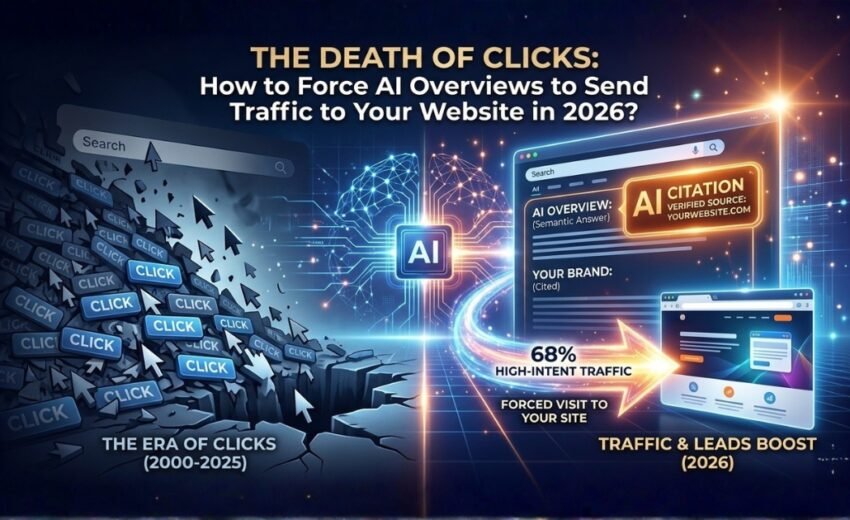
AI Overviews have officially triggered what industry experts are calling The Death of Clicks, fundamentally rewriting the rules of organic discovery in 2026. For many USA brand owners, this shift feels like a digital death sentence as Google evolves from a search engine into a sophisticated answer engine. With AI Overviews (formerly SGE) occupying the prime real estate above the fold, the traditional organic visit is becoming a rare commodity. This is the brutal reality of Google’s Zero-Click Search growth, where users find definitive answers on the search results page without ever feeling the need to click through to your website.
For the average small business, this “Great Erasure” of traffic is the primary reason why your USA business is invisible on Google despite spending thousands on legacy SEO tactics. When AI Overviews summarize your best content into a neat paragraph and omit your link, you aren’t just losing a visitor—you are losing data, attribution, and revenue. You are essentially burning cash on SEO strategies that were designed for a pre-AI era.
However, in every crisis lies a massive opportunity for those who understand the new “Citation Math.” The goal in this new landscape is no longer just to rank; the goal is to force the AI Overviews to cite your brand as the ultimate authority. To survive and thrive, you must pivot from traditional keyword chasing to a comprehensive AEO Strategy for 2026. This is about moving away from “renting” attention and learning how to own your market organically by becoming semantically indispensable to the algorithms.
This 3,000-word blueprint isn’t just another SEO guide; it is a survival manual for the AI era. We will dissect the exact technical framework required to dominate AI Overviews, explore how to build a self-sustaining SEO Flywheel, and reveal the secrets to capturing high-intent leads even when traditional clicks are dying. If you want to stop being a victim of the AI revolution and start becoming its most cited authority, you are in the right place.
Something fundamental broke in the relationship between users and search engines. It didn’t happen overnight, but the data confirms it’s no longer reversible. The way people find information online has crossed a threshold — and for website owners who haven’t adapted, the consequences are already showing up in their analytics.
The shift is simple to describe and brutal to absorb: users stopped looking for links. They started expecting answers.
According to Gartner, traditional search engine volume is projected to drop by 25% by 2026 as users migrate toward AI-powered chatbots and on-page summaries instead.
On mobile devices, that migration is already complete. Zero-click searches have hit 77% on mobile — meaning nearly four out of five mobile searches end without a single tap on a result. The scroll is gone. The click is optional. The blue link is becoming a footnote.
This is the psychology driving the collapse: users now trust the AI-generated summary more than the list of sources sitting beneath it. When Google’s AI Overview delivers a confident, structured answer at the top of the page, the instinct to dig deeper evaporates. Why scroll when the answer is already there?
This behavioral shift has forced a fundamental redefinition of what “ranking” even means. The old goal was to appear in the top ten results. The new discipline — Answer Engine Optimization (AEO) — is about becoming the source an AI cites, not just a URL it lists. Understanding how to rank in AI overviews isn’t optional anymore; it’s the entire game. The question worth asking, though, is whether any of this is actually bad for business — or whether the traffic that does make it through is now worth far more than before.
Is SEO Still Worth It? The Rise of the ‘Citation Premium’
Let’s put the “SEO is dead” narrative to rest right now. SEO isn’t dying — it’s being restructured around a completely different value proposition. The volume game is over. What’s replacing it is something far more interesting: a quality premium that rewards the right visibility over raw traffic numbers.
Being cited in an AI Overview is now worth more than holding the #1 organic ranking.
That’s not a provocative take. It’s math.
Fewer Clicks, Better Customers
Traffic originating from AI citations converts at 14.2%, compared to just 2.8% for traditional organic search — a 5x conversion lift, according to data from Semrush. Think about what that means in practice: a site generating 500 AI-referred visits per month is outperforming one pulling 3,000 traditional clicks on revenue, leads, and engagement.
The math reframes everything. Fewer people are clicking — but the people who do click arrive pre-qualified. They’ve already received a synthesized answer from Google’s AI, and they’re visiting your site because they want more from you specifically. That’s intent at a different level entirely.
The Citation Premium, Defined
The Citation Premium describes the measurable quality gap between AI-referred traffic and traditional organic traffic. Brands that achieve consistent placement within AI Overviews through deliberate Google AI Overview optimization don’t just survive the click decline — they benefit from it. Semrush data confirms that brands successfully cited within AI Overviews see a 35% increase in organic clicks despite the overall CTR drop affecting every other result on the page.
| Metric | Traditional SEO | Answer Engine Optimization (AEO) |
|---|---|---|
| Primary goal | Rankings & click volume | Citations & conversion quality |
| Success KPI | Top 10 position | Frequency of AI citations |
| Average conversion rate | 2.8% | 14.2% |
| Traffic trend (2026) | Declining | Growing in value |
| Content format focus | Keywords & backlinks | Structured, citable answers |
The New ROI Calculation
What this table reveals is a fundamental shift in how SEO value gets measured. The old playbook optimized for volume because volume was the only lever. The new playbook optimizes for citation-readiness — and the returns are disproportionately stronger. This transition is why top-tier strategists are moving away from linear growth and focusing on how to scale organic growth and escape the ‘ad spend’ trap forever. That shift also raises an uncomfortable question about where those citations actually come from, because the answer challenges everything the industry assumed about rankings.
The Death of the Top 10 Monopoly
The previous section established that SEO value hasn’t disappeared — it’s simply relocated. But here’s where things get genuinely disorienting for marketing teams: the map they’ve been using to navigate that value is now wildly inaccurate.
The Ranking Gap
Traditional SEO operated on a simple premise — rank in the top 10, capture traffic. AI Overviews have shattered that premise completely. According to Ahrefs, only 38% of pages cited in Google AI Overviews also rank in the traditional top 10 for that query. That means nearly two-thirds of AI citations are pulled from pages that conventional ranking reports would never flag as winners.
- Pages ranking on page two, three, or further back are regularly cited in AI responses
- A well-structured page at position 47 can outperform a thin page at position 3 for AI visibility
- Traditional rank tracking tools are, by design, blind to this entire category of opportunity
The Data Shift
What’s driving this disconnect? AI models don’t crawl content the way the old algorithm did. Rather than weighting domain authority and backlink volume as primary signals, they prioritize citation-readiness — the degree to which a page presents clear, verifiable, and well-structured information. Ahrefs confirms that technical citation-readiness now outweighs traditional domain authority for AI visibility. A newer site with precise, logically organized content can leapfrog legacy domains that built their rankings over a decade.
- Content structure, factual density, and source attribution matter more than link counts
- AI models reward clarity and specificity over keyword repetition
- A zero-click search strategy must account for where AI actually pulls citations, not where you rank
The New KPIs
Marketing teams clinging to “top 10 rankings” as their north star are measuring the wrong thing entirely. The metrics that matter are shifting fast.
- AI citation rate: How frequently your content appears in AI-generated answers
- Impression share in AI Overviews: Visibility beyond the traditional SERP
- Citation-to-click conversion: The percentage of AI mentions that still drive traffic
The question, then, isn’t just how to get cited — it’s how to structure your content so AI models have no choice but to pull from it. That’s exactly what the optimization blueprint coming up next breaks down.
How to Rank in AI Overviews: The 2026 Optimization Blueprint
The previous sections established that SEO value hasn’t vanished — it’s migrated to a new form of visibility. Now the real question becomes: how do you actually earn that visibility? Answer engine optimization 2026 isn’t about gaming an algorithm. It’s about structuring content so that AI systems can extract, trust, and cite it with confidence. This level of semantic clarity is impossible if your SEO strategy is failing without a technical foundation to support it. As Rubeena Singh noted at Intersec 2026, “Traditional SEO playbooks are no longer enough; if your strategy hasn’t evolved to meet AI rules, your rankings won’t either.”
Here’s the practical blueprint.
Step 1: Structure Content Using the ‘Claim-Evidence-Conclusion’ Framework
AI systems are trained to extract coherent answers. Content that mirrors their logic gets cited more reliably. For every topic you cover, lead with a clear declarative claim, follow it with specific evidence (data, examples, expert quotes), and close with a tight conclusion that restates the value.
Pro Tip: Keep each claim-evidence-conclusion unit to three to five sentences. Longer blocks dilute the signal. AI ingestion rewards precision over prose.
Step 2: Use Schema Markup to Force Citation Eligibility
Structured data is essentially a direct instruction to AI crawlers about what your content contains. Implementing FAQPage, HowTo, and Article schema tells Google’s systems exactly how to classify and surface your content within an overview.
Pro Tip: Prioritize
FAQPageschema for any content answering a specific question. Semrush’s research confirms that FAQ-structured pages appear in AI Overviews at a significantly higher rate than unstructured alternatives.
Step 3: Optimize for Natural Language Queries, Not Keyword Strings
Users increasingly type — and speak — in full sentences. A query like “what’s the fastest way to reduce customer churn for a SaaS startup” is now standard. Content built around conversational query patterns aligns with how AI models interpret intent.
Pro Tip: Write headers as actual questions. Then answer them directly in the opening sentence of that section. This creates clean extraction points for AI overviews.
Step 4: Maximize Information Density
Information density is the ratio of useful, specific facts to total word count. AI systems favor sources that deliver maximum insight per sentence. Vague, padded content loses citation battles to lean, fact-rich competitors.
Pro Tip: Audit every paragraph for filler phrases like “it’s important to note that” or “in today’s digital landscape.” Cut them. Replace each one with a specific claim or data point.
Step 5: Build ‘Answer Clusters’ Around a Single Topic
Rather than one long article, consider creating a hub-and-spoke content cluster where a central page answers the primary query and supporting pages address every related sub-question. This signals topical authority — a key factor in how AI Overviews select citation sources.
Pro Tip: The spoke pages don’t need to be long. A 400-word page that fully answers one specific question outperforms a 2,000-word page that partially answers five.
These five steps apply universally, but the path to citation-readiness looks different depending on your brand’s size, audience, and platform presence — especially for local businesses and startups that may actually hold a surprising structural advantage in the AI search era.
Engineering ‘Citation-Readiness’ for Local and Startup Brands
Here’s a counterintuitive truth that the previous sections haven’t yet surfaced: local businesses and early-stage startups may actually hold a structural advantage in AI Overviews. When someone searches “best pediatric dentist near me” or “affordable bookkeeping service in Austin,” AI can’t default to a national brand. Hyper-local queries demand hyper-local answers — and that’s your lane.
“Local specificity is citation currency. The more precisely your content answers a geographically or contextually narrow question, the harder you are for an AI to ignore.” — Core principle of a sound AIO citation strategy
The challenge for smaller brands, however, is generic invisibility. As noted in Gemini Visibility Analysis research, Gemini frequently produces vague responses when brand-specific, authoritative data is absent from its training inputs. The fix isn’t bigger budgets — it’s proprietary insight. Publish original data: local market surveys, customer behavior stats, neighborhood pricing benchmarks. Numbers tied to your brand name become un-ignorable source material.
“An original statistic with your brand’s name attached is worth more than a hundred polished blog posts that repeat what everyone else already said.”
Platform presence matters just as much. AI systems increasingly pull signals from community-driven platforms — Reddit threads, LinkedIn posts, niche industry forums — not just traditional websites.
“If your brand isn’t being discussed where real people ask real questions, AI has no conversational context to pull your citation from.”
Seed those platforms deliberately. Answer questions on Reddit. Publish perspective-driven posts on LinkedIn. Engage in niche forums where your customers already gather. That off-platform footprint is precisely what the next section examines in depth.
The Zero-Click Survival Playbook: Beyond the Website
The uncomfortable truth is that your website has already changed roles. It’s no longer a destination users browse — it’s a structured data source that AI systems mine for answers. Accepting this shift isn’t defeatist. It’s the foundation of every smart visibility strategy going forward.
A telling data point reinforces the urgency: 10 major SERP competitors currently rank in traditional search but are completely absent from AI platform citations. Organic rankings and AI citations are now two separate games, and winning one doesn’t guarantee winning the other. This divergence is exactly why smart founders are hiring an SEO Flywheel Architect to break the traditional CAC (Customer Acquisition Cost) crisis and build a system that works for both humans and AI models.
Your Weekly AEO Audit Checklist
Use this checklist every week to stay citation-ready across platforms:
- Verify schema markup is live on all core answer pages
- Check brand mentions in AI chatbot outputs using manual spot-tests
- Audit Reddit threads in your niche — identify unanswered questions worth targeting
- Publish one LinkedIn post that models the Answer-First format (lead with the conclusion)
- Review “Share of Model” by prompting AI tools with 5 key industry questions
- Update FAQ sections on pillar pages with freshly observed user questions
- Confirm citations in any recent AI Overview screenshots shared in your industry community
Winning the Off-Platform Game
Reddit and LinkedIn have become the new SEO battlegrounds — not because Google loves them, but because AI systems are trained on their content and pull from them heavily. In practice, a well-structured LinkedIn article answering a specific professional question can influence an AI-generated response far more reliably than a conventional blog post. The Answer-First model — leading with the direct answer before any supporting context — is what gets cited. Give the value away immediately.
Measuring success now means tracking brand mentions and Share of Model, not just clicks. The brands that thrive in the zero-click era will be the ones that treat citation visibility as a primary KPI, not an afterthought. This is exactly why quality content is your best long-term sales representative; it builds the trust and authority required to be the “chosen” answer in an AI-driven search environment.
The clicks didn’t disappear entirely — they migrated to a different stage of the journey. Your job in 2026 is to make sure AI sends users to you when it matters most.
Key Takeaways
- Pages ranking on page two, three, or further back are regularly cited in AI responses
- A well-structured page at position 47 can outperform a thin page at position 3 for AI visibility
- Traditional rank tracking tools are, by design, blind to this entire category of opportunity
- Content structure, factual density, and source attribution matter more than link counts
- AI models reward clarity and specificity over keyword repetition

May 12, 2026