
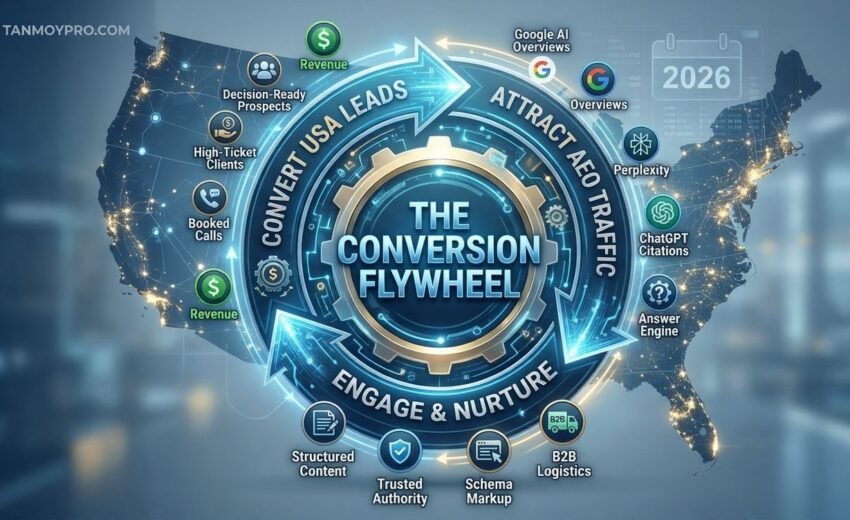
The Conversion Flywheel is the missing piece of the puzzle for USA founders who have mastered traffic but are still struggling with revenue. In 2026, getting eyes on your website through a solid AEO Strategy 2026 is only half the battle. If that AI-driven traffic isn’t turning into high-value leads, you aren’t building a business—you’re just running a popular blog.
Think of the Conversion Flywheel as a self-sustaining engine. Instead of a leaky sales funnel where prospects drop off at every stage, the flywheel uses the momentum of your existing organic reach to create a seamless loop of trust and sales. In an era where most entrepreneurs are still stuck in the death of local ads, those who pivot to a conversion-first mindset are the ones who actually scale.
In this guide, I’m going to show you exactly how to stop “renting” attention and start “owning” your market by turning every AI Overview citation into a loyal, high-ticket client.
The rules of digital marketing are being rewritten in real time — and most brands haven’t noticed yet. Users aren’t searching the way they used to. They’re asking. And increasingly, they’re getting complete answers without ever clicking a single link.
This isn’t a minor behavioral shift. It’s a structural collapse of the traffic model that the last two decades of digital marketing were built on.
Gartner projects that by 2026, traditional search engine volume will drop by 25% as users migrate toward AI chatbots and virtual agents.
That number deserves a moment of silence — and then a serious strategy conversation.
Zero-click is no longer an edge case. It’s the new baseline for US consumer behavior. When someone asks an AI assistant for the best accounting software for small businesses or the top personal injury attorney in Dallas, they get a direct, confident answer. The underlying websites those answers were pulled from? Largely invisible to the person asking.
For brands still optimizing purely for ranked positions and page traffic, this is an existential problem. This shift is precisely why many are witnessing the death of local ads as traditional search models crumble. What remains, and what’s genuinely growing, is high-value lead flow: the smaller, more intentional audience of buyers who are already pre-qualified by the time they make contact.
This is where the Conversion Flywheel enters the picture. Rather than chasing volume, it’s a framework for engineering the conditions under which AI systems recommend your brand, your product, or your expertise — turning answer engine optimization into a repeatable lead generation engine.
The catch? Traditional SEO alone won’t get you there. The strategic pivot required goes much deeper than keywords and rankings.
AEO vs. SEO: The Strategic Pivot for High-Value Leads
Understanding why clicks are declining is only half the battle. The more urgent question is: what replaces them? That answer lies in a fundamental shift from how search engines index content to how AI engines cite it.
| Dimension | Traditional SEO | Answer Engine Optimization | Business Impact |
|---|---|---|---|
| Core Unit | Keywords & clicks | Entities & citations | AEO drives qualified intent, not volume |
| Discovery Model | User browses ranked links | AI synthesizes and recommends | Reduces comparison shopping friction |
| Content Goal | Rank on page 1 | Become the cited source | Positions brand as authoritative answer |
| Traffic Type | Mixed intent | Pre-filtered, high intent | Higher close rates on inbound leads |
| Measurement | Click-through rate | Citation frequency & share of voice | Reframes what “visibility” actually means |
Traditional SEO optimizes for ranking signals — backlinks, keyword density, and page authority. Answer Engine Optimization, by contrast, trains AI models to recognize your brand as a trusted, citable entity. That distinction matters enormously for lead quality. According to HubSpot, early implementation of AEO strategies has demonstrated a 3x improvement in lead conversion rates compared to other traffic sources. The reason is straightforward: AI pre-qualifies users before they ever reach your site.
Think of it as an invisible filter. When someone asks ChatGPT or Gemini a high-intent question — “What’s the best B2B logistics software for mid-market companies?” — the AI doesn’t return ten links. It returns one or two recommendations. Users who click through have already received a trusted endorsement. Low-intent browsers never arrive. In practice, this means your sales team fields fewer cold inquiries and more decision-ready prospects. This is why businesses must adapt to Google’s Zero-Click Search to avoid losing their primary revenue streams.
Here’s the uncomfortable reality most brands haven’t confronted: page 1 Google rankings offer zero guarantee of AI visibility. Gemini and ChatGPT don’t crawl SERPs — they pull from structured, semantically rich content that directly answers questions. Brands invisible to these models are missing from the conversation entirely, regardless of their organic ranking. Structured data markup, FAQ schema, and answer-first content architecture are the building blocks of any credible AEO strategy 2026 — not optional enhancements, but foundational requirements. Developing a comprehensive AEO Strategy 2026—including structured data markup, FAQ schema, and answer-first content architecture—is no longer an optional enhancement, but a foundational requirement.
The brands that earn AI citations don’t just get traffic — they get trust transferred at scale. Understanding that dynamic is the first step. Turning it into a repeatable revenue engine is where the real work begins.
The 2026 GTM Flywheel: Turning AI Citations into Revenue
Knowing the difference between AEO and SEO is valuable — but it’s only useful if it translates into a repeatable system for generating revenue. That’s exactly what the Conversion Flywheel delivers: a four-step growth engine that transforms AI visibility into qualified leads, and qualified leads into long-term clients.
Here’s how each stage works:
- Step 1 — Visibility (Rank in ChatGPT’s citation block). The flywheel starts with one goal: getting your brand cited as a trusted source inside AI-generated answers. To rank in ChatGPT and similar platforms, your content needs to be structured as a direct, authoritative response to high-intent queries. Think of this as earning a front-row seat in the conversation your prospect is already having with AI — before they ever visit a website.
- Step 2 — Trust (Let the AI validate your brand). This is where AEO creates an advantage no paid ad can replicate. When an AI model cites your brand unprompted, it functions as an impartial, third-party endorsement. According to Tactical Marketing in the Age of AI Agents, B2B buyers increasingly treat AI-recommended sources as pre-vetted — meaning your brand arrives with credibility already built in.
- Step 3 — Conversion (Capture intent with optimized landing pages). High-intent visitors arriving from AI citations aren’t browsing. They’re evaluating. A common pattern is that this audience converts at a dramatically higher rate than traditional organic traffic.
The data is striking: Seer Interactive reports that ChatGPT referral traffic converts at 15.9% — compared to just 1.76% for standard Google organic traffic. That’s nearly a 9x difference in conversion efficiency.
CRO-optimized landing pages — built around the specific question that triggered the AI citation — are what capture that intent before it evaporates.
- Step 4 — Retention (Close the loop, then spin it again). The flywheel doesn’t stop at the first sale. Satisfied clients become case studies. Case studies become authoritative content. Authoritative content earns more AI citations. In practice, US logistics companies are already leveraging this loop to win high-value contract bids — using AI-cited thought leadership to establish credibility long before a formal RFP process begins.
The mechanics of actually building that visibility — structuring content, establishing entity authority, and earning citations — require a specific technical approach. That’s exactly where we’re headed next.
How to Rank #1 in ChatGPT: The 2026 Technical Playbook
The GTM flywheel playbook only generates revenue if your content is actually surfaced by AI engines. Understanding why AEO works is meaningless without knowing how to execute it. However, most efforts fail because of a weak technical SEO foundation, which acts as the ghost in the machine preventing AI crawlers from accessing your data. Here’s the technical framework for getting your content cited by ChatGPT, Perplexity, and Google’s AI Overviews in 2026.
Structure: Lead With the Answer
AI language models are built to extract the clearest, most direct response to a query — and they reward content that makes that job easy. The ‘Answer-First’ paragraph is non-negotiable: your first 50 words should state the core answer to the page’s target question plainly and completely, before any context, caveats, or storytelling.
- Open every key page with a one- or two-sentence direct answer to a specific question
- Use structured HTML elements (H2s, H3s, definition lists) to signal content hierarchy
- Deploy FAQ schema markup to make discrete Q&A pairs machine-readable
- Keep paragraphs short and scannable — AI models favor digestible, modular content blocks
Authority: Build Topic Depth, Not Keyword Density
Entity-based content shifts the goal from ranking for isolated keywords to owning a topic cluster. As Alan Antin, VP Analyst at Gartner notes, “search engine algorithms will further value the quality of content to offset the sheer amount of AI-generated content, as content utility and quality still reigns supreme.” That means covering a subject with genuine depth across multiple, interlinked pages — not stuffing a single article with variations of one phrase.
- Map your content to semantic entities (people, products, concepts) rather than keyword strings
- Build supporting pillar pages and cluster content that link back to a central authoritative resource
- Prioritize original data, expert quotes, and proprietary insights that AI cannot synthesize from generic sources
- Update content regularly — recency is a meaningful trust signal for LLM training cycles
Citations: Earn Mentions, Not Just Links
Being cited by authoritative external sources is the new backlink. AI models weigh co-citation patterns — meaning the sites that reference you matter as much as the number of sites that link to you.
- Pursue guest contributions and data partnerships with industry publications in your niche
- Create citable assets: original research, benchmark reports, and quotable statistics
- Build relationships with journalists and analysts who cover your vertical
- Monitor brand mentions across non-linked citations using tools that track unlinked references
Executing all three pillars consistently is what separates brands that appear in AI answers from those that don’t. And once that visibility is established, the next critical question becomes whether the leads it generates are actually worth having.
Scaling in the USA: Why Lead Quality is the Only Metric That Matters
Raw traffic numbers look great in a monthly report. They feel less impressive when your sales team is spending half its week disqualifying tire-kickers who bounced after reading one paragraph. In 2026, chasing volume is the wrong game — especially for US-based B2B providers in logistics, SaaS, and consulting, where every sales conversation carries real cost.
The technical playbook covered how to get cited by AI engines. Now the question is: what kind of buyer shows up when you do?
The answer is the most valuable kind.
Seer Interactive research confirms that AI acts as a pre-qualifying filter — users who click through from an answer engine have already had their primary questions answered and are ready for deep-funnel engagement. They’re not browsing. They’re evaluating.
“The buyer who arrives via an AI citation has already been educated by the AI. Your landing page isn’t their introduction to the problem — it’s their introduction to you.”
This is the AEO Lead Quality Multiplier in practice. A logistics company getting 500 AI-referred visitors per month isn’t competing with a site pulling 5,000 organic clicks if those visitors are still problem-aware rather than solution-ready. Fewer, better visitors convert at dramatically higher rates.
“For SaaS and consulting firms especially, one high-intent lead is worth twenty curiosity clicks. AEO systematically shifts your mix toward the former.”
However, this advantage evaporates the moment a high-intent visitor hits a slow, confusing, or misaligned landing page. That’s precisely why conversion rate optimization services are not optional in this stack — they’re the mechanism that captures the value AEO creates. This is why you must implement specific landing page conversion strategies to ensure you aren’t killing your sales at the finish line. A CRO audit that tightens page-load speed, clarifies the value proposition above the fold, and aligns CTAs to buyer stage can double the return on an AEO investment without adding a single new visitor.
“Traffic quality is only half the equation. The landing experience must match the sophistication of the buyer AEO delivers — or the opportunity is wasted.”
For B2B service providers specifically: map your high-intent AI queries directly to dedicated, conversion-optimized landing pages. Don’t send a procurement manager researching “enterprise logistics software vendors” to your generic homepage.
The businesses that win in 2026 won’t be those with the most traffic — they’ll be those with the tightest connection between AI visibility, lead quality, and conversion infrastructure.
Of course, building that infrastructure requires the right partners. Knowing what to look for — and what to avoid — is the final piece of the puzzle.
Selecting Your Partners: What to Look for in an AEO Agency
The agency landscape has shifted dramatically. The firms still pitching “we’ll get you to page one” are selling a map to a destination that no longer exists. What you need in 2026 is a growth partner who understands that AI visibility — your presence inside ChatGPT, Perplexity, and AI Overviews — is now as commercially important as any traditional ranking.
Top-tier AEO agencies have pivoted toward Retrieval-Augmented Generation (RAG) optimization, focusing on how AI systems retrieve and cite your content rather than just how search crawlers index your metadata. That’s a fundamentally different skillset, and it requires fundamentally different questions during your vetting process.
Ask This vs. Avoid This
| Ask This | Avoid This |
|---|---|
| “How do you measure AI visibility across ChatGPT and AI Overviews?” | Agencies that measure success exclusively by keyword rankings |
| “Walk me through your entity-mapping process.” | Partners who can’t explain structured data or knowledge graph strategy |
| “How does your content strategy connect to our sales pipeline?” | Firms managing SEO, paid, and content in completely isolated silos |
| “What does your RAG optimization workflow look like?” | Anyone promising “guaranteed #1 rankings” for high-volume keywords |
| “How do you align GTM strategy with AEO execution?” | Vendors focused on vanity metrics — impressions, raw traffic, clicks without conversion context |
The guaranteed-rankings red flag deserves special emphasis. Any agency promising guaranteed positions on competitive terms is either misleading you or working with tactics that carry serious long-term risk. AI-driven search doesn’t work that way, and no honest partner will claim otherwise.
What separates a capable AEO partner from a rebranded SEO shop is a genuinely holistic GTM approach — one where content strategy, entity authority, lead qualification, and sales enablement are treated as a single connected system, not separate line items on an invoice.
The 2026 conversion flywheel only spins when every component works together. Choose partners who understand the whole machine.
Why Your USA Business Needs a High-Performance Conversion Flywheel
The Core Mechanics of a Conversion Flywheel in 2026
To stay competitive, you must move beyond linear funnels. The Conversion Flywheel focuses on creating momentum by aligning your content with AI behavior. When your AEO efforts start surfacing your brand, the Conversion Flywheel ensures that the resulting interest is immediately captured and nurtured.
1. Aligning User Intent with Conversion Flywheel Stages
Every buyer in the USA market goes through different stages of awareness. Your Conversion Flywheel must provide specific “Answers” for top-of-funnel queries while offering “Solutions” for bottom-of-funnel intent. This alignment is what makes the Conversion Flywheel so effective at generating high-ticket leads.
2. Technical Optimization for Conversion Flywheel Success
A slow website is a conversion killer. Part of your Conversion Flywheel maintenance involves optimizing for Core Web Vitals and mobile responsiveness. Without technical precision, the momentum of your Conversion Flywheel will stall, regardless of how much traffic you attract through AI Overviews.
Measuring the Success of Your Conversion Flywheel
How do you know if your system is working? Tracking “Leads per AI Citation” is a crucial metric for the Conversion Flywheel. By monitoring how effectively your Conversion Flywheel turns zero-click search visibility into booked calls, you can refine your strategy for maximum ROI.
Table of Contents: Mastering the Conversion Flywheel
| Section | Key Takeaways |
| 1. The Shift to Zero-Click Search | Why US consumer behavior is moving away from traditional link-clicking toward instant AI answers. |
| 2. Defining the Conversion Flywheel | A deep dive into the framework that turns AI visibility into a repeatable lead generation engine. |
| 3. AEO vs. Traditional SEO | Understanding why training AI models is more important than chasing ranked positions in 2026. |
| 4. Technical AEO Framework | The “Must-Haves” for ChatGPT, Perplexity, and Google AI Overviews to cite your brand. |
| 5. Building the Conversion Flywheel | How to align your Conversion Flywheel with high-intent USA buyer behavior. |
| 6. The Role of CRO in the Stack | Why your Conversion Flywheel fails without a high-converting landing page strategy. |
| 7. Measuring Success & ROI | Critical metrics to track how your Conversion Flywheel is performing for your bottom line. |
| 8. Conclusion & Action Plan | How to start building your own Conversion Flywheel today with TanmoyPro. |
Key Takeaways
- Open every key page with a one- or two-sentence direct answer to a specific question
- Use structured HTML elements (H2s, H3s, definition lists) to signal content hierarchy
- Deploy FAQ schema markup to make discrete Q&A pairs machine-readable
- Keep paragraphs short and scannable — AI models favor digestible, modular content blocks
- Map your content to semantic entities (people, products, concepts) rather than keyword strings

May 11, 2026
AEO Strategy 2026: How to Optimize Your Website...

May 11, 2026