
SEO Flywheels are rapidly becoming the secret weapon for savvy USA business owners who are tired of the “pay-to-play” trap. For years, local ads were the easy button for growth, but with skyrocketing costs and thinning margins, that button is now broken. Smart founders are no longer renting their traffic from Google or Meta; instead, they are building a Startup Marketing Engine—a scalable, self-sustaining system that compounds over time. If you want to stop burning cash on temporary clicks and start building a permanent market asset, it’s time to shift your strategy toward a long-term organic powerhouse.
Not long ago, a modest daily ad budget and a decent landing page were enough to build a real business. Between 2010 and 2020, local digital advertising felt almost unfair — clicks were cheap, competition was thin, and founders who moved fast were rewarded generously. That era is over.
Then vs. Now: The Ground Has Shifted
- 2010–2020 (Easy Mode): Low CPCs, underserved local markets, simple ad creative wins, paid traffic = predictable growth
- 2026 (Survival Mode): Saturated ad auctions, rising distrust of sponsored content, algorithmic volatility, and a Why Traditional SEO Is Dying in 2026 (And What To Do Instead) warning that the old content-volume game is equally broken
What’s emerged is something founders are quietly calling a Growth Tax — the unavoidable, ever-increasing ad spend required just to maintain visibility, let alone grow. It’s no longer an investment with compounding returns. For many small businesses, it’s become a subscription fee paid to platforms that capture all the margin.
The instinctive response has been to pivot toward SEO. But here’s where the narrative gets nuanced. After 15 years and more than $30 million in online sales tracked, the fundamental rules of digital acquisition have shifted from volume to trust. And as Lead Wolf puts it plainly: “SEO in 2026 Is Not Dead. Lazy SEO Is.”
The 2026 landscape rewards authority — earned, demonstrated, and compounding. It’s not about publishing more content. It’s about owning a topic so completely that no algorithm change or ad auction can take it from you.
The question is: what does that actually cost — and what happens to founders who keep renting traffic instead?
The Math of Failure: Why Local CPCs Are Killing USA Startups
The previous section established that the old local ad playbook is broken. Now it’s time to look at exactly how much that broken system is costing founders — in real dollars.
The CPC Spiral Is Not Slowing Down
According to WordStream / LocaliQ’s 2025 Google Ads Benchmarks, the average cost-per-click rose 12.88% year-over-year in 2025. That’s not a blip — it’s a compounding pressure that erodes margins every single quarter. For a startup already operating on tight budgets, a near-13% annual cost increase on a channel that generates no residual value is a structural problem, not a temporary inconvenience.
The Danger Zones: Industries Feeling It Most
Some verticals are getting hit far harder than average. The Beauty & Personal Care sector, for example, saw CPC spikes of up to 60.1% in 2025. That kind of increase doesn’t just tighten margins — it can make a previously profitable campaign outright unsustainable overnight.
High-Inflation Industries for Local CPCs (2025):
- Beauty & Personal Care (+60.1%)
- Legal & Attorney Services (historically among the highest absolute CPCs)
- Home Services & Contractors
- Health & Wellness / Med Spa
- Real Estate & Mortgage
If your startup operates in any of these categories, the paid traffic model is increasingly a race you can’t win on budget alone.
Renting Traffic Is a Losing Game
Here’s the core problem: paid traffic is rented, not owned. When platform costs rise faster than revenue growth — and right now, they are — every dollar spent on ads buys progressively less. Stop paying, and the traffic disappears instantly.
“Spending more each year to acquire the same customer, on a channel that stops working the moment you pause it, is not a growth strategy — it’s a subscription to someone else’s algorithm.”
The ROI data makes the alternative impossible to ignore.
The ROI Gap You Can’t Unsee
📈 Mature SEO campaigns: Average ROI of 748% 📉 Long-term PPC campaigns: Average ROI of just 36%
(Source: First Page Sage / Outpace SEO)
That’s not a minor performance difference. It’s a fundamentally different category of return.
This ROI gap is exactly why the broader SEO vs AEO Shift conversation is accelerating among smart founders — and it sets the stage for a much bigger disruption already reshaping search results at the very top of the page.
The AI Squeeze: How Google Overviews Shrank the Paid Real Estate
The broken economics covered in the previous section don’t exist in a vacuum. There’s a structural reason ad costs keep climbing while results keep shrinking: Google’s search results page looks fundamentally different than it did even two years ago, and that change is eating into the space advertisers used to own.
Less Screen, Same Competition
AI Overviews — the large, AI-generated answer blocks that now appear at the very top of many search results — have physically displaced both paid ads and organic links. When a full-paragraph AI summary occupies the first visible screen on desktop (and nearly the entire screen on mobile), everything else gets pushed below the fold. Users have to scroll before they even see your ad. In practice, that scroll rarely happens.
This is the zero-click reality. A local user searches “best HVAC repair near me,” reads a synthesized answer pulled from multiple sources, and closes the tab — satisfied, without clicking a single result. No ad impression becomes a visit. No budget gets spent converting that search into revenue.
| Factor | Traditional Search (Pre-2023) | AI-Driven Search (2026) |
|---|---|---|
| Above-the-fold space | Ads + 2–3 organic links | AI Overview occupies most of it |
| Click-through likelihood | Moderate to high | Significantly reduced |
| Ad slot competition | High | Extreme (fewer slots remain) |
| User behavior | Scan and click | Read summary, often exit |
The AEO Shift Changes Everything
The broader strategic response to this squeeze is the move from SEO (Search Engine Optimization) to AEO (Answer Engine Optimization). Rather than targeting high-volume keywords and hoping for a click, AEO means structuring content so that Google’s AI cites your business as the source of the answer. For anyone focused on local SEO in 2026, this isn’t optional positioning — it’s the competitive baseline.
Bidding higher for fewer available slots isn’t a growth strategy — it’s a race to the bottom that only the biggest ad budgets can survive.
The real opportunity isn’t in fighting for shrinking paid real estate. It’s in building the kind of trusted, authoritative content that earns the AI Overview citation in the first place — which is exactly what the SEO flywheel is designed to do.
The SEO Flywheel: Building a Compounding Asset for 2026
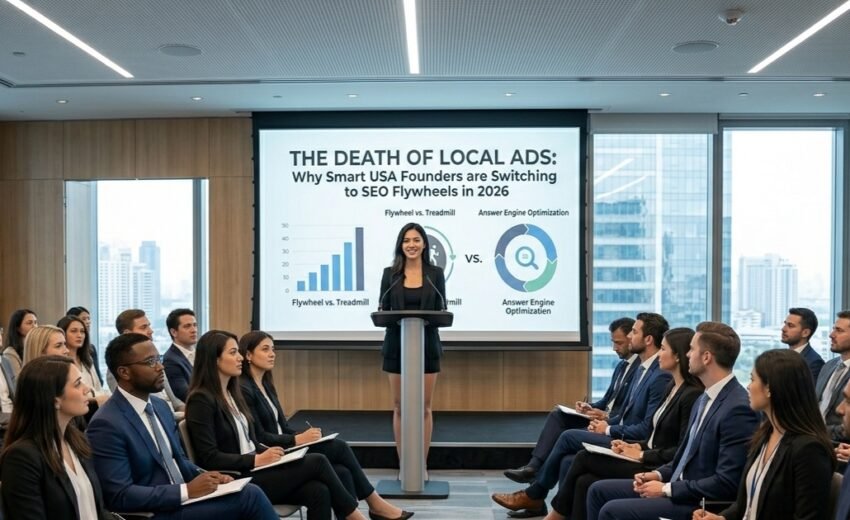
Think of your marketing spend as either a treadmill or a flywheel. The treadmill keeps you moving only while you’re paying for it. The flywheel takes effort to get spinning, but once it’s moving, momentum does the work. That’s the clearest way to understand the SEO flywheel vs PPC debate in 2026.
The flywheel model works like this: you publish content that demonstrates genuine expertise, that content earns backlinks and brand mentions, those signals improve your search rankings, higher rankings drive more visibility and traffic, and that traffic reinforces your authority. Each rotation compounds the last. It’s a self-reinforcing loop — not a line item on an ad invoice. By building this system, you can finally stop chasing clients and let the momentum generate leads while you sleep.
Authority: The Engine That Starts the Spin
Every flywheel needs an initial push. For local founders, that push is topical authority — becoming the most credible, comprehensive voice on your niche in your market. This isn’t about publishing dozens of thin blog posts. It’s about creating content that genuinely answers the questions your customers are already asking. High-quality content is the only “ad” your business will ever need to build this authority. Google’s own guidance reinforces this: as Danny Sullivan, Google’s Search Liaison, has stated, “Our systems do not sit out there and say, ‘big brand, rank it well.’ It is about recognition. If you are recognized as a brand in your field… that matters.” Recognition is earned, not bought.
Recognition: When Google Sees You as a Signal
Brand recognition has become a measurable ranking input. When users search for your business name directly, click your results consistently, and engage with your content across multiple sessions, Google interprets those behavioral signals as trust indicators. In practice, local founders who build recognizable brand entities — consistent names, addresses, categories, and content themes — outperform competitors who only optimize individual pages. If you want to scale your presence this way, you can hire Tanmoy to build a premium, authority-driven brand site that stands out.
Momentum: The Advantage Ads Can Never Replicate
Here’s what separates compounding SEO from the ad treadmill: pause your campaigns, and your visibility drops to zero overnight. Pause your content investment for a month, and your rankings hold. The momentum you’ve built continues generating leads, citations, and brand searches. That asymmetry is the core financial argument.
Retention: Capturing Follow-Up Questions
The real SEO opportunity in 2026 lies in follow-up questions that AI engines prompt users to ask. When your content answers not just the first question but the second and third — the “but how do I…” and “what if I…” follow-ups — you deepen user trust and reduce bounce signals that hurt rankings over time.
The flywheel isn’t a campaign. It’s an asset that appreciates — and understanding how AI surfaces that asset is what we’ll explore next.
GEO: The New Layer of Local Visibility
The SEO flywheel described in the previous section is powerful, but there’s a newer layer sitting on top of traditional search that founders can’t afford to ignore. Generative Engine Optimization (GEO) is that layer — and understanding it separates businesses that get cited by AI from those that get buried by it.
Discover: Getting Found by AI Engines
As Smart Business Revolution notes, GEO focuses on how AI engines remix and cite source content — not simply retrieve it. Platforms like Gemini and Perplexity don’t rank ten blue links; they synthesize answers from sources they trust. That means your goal shifts from climbing a results page to becoming the source an AI quotes.
In practice, this requires entity-based SEO: making it crystal clear to both crawlers and AI models who your business is, where it operates, and what problems it solves. Structured data markup (Schema.org for local businesses, services, and FAQs) is no longer optional — it’s the vocabulary AI uses to understand your relevance.
Cite: Earning Brand-Led Citations
Lazy link building — bulk directories, low-quality guest posts, generic press releases — is effectively dead. What The Lead Wolf accurately identifies is that AI engines prioritize brand relevance over keyword density. A citation from a respected local news outlet, a niche industry podcast, or a recognized community platform carries exponentially more weight than fifty mediocre backlinks.
One practical approach is to pursue brand-led citations: mentions that connect your business name, location, and area of expertise together in a single authoritative context. That’s what AI models treat as a trusted signal.
Convert: Turning AI Visibility Into Revenue
Getting cited in an AI overview is only valuable if the underlying content converts. Keep landing pages clean, answers specific, and calls to action direct.
Action Step: Audit your top five service pages today. Add FAQ schema, verify your Google Business Profile is complete, and identify one local publication where a genuine citation opportunity exists.
The good news? Once you understand GEO, it maps directly onto the practical playbook coming up next.
The Founder’s 2026 Playbook: How to Transition from Ads to Flywheel
The flywheel is real. The GEO opportunity is real. The question is: how do you actually shift gears without stalling your lead flow? Here’s a practical four-step transition plan built for founders who are done paying the growth tax.
Step 1: Audit Your Growth Tax Pull every active ad campaign and calculate true ROI — factoring in creative costs, management fees, and platform markup. The cost of local ads in 2026 has quietly eaten into margins for thousands of founders who assumed “running” meant “working.” If a campaign can’t prove positive ROI after three months, it’s a treadmill, not an engine.
Step 2: Reinvest Wasted Spend into Pillar Content Take that recaptured budget and build two to three high-authority pillar pages around your core service. These aren’t blog posts — they’re comprehensive resources that answer every question a buyer has before they pick up the phone. This is where compounding begins.
Step 3: Build Recognition, Not Just Rankings Rankings are a byproduct of brand. Focus on becoming the name your market searches for directly. Podcast appearances, local press mentions, and consistent social proof all feed the flywheel and signal authority to both Google and AI-driven search tools.
Step 4: Trust the Exponential Framework As Sam Altman’s framework reinforces, marketing in 2026 isn’t about more content — it’s about applying exponential thinking to brand authority. SEO gains don’t pay out weekly, but they don’t disappear on Monday morning either. To see how this compounding effect works for your bottom line, follow a proven small business ROI blueprint to guide your transition.
Key Takeaway: The founders who win in 2026 won’t outspend their competitors — they’ll out-compound them.
💡 Pro Tip: Start with just 20% of your ad budget redirected to content. Track branded search volume monthly. When you see that number climb, you’ll know the flywheel is spinning.
Key The Death Of Local Ads: Why Smart Usa Founders Are Switching To SEO Flywheels In 2026 Takeaways
- 2010–2020 (Easy Mode): Low CPCs, underserved local markets, simple ad creative wins, paid traffic = predictable growth
- Beauty & Personal Care (+60.1%)
- Legal & Attorney Services (historically among the highest absolute CPCs)
- Home Services & Contractors
- Health & Wellness / Med Spa

May 10, 2026