

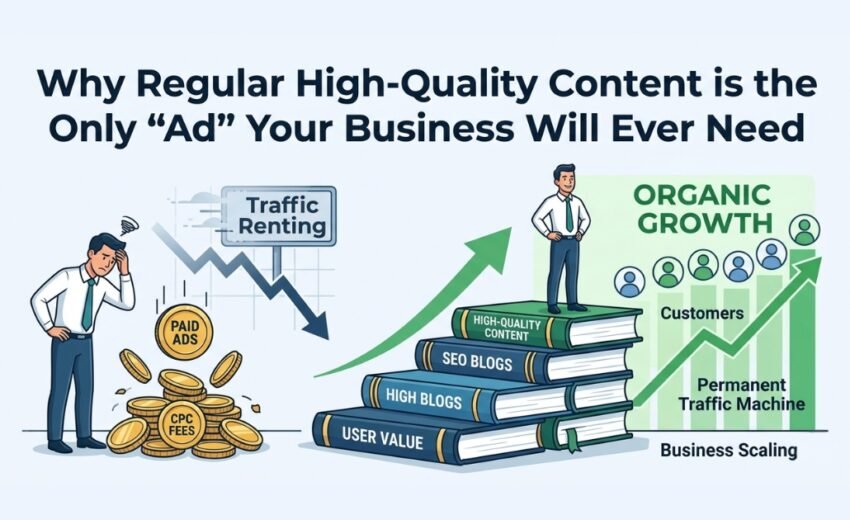
Discover why regular high-quality content is the ultimate marketing strategy. Learn how it drives organic traffic and builds trust without ongoing ad costs.
Introduction: The Power of High-Quality Content
Most small businesses are spending hundreds — sometimes thousands — of dollars every month on ads that disappear the moment the budget runs out. There’s a smarter way. High-quality content works around the clock, builds real trust, and keeps bringing in new customers long after it’s published.
Consider this. A well-written blog post or guide answers exactly what your ideal customer is searching for. It shows up in Google. It earns clicks. It builds credibility. That’s how quality content drives SEO results — not through tricks, but through genuine value.
According to Agility PR, quality content builds audience trust and positions your brand as an authority. For USA small businesses with tight budgets, that’s a massive competitive advantage.
The best part? Content is a lasting digital asset — unlike paid ads. And as the next section shows, that gap in performance is even bigger than most business owners realize.
Why High-Quality Content Outperforms Traditional Ads
Ads rent attention. SEO content owns it.
That’s the core difference most small business owners miss. A paid ad stops the moment your budget runs out. A well-written blog post, guide, or resource page keeps working — attracting clicks, building visibility, and pulling in potential customers — for months or even years after you publish it.
View content as a digital asset rather than an expense. According to Funded.com, quality content consistently drives long-term business growth by attracting the right audience at the right time — without ongoing ad spend.
Content compounds over time, while ads do not.
One strong article can rank on Google, get shared on social media, and pull steady traffic to your site — all at zero additional cost. That’s a return no paid campaign can realistically match over time.
And here’s what makes it even more powerful: quality content doesn’t just drive traffic. It positions your business as the go-to expert in your space. That credibility is something ads simply can’t buy — which is exactly what we’ll dig into next.
The Role of Trust and Credibility in Content Marketing
People buy from businesses they trust. It’s that simple.
And quality content is one of the fastest ways to build that trust — especially for small businesses competing against bigger brands with deeper pockets.
When you consistently publish helpful, accurate, and honest content, something shifts in how potential customers see you. You’re no longer just another business trying to sell them something. You become a reliable resource. According to Farotech, content that genuinely helps readers builds far stronger brand loyalty than high-volume, low-value publishing ever could.
Credibility isn’t claimed — it’s earned, one helpful piece of content at a time.
Think of each blog post or article as a small trust deposit. Over time, those deposits add up. Visitors who find your content useful are far more likely to convert into paying customers than cold-traffic from an ad they scrolled past.
That compounding credibility is exactly what makes content a true long-term asset — and a perfect lead-in to understanding how it fuels organic search growth.
SEO Benefits: How Content Drives Organic Traffic
Content marketing is one of the most powerful tools a small business can use to show up on Google — without paying for every click.
Here’s the process. Every blog post or article you publish is a new page Google can index. More indexed pages mean more chances for potential customers to find you. A common pattern is that businesses publishing consistent, helpful content see compounding traffic growth over time — meaning results keep growing even when you’re not actively promoting.
Quality content doesn’t just attract visitors — it attracts the right visitors, people already searching for what you offer.
This matters because organic traffic converts better than cold ad traffic. Visitors from search engines arrive with intent. They’re looking for answers, solutions, or services. That’s a warm lead, not a random impression.
Pairing strong content with a well-structured website amplifies these results significantly. Good design keeps readers on the page longer, which signals to Google that your content is valuable.
Of course, not all content strategies are created equal — and that’s where many small businesses get tripped up by outdated assumptions.
Conventional Wisdom vs. Reality: Content as a Marketing Tool
Most small business owners still think marketing means running ads. Spend money, get customers. Stop spending, stop getting customers. That’s the old playbook — and it’s expensive.
Here’s the reality: regular content works differently. Unlike paid ads that disappear the moment your budget dries up, quality content keeps working for you around the clock. A well-written blog post published today can still bring in new visitors two or three years from now.
Think of it this way — content is a digital asset, not an expense.
According to Agility PR, high-quality content builds lasting credibility that no single ad campaign can match. It answers real questions, solves real problems, and earns real trust.Contentn writer
In practice, businesses that commit to consistent content — blogs, videos, guides — build compounding momentum over time. Pair that with a smart social media strategy and you multiply the reach of every single piece you create.
The data supporting this shift is compelling.
The Data Behind Content Marketing Success
Numbers don’t lie — and the data around content marketing is hard to ignore.
According to research on content quality, businesses that prioritize high-quality, consistent content see stronger customer trust and longer engagement than those relying on one-off campaigns. That trust translates directly into sales.
Search engine optimization is where content really proves its worth. Businesses that blog regularly generate significantly more indexed pages, which means more chances to appear in Google searches — without spending a dollar on ads.
Quality content doesn’t just attract visitors — it attracts the right visitors who are already looking for what you sell.
Content also compounds over time. A well-written blog post can drive traffic for years, making it a true long-term digital asset that keeps working while you focus on running your business.
The bottom line? Content isn’t a cost — it’s an investment with measurable returns. And the businesses proving that every day might be closer to home than you think.
Example Scenarios: Businesses Thriving with Content
The data presents a strong case — but real-world patterns make it even clearer. Across industries, small businesses that commit to consistent, high-quality content are seeing compounding returns that paid ads simply can’t match.
Example scenario: A local plumbing company publishes one helpful blog post per week answering common questions like “why is my water heater making noise?” Over 12 months, those posts quietly build organic traffic — bringing in homeowners actively searching for help, not just scrolling past an ad.
Example scenario: A boutique fitness studio shares detailed workout guides and nutrition tips on their website. Instead of chasing clicks, they attract loyal readers who eventually become paying members.
What’s consistent across these patterns? Content creates a bridge between discovery and trust. When someone reads your article, watches your video, or follows your tips — they already feel like they know you before they ever reach out. That’s a huge advantage. In fact, connecting content to a clear conversion path is what separates businesses that grow from those that just get views.
Content doesn’t just attract visitors — it converts strangers into buyers by earning their trust long before a transaction ever happens.
Of course, no strategy is without its challenges — and content marketing is no exception.
Limitations and Considerations When Relying on Content
Content marketing is powerful — but it’s not perfect. Being honest about its limitations actually builds more trust than overselling it.
The biggest challenge? Time. Quality content takes weeks or months to gain traction. If your business needs leads tomorrow, a blog post written today won’t save you. Content works best as a long-term investment, not a quick fix.
There’s also the matter of strategy. Publishing without proper keyword research means you’re guessing what your audience actually searches for. That guesswork leads to content nobody finds — no matter how well-written it is.
Other real-world considerations include:
- Consistency is hard to maintain without a clear content plan
- Conversion isn’t guaranteed — even great traffic can stall if your site isn’t built to convert
- Algorithm shifts can affect your visibility overnight
On the other hand, these challenges are manageable. Working with an experienced content strategist helps you avoid the most common pitfalls and build a system that actually delivers.
The goal isn’t perfection — it’s sustainable progress. Understanding the limitations upfront sets realistic expectations and sharpens your overall approach, which brings us to the key lessons worth carrying forward.
Key Takeaways
At this point, the case is clear: regular, high-quality content isn’t a marketing tactic — it’s a long-term business asset that compounds over time.
Here’s what matters most:
- Content builds trust before a prospect ever contacts you
- Long-tail keywords attract buyers who are ready to act — not just browse
- Blogging outperforms paid ads in long-run ROI because your content keeps working around the clock
- Consistency beats perfection — showing up regularly matters more than going viral once
- Every piece of content you publish strengthens your overall online presence and search visibility
One truth worth repeating: Quality content is the only marketing asset that gets more valuable the longer you keep it.
The next natural question most business owners ask is — what actually counts as “high quality”? That definition matters more than most people realize.
What Actually Makes Content “High Quality”?
Not all content is created equal. You can publish blog posts every week and still get nowhere — if those posts don’t truly serve your audience.
High-quality content starts with user intent. That means understanding why someone is searching, not just what they’re typing. Are they looking to learn something? Compare options? Make a purchase? Content that matches intent gets read, shared, and trusted.
Beyond intent, quality content shares a few common traits:
- It’s accurate and specific — not vague or generic
- It solves a real problem your audience actually has
- It’s easy to read — short paragraphs, plain language, no fluff
- It builds on a credible foundation — your well-designed website is the home base for all of it
Quality content isn’t about impressing search engines — it’s about genuinely helping a real person make a better decision.
In practice, a 600-word post that answers one question clearly outperforms a 2,000-word post that rambles. That’s the standard to aim for. And as you’ll see next, the visual presentation of that content matters just as much as the words themselves.
Does High-Quality Graphic Design Have Any Value in Your Content Strategy?
So why is quality content important beyond just the words on the page? Because design is part of the content.
A well-written blog post wrapped in cluttered, unprofessional visuals sends mixed signals. Readers judge credibility fast — often within seconds. Good graphic design reinforces your message, builds trust, and keeps people reading longer.
Think of design as the packaging. Great packaging doesn’t replace the product, but it makes people pick it up. In content marketing, visuals support your words, guide attention, and make your brand memorable.
Strong design paired with strong writing creates a complete experience. It’s the difference between content people skim and content people actually absorb.
If your website looks outdated, even great content gets dismissed. A professional-looking site signals that you take your business seriously — and that signal matters to potential customers.
Content without effective design tells only half the story. Make sure you’re telling the whole one.
Can You Get Sales Just by Running Ads Alone, If Organic Content Is Ignored?
Short answer: yes, but not sustainably.
Ads can drive quick traffic. But the moment you stop paying, that traffic disappears. There’s no residual value. No asset left behind. Organic content, on the other hand, keeps working — answering questions, building trust, and pulling in buyers long after it’s published.
Paid ads rent attention. Quality content owns it.
A common pattern is that small businesses burn through ad budgets chasing clicks, while their competitors quietly build a library of helpful blog posts that rank for years. Learning how to write high-quality SEO content is what turns that content library into a long-term sales engine — one that doesn’t charge you per click.
The equation is straightforward: ads stop, but good content endures.
Is “Content Marketing” Even a Real Thing Anymore?
Yes — and it’s more important than ever.
Some small business owners wonder: do ads alone drive sales well enough to skip content entirely? As we’ve seen throughout this article, the answer is a hard no. Ads rent attention. Content owns it.
Content marketing isn’t a trend. It’s the foundation. It builds trust, fuels long-term SEO, and turns your website into a digital asset that works around the clock — no ad budget required.
Here’s what to take away:
- Consistency beats volume — publish less, but publish well
- Design matters — good visuals reinforce your message
- Organic content compounds — ads stop; great content doesn’t
Ready to start? Connect on LinkedIn, hire via Fiverr, or reach out on WhatsApp. Let’s build content that works for you.

April 13, 2026
Is Your Traffic Wasted? Why Your Business Needs...

April 13, 2026