

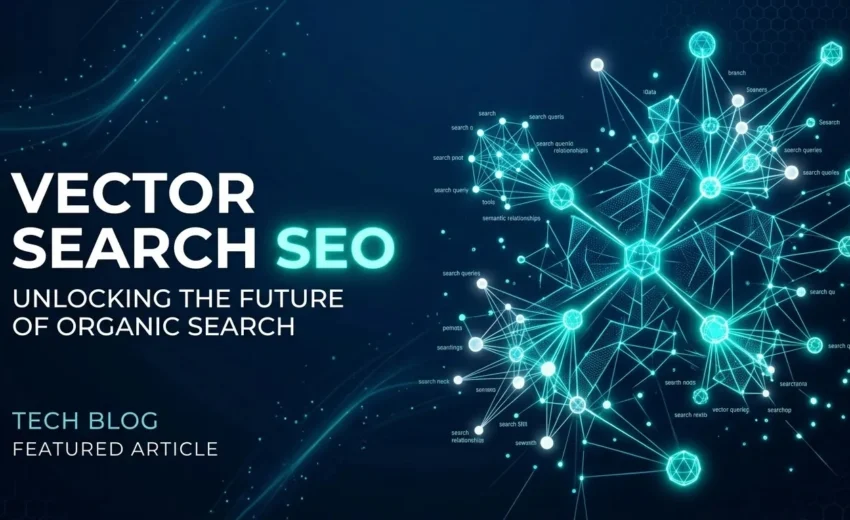
In 2026, search engines rank content based on deep contextual meaning rather than simple keyword repetition, making Vector Search SEO essential for modern search visibility. To establish strong machine-readable authority, implementing an advanced structured data schema strategy helps search engines understand your entity relationships. Additionally, optimizing your site with clear entity authority signals ensures your pages stay ahead in AI indexing.
Traditional keyword matching is no longer the gateway to search visibility — meaning is, and the engines that now govern discovery operate entirely in the language of mathematics.
The shift has been building for years, but AI-powered search has made it irreversible. Search engines powered by large language models do not scan pages for exact-match terms and rank them by frequency. Instead, they convert both queries and content into high-dimensional numerical representations called vector embeddings — geometric points in space where proximity equals relevance. A page about “running shoes for flat feet” and a query about “footwear for overpronation” may share zero overlapping words, yet a vector-based system will surface one for the other because they occupy the same conceptual neighborhood. That is a fundamental break from everything traditional SEO was built on.
Keyword density as a metric is not just obsolete — it is actively misleading. Founders and content teams who continue optimizing around it are engineering for a system that no longer runs the decisions. Zero-click searches reached 69% in the US with AI overviews, meaning the majority of queries now resolve inside the search interface itself. If you notice an unexplainable organic traffic drop, learning how to audit lost website traffic and recover wasted revenue is the necessary first step before making drastic site overhauls. You do not win those answers by matching terms — you win them by being the source a model trusts enough to cite verbatim.
Relevance Engineering is the discipline that replaces keyword strategy in this environment. Where traditional SEO asked “what words should this page contain?”, Relevance Engineering asks “what conceptual territory does this content authoritatively own, and how clearly does its structure communicate that ownership to a retrieval model?” It treats content as a signal to a machine, not just a message to a human reader. Semantic depth, entity clarity, and structural consistency become the new ranking variables — and understanding the Vector Search SEO framework behind how AI systems index and retrieve content is now the foundational skill for anyone competing in organic discovery.
And that starts with understanding what it actually means to provide information a model cannot find anywhere else — which is exactly where we are headed next.
Secret 1: Mastering Information Gain to Win AI Citations
Information Gain is the decisive factor separating content that AI models cite from content they silently discard — and it has nothing to do with keyword density.
As the previous section established, search engines have moved from matching strings to interpreting meaning. That shift creates an immediate, practical consequence for content strategy: AI indexing systems evaluate not just what your content says, but what it adds to the existing information landscape. Redundant content — no matter how well-structured — is effectively invisible to AI retrieval models during the indexing phase.
What Information Gain Actually Means
Information Gain, in the context of an advanced Vector Search SEO strategy, refers to the measurable value your content provides beyond what already exists in the top-ranking results. If your page restates what ten other pages already say, an AI model has no incentive to surface it. The engine has already “learned” that information. According to Searchbloom, there are 12 specific techniques that consistently win AI citations by providing unique data points — reinforcing that originality is an operational requirement, not a stylistic preference.
Why AI Models Penalize Redundancy
AI retrieval systems are optimized for efficiency and breadth. When an AI agent scans your content during indexing, it is essentially asking: “Does this source tell me something I do not already know?” Redundant content fails that test immediately. In practice, pages that paraphrase widely available information are deprioritized during vector recall because they occupy overlapping positions in high-dimensional embedding space — meaning they offer no additional signal. The result is lower retrieval probability, regardless of domain authority or backlink profile.
Injecting Proprietary Data and Unique Perspectives
One practical approach is building what practitioners sometimes call “knowledge anchors” — original statistics, case-specific observations, or synthesized frameworks that cannot be found elsewhere. Proprietary survey data, annotated datasets, or documented process outcomes all function as strong information-gain signals. Furthermore, maintaining a consistent daily blogging content strategy ensures your domain establishes a continuous stream of original, high-value signals to search crawlers.
“The sites that will dominate AI-driven search are not the ones with the most content — they are the ones with the most irreplaceable content.”
Achieving that irreplaceability is precisely what separates adequate SEO from GOAT-level status. Implementing advanced Vector Search SEO techniques ensures that embedding relevance and vector recall work directly in your favor, as the next section examines in detail.
Secret 2: Optimizing for Embedding Relevance and Vector Recall
Embedding relevance has replaced keyword rank as the metric that determines whether AI systems surface your content or bury it permanently.
The shift is more fundamental than most content strategies acknowledge. Traditional SEO measured success by where a page ranked for a specific query. Vector search measures something different: how closely your content’s mathematical representation — its embedding — aligns with the embedding of a user’s intent. That gap between the two concepts is enormous, and closing it requires rethinking what “optimized content” actually means.
Embedding relevance describes the degree of semantic proximity between your content and a query inside high-dimensional vector space. When a user asks an AI a question, the system does not scan for matching words. It converts the query into a vector, then retrieves the stored content vectors that sit nearest to it geometrically. The closer your content’s embedding, the higher the recall. And vector indexes typically achieve 90% or higher recall in retrieval tasks — meaning the technical ceiling is high, but only for content structured to take advantage of it.
Site structure affects recall directly. A fragmented site with isolated, thin pages produces disconnected embeddings that fall into different regions of the vector space, reducing the chance any single page surfaces for a broad intent. Contrast that with a tightly interconnected content architecture — where pages share thematic vocabulary, reference each other naturally, and build outward from core concepts — which clusters embeddings together. Rather than burning budget on continuous advertising, building a resilient SEO flywheel to scale organic growth establishes the compounding internal site architecture that vector recall relies on.
AI-ready site architecture carries several technical requirements that diverge from conventional best practices:
- Consistent entity language: Use the same terminology for core concepts across all pages so embeddings encode a coherent signal rather than noise.
- Structured data markup: Schema annotations help AI crawlers interpret relationships between entities without ambiguity.
- Logical internal linking: Links should reflect genuine conceptual proximity, reinforcing the thematic clusters your embeddings need to form. Leveraging tools for AI internal linking automation can accelerate this process across large sites effortlessly.
- Content density over content volume: A single comprehensive page on a topic tends to produce a stronger, more retrievable embedding than five shallow pages covering the same ground.
High-dimensional space is not simply a technical abstraction. It is the arena where your content either becomes findable or disappears. Each dimension in that space encodes a latent concept — tone, expertise level, subject specificity — and the position your content occupies is the cumulative result of every editorial choice made during production. Understanding that dynamic shifts the entire framing of optimization. You are not writing for a keyword; you are engineering a position in semantic space.
That positional thinking connects directly to a broader hierarchy of SEO sophistication — one that separates content performing at a basic level from content operating at the highest tier of AI visibility.
Secret 3: The 7 Levels of SEO—From Trash to GOAT
Not all SEO is created equal — and the gap between a Level 2 strategy and a Level 7 strategy is the difference between invisibility and consistent AI citation.
Understanding where your current approach sits on the competitive spectrum is one of the most clarifying exercises a founder can do. The 7 Levels of SEO framework provides exactly that benchmark, mapping every tactic from basic keyword stuffing to full semantic network optimization. Think of it as a diagnostic tool — one that reveals not just where you are, but how far you need to travel to compete in an AI-first search environment.
Levels 1–2: The Trash Tier. At these foundational levels, content strategy is almost entirely mechanical. Level 1 relies on raw keyword repetition — matching exact phrases with no regard for context, depth, or user intent. Level 2 adds meta tags and basic on-page signals, which were sufficient in the early 2000s but now represent table stakes that virtually every competitor already meets. Content operating at these levels is unlikely to surface in AI-generated overviews because it offers no genuine information gain and produces weak embedding signals.
Levels 3–5: The Average Middle. This is where most brands currently live, and it is a comfortable but dangerous place to stay. Level 3 introduces content clusters — grouping related articles around pillar pages to signal topical depth. Level 4 builds domain authority through backlink acquisition and consistent publishing cadence. Level 5 adds structured data, internal linking strategies, and early semantic optimization. These tactics still generate organic traffic, but they rarely earn citations from AI systems because they stop short of true vector relevance.
Levels 6–7: The GOAT Tier. Level 6 is where semantic networks take shape — content is architected so that every entity, concept, and relationship reinforces a coherent topical identity across the entire domain. Level 7, the ceiling, is full Vector Search SEO optimization: content is written with embedding relevance as a primary design constraint, information gain is deliberately engineered into every piece, and the site functions as a knowledge graph that AI retrieval systems can confidently cite.
Moving from Level 3 to Level 7 requires a deliberate progression through four practical steps:
- Audit your topical coverage — identify gaps in your content clusters where competitor domains hold stronger semantic authority.
- Restructure for entity density — rewrite existing content to surface named entities, relationships, and definitions that embedding models can parse cleanly.
- Engineer information gain — as covered in Secret 1, every new piece must contribute original data, perspective, or synthesis that does not already exist in indexed sources.
- Validate with vector logic — before publishing, test whether your content answers the implicit questions surrounding a topic, not just the explicit keyword query.
And here is the important caveat: moving between levels is not instantaneous. In practice, meaningful gains in embedding relevance and topical authority accumulate over months, not days. But the upside is significant — domains that reach Level 7 tend to become the default citation sources for AI systems across entire topic categories.
As you build toward that ceiling, it is worth understanding why purely semantic strategies still carry one meaningful blind spot — which is exactly what Secret 4 addresses next.
Secret 4: Hybrid Search—The 95% Accuracy Benchmark
Hybrid search — combining traditional keyword retrieval with vector-based semantic matching — is the current gold standard for AI agents that need to surface the right content, fast.
The appeal of purely semantic search is understandable. Vector embeddings capture meaning, context, and conceptual relationships in ways that keyword matching never could. But semantic search alone carries a real weakness: it can drift. When a query requires precise terminology — a product name, a regulatory code, a specific statistic — a purely semantic model may return results that are conceptually adjacent but factually off-target. That imprecision is expensive in an AI-driven retrieval environment where a single wrong result erodes user trust.
Hybrid mechanics solve this by running both retrieval methods in parallel and merging their scored outputs. A keyword index handles exact-match precision; a vector index handles conceptual breadth. The final ranking fuses both scores, typically through a technique called Reciprocal Rank Fusion (RRF). The result is a retrieval pipeline that catches what each method alone would miss. According to research on deterministic AI retrieval, hybrid vector search achieves 90–95% accuracy — a benchmark that neither approach reaches independently.
Content structure is where this becomes directly actionable for publishers. Investing in Vector Search SEO for hybrid retrieval means building content that scores exceptionally well on both keyword and semantic axes rather than optimizing for just one. Concretely, that means leading each section with a clear declarative sentence, using your target terms verbatim at least once, and clustering related concepts within the same passage rather than scattering them across a page.
AI Overview positioning depends heavily on retrieval accuracy. If an AI agent cannot retrieve your content with high confidence across both keyword and semantic signals, it will default to a source it can. Mastering an AEO framework for Google AI Overviews ensures that your technical architecture directly feeds these hybrid engines with clear, answer-ready passages.
Technical tip for developers: When configuring a hybrid search pipeline, weight your vector and keyword scores dynamically based on query type rather than applying a fixed ratio. Factual, entity-heavy queries benefit from a higher keyword weight; exploratory or conceptual queries should lean toward the vector score. Tunable weighting at inference time consistently outperforms static blends.
Getting hybrid retrieval right is fundamentally a content architecture problem as much as a technical one. And that architecture extends deeper than prose structure — into the metadata, markup, and entity signals that tell AI systems exactly what your content represents. That is precisely what structured data, covered next, enables.
Secret 5: Structured Data as the AI’s Navigation Map
Structured data is not just an SEO checkbox — it is the navigation map that allows AI agents to index your content with precision, speed, and confidence.
As hybrid search systems grow more sophisticated (recall from Secret 4 that they now combine keyword retrieval with vector-based semantic matching), the underlying question becomes: how does an AI agent decide which content deserves high-confidence retrieval? Structured data is a significant part of that answer. Vector search adoption is growing at 40–45% annually, and as AI-driven discovery scales, the cost of ambiguity compounds. Structured data eliminates that ambiguity at the source.
Moving beyond basic Schema. Most sites deploy only rudimentary Schema markup — a basic Article or LocalBusiness type — and leave enormous opportunity on the table. Advanced entity linking means connecting your Schema to recognized external identifiers: sameAs properties that point to authoritative Knowledge Graph nodes, mentions attributes that link related concepts, and speakable markup that surfaces quotable passages for AI assistants. This is where Vector Search SEO becomes fully actionable; structured JSON-LD data tells an AI agent not just what your page is about, but how its embeddings connect to the broader knowledge ecosystem.
Reducing computational cost for AI agents. When an AI crawler encounters unstructured prose, it must infer relationships between entities — an expensive, error-prone process. Clean JSON-LD eliminates that inference step. The agent reads explicit relationships directly, which lowers the computational cost of indexing and raises the probability that your content surfaces in high-confidence retrieval. Think of it as pre-translating your content into the language AI systems already speak.
The Knowledge Graph connection. Vector embeddings do not exist in isolation. They gain meaning through proximity to established entities within Google’s Knowledge Vault and similar graph structures. Structured data serves as the bridge between your content’s vector representation and its position within those graphs, reinforcing topical authority at a mathematical level.
Here is a checklist of must-have Schema types for AI indexing readiness:
Article/BlogPostingwithdateModified,author, andheadlinepopulatedFAQPagefor surfacing direct answers in generative resultsHowTofor procedural content that AI agents parse as step sequencesOrganizationwithsameAslinks to authoritative directoriesSpeakableto flag quotable, AI-digestible passagesBreadcrumbListto reinforce site hierarchy and topical structure
Startups, in particular, should treat technical clean-up as a first-priority investment rather than an afterthought. A site with ambiguous entity signals competes at a disadvantage regardless of content quality. And as the next section will show, that entity clarity extends far beyond markup — it shapes the very architecture of how your content should be organized.
Secret 6: Entity-Based Content Architecture
Organizing your site around entities rather than topics is one of the most effective ways to strengthen embedding relevance and signal authority to AI indexing systems.
Traditional SEO taught us to cluster content around keywords. But AI agents do not read keywords — they read meaning. And meaning, in the context of systems like Google’s Knowledge Vault, is anchored to entities: distinct, identifiable concepts such as people, places, products, and organizations that carry consistent semantic weight across the web. When your content architecture maps cleanly to these recognized entities, incorporating Vector Search SEO principles allows AI systems to place your pages with mathematical precision inside their vector space.
Entity Hubs as AI Anchors
An Entity Hub is a central, authoritative page that comprehensively defines a core concept your business owns — not just mentions. Think of it as a pillar page, but built for machine comprehension rather than human navigation. It consolidates the who, what, why, and how of a specific entity in one structured location. AI agents use these hubs as anchor points when building their internal representations of your domain, which directly strengthens your vector clustering across related queries.
Internal Linking as a Proximity Signal
Internal linking is not decorative — it is architectural. When you link an Entity Hub to several supporting pages that each expand on a related sub-concept, you create a graph of semantic relationships that AI systems can traverse. What typically happens is that closely linked pages end up with higher vector proximity to one another, which reinforces topical authority signals. Sparse or disconnected linking, by contrast, scatters your content across unrelated vector clusters and dilutes your positioning.
Thin Content as a Vector Killer
Thin content — pages with low informational depth, minimal structure, or redundant phrasing — actively harms your entity architecture. As Moz notes, transitioning to relevance engineering is the only way to win AI citations in the long term. Thin pages produce weak embeddings. Weak embeddings mean poor cluster membership. And poor cluster membership means AI agents will bypass your content when forming a cited response.
Here is a practical three-step Entity Mapping workflow to apply this immediately:
- Identify your core entities. List the 5–10 distinct concepts, products, or services that define your domain. These become your Entity Hub targets.
- Audit existing content for depth. Flag any page under 600 words or lacking structured data as a thin content risk. Executing a technical e-commerce SEO audit or content check can help isolate those conversion-killing flaws quickly.
- Map your internal links deliberately. Every supporting page should link back to its parent Entity Hub with descriptive anchor text that reinforces the target concept — not generic phrases like “click here.”
Getting this architecture right sets a strong foundation — and it connects directly to the broader strategic picture that pulls all of these secrets together.
Secret 7: The Bottom Line on AI Indexing Success
Vector search is the bridge between your content and AI understanding — and closing that gap is now the defining factor in whether your brand gets cited or ignored.
The previous sections mapped out the technical and architectural strategies that power modern AI indexing. Executing a complete Vector Search SEO roadmap is the bridge between your content and AI understanding, determining whether your brand gets cited or ignored. AI systems do not retrieve content the way traditional search engines do. They reason across semantic space, weighting content by conceptual relevance and novelty rather than keyword density. That fundamental shift changes everything about how you earn visibility.
Information Gain is the primary currency for AI citations. Content that restates what is already widely known across the web offers little signal value to a retrieval model. What earns a citation is content that adds something new — a specific data point, a clarified distinction, or a framing that no other indexed source provides. Google’s own guidance on AI search performance reinforces this: content should demonstrate genuine expertise and provide value that goes beyond surface-level summaries.
Hybrid search models are not optional. Pure vector search surfaces contextually relevant results but can miss precise factual matches. Pure keyword search catches exact terms but lacks semantic depth. In practice, the combination tends to work far better — and research into vector search optimization confirms that hybrid retrieval approaches are what enable the 90%+ accuracy thresholds that enterprise-grade AI systems demand. Shifting focus toward targeting high-intent traffic conversion funnels leverages these hybrid signals to turn AI-referred visits directly into revenue.
The shift from SEO to GEO — Generative Engine Optimization — is not a rebranding exercise. It is a fundamentally different discipline involving embedding architecture, entity salience, structured data, and retrieval-layer performance. As Siteimprove notes, winning in AI search requires aligning identity, behavior, and content signals in ways that go well beyond traditional on-page tactics. That level of technical complexity is precisely why the next section matters.
Future-Proofing Your Digital Growth with Tanmoypro
Vector search, entity architecture, embedding optimization, and AI indexing signals are not separate tactics — they form an interconnected system that determines whether your brand surfaces in the AI-driven search landscape or disappears from it entirely.
The complexity here is real. Across the sections of this article, a clear picture has emerged: modern search success depends on technical precision at every layer, from how your content is chunked and embedded to how AI crawlers interpret your entity relationships. Optimizing Vector Search SEO involves balancing index structures, chunking strategies, embedding model selection, and query alignment — and that is before you factor in content architecture decisions that affect long-term authority signals.
The DIY problem is significant for startup founders. Time spent reverse-engineering vector indexing behavior is time pulled away from product development, sales, and customer acquisition. And the cost of getting it wrong is not just a missed ranking — it is months of compounding lost visibility at a stage when growth momentum matters most. In practice, founders who attempt to manage technical SEO in the AI era without a structured system tend to produce fragmented, inconsistent signals that undercut the very authority they are trying to build.
Tanmoypro’s Scalable Digital Systems approach addresses this directly. Rather than treating SEO as a checklist of isolated fixes, the framework builds cohesive digital infrastructure — content architecture aligned to entity graphs, technical signals calibrated for AI indexing, and conversion pathways designed to turn search visibility into measurable revenue. Every component serves the larger system, not just a single ranking variable.
If your startup is ready to move beyond keyword tactics and build a result-driven system that converts leads into sales, the next step is straightforward. Explore what a scalable digital system could look like for your growth stage and start closing the gap between your content and the AI engines that now control discovery.
September 1, 2026
How to Recover Lost Organic Traffic and Scale...
September 1, 2026