
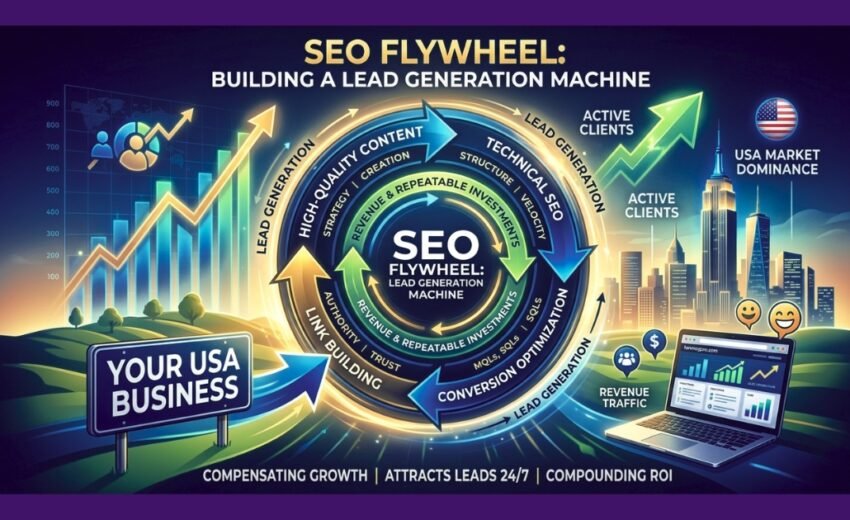
SEO Flywheel—this is the secret engine behind the world’s fastest-growing digital brands in 2026. While most small business owners in the USA are exhausted from the constant hunt for new leads, the winners have stopped chasing and started attracting. Imagine a marketing system so powerful that it doesn’t just bring in traffic; it builds its own momentum, turning every blog post and backlink into a self-sustaining lead generation machine that works even while you sleep.
The Exhaustion of the Hustle: Why Chasing Clients is a Losing Game
It’s 3 AM. You’re staring at your pipeline spreadsheet, wondering where next month’s revenue is coming from. Sound familiar? For countless founders and agency owners, this isn’t an occasional bad night — it’s a recurring operating condition. The relentless cycle of outbound prospecting, cold outreach, and manual follow-ups creates a business that demands your constant attention just to survive.
This is the Feast or Famine trap at its most punishing. You land a few clients, shift your focus to delivery, and then surface weeks later to find your pipeline completely dry. So you hustle again. You cold call, you DM prospects on LinkedIn, you attend every networking event on the calendar. The revenue trickles back — until delivery consumes you once more. Repeat indefinitely.
If you are stuck in this cycle, it’s often because your digital presence is failing to work for you. Many businesses remain in this “hustle” mode simply because they are invisible to their ideal audience on Google. Without an automated way to attract high-value leads, you are forced to rent attention through constant effort rather than owning it through an asset that compounds over time.
The math here is brutal:
SEO-generated leads close at an average rate of 14.6%, compared to just 1.7% for traditional outbound tactics like cold calling — according to HubSpot.
That’s nearly nine times the effectiveness. Yet most founders continue pouring their most finite resource — time — into the lower-converting approach.
Manual prospecting has a hard ceiling. It doesn’t scale with your business growth because it’s entirely dependent on your personal bandwidth. Every new client you want requires another round of outreach. There’s no leverage, no compounding, no momentum.
The hidden cost goes beyond lost revenue. It’s the founder burnout that accumulates quietly — the erosion of creative energy, strategic thinking, and simple enjoyment of the work you built your business around.
The antidote isn’t working harder. It’s building a lead machine that attracts qualified prospects while you sleep. That starts with understanding a fundamentally different model — one that builds momentum rather than constantly restarting from zero. That model is the SEO flywheel, a strategy designed to turn your website into a long-term sales representative that consistently delivers results without manual intervention.
What is an SEO Flywheel? (And Why It Beats a Traditional Funnel)
The traditional marketing funnel has one fatal flaw: it’s linear. Leads enter at the top, move through stages, and either convert or disappear. Every month, you refill it from scratch. It doesn’t learn, it doesn’t compound, and it certainly doesn’t work while you’re asleep.
The SEO flywheel operates on an entirely different principle — one that’s self-reinforcing rather than self-depleting.
H3: The Funnel vs. The Flywheel
Think of a traditional funnel like a bucket with holes. You pour effort in at the top (ads, cold outreach, referrals), some trickles through to revenue, and the rest leaks out. Stop pouring, and the output stops immediately.
| Traditional Funnel | SEO Flywheel | |
|---|---|---|
| Motion | Linear, one-directional | Circular, self-reinforcing |
| Effort over time | Constant to maintain results | Decreasing per unit of output |
| Stops when… | You stop paying/pushing | Almost never |
| New content impact | Isolated campaign | Strengthens existing content |
| Lead quality | Variable | Improves as authority builds |
Repeatable Investments That Build on Themselves
The mechanics here are straightforward once you see them. When you publish a well-optimized piece of content, it starts ranking. That ranking earns backlinks. Those backlinks lift your domain authority. Higher domain authority makes your next piece of content rank faster and with less effort.
As Rand Fishkin, Founder of SparkToro, puts it:
“A marketing flywheel is a continuously improving set of repeatable, tactical investments that scaled with decreasing friction. Each subsequent post is less work, but somehow yielded greater results.”
That’s the compounding effect in plain language. Every new post makes the previous ones more valuable by reinforcing topical authority and internal link equity across your entire site.
In practice, what looks like overnight success at month 18 is actually the accumulated weight of every article, backlink, and optimized page working together — a machine built piece by piece.
Understanding what a flywheel is, though, is only half the picture. The harder truth is that momentum doesn’t arrive all at once. It builds in distinct phases — and knowing which phase you’re in changes everything about how you should think about your efforts. To ensure this momentum actually translates into profit, you must follow a proven small business ROI blueprint.
The Three Phases of Flywheel Momentum
Understanding the flywheel concept is one thing. Committing to the timeline is another. The honest truth about building a lead generation machine through SEO is that momentum doesn’t arrive overnight — but when it does arrive, it compounds in ways that traditional outreach simply cannot match. Here’s how the journey actually unfolds.
Phase 1: The Heavy Lift (Months 1–6)
This is the grunt work phase, and there’s no shortcut through it. You’re laying the technical foundation, publishing foundational content, and establishing your site’s credibility with search engines. Progress feels slow because it is slow — initial growth in the first six months averages around 11.4%, according to NP Digital. That number can feel discouraging, but it’s not a sign of failure. It’s the price of admission.
ROI reality: Every dollar invested here is structural. You’re building the infrastructure that everything else will run on.
Phase 2: The First Rotation (Months 6–12)
Something shifts around the six-month mark. Content that sat quietly begins ranking. Pages that earned a few backlinks start generating referral traffic. Lead inquiries trickle in without a single cold email sent. This isn’t luck — it’s the flywheel completing its first full rotation. Growth becomes non-linear, meaning small inputs begin producing disproportionately larger outputs.
ROI reality: Businesses that push through Phase 1 often report that Phase 2 is when their cost-per-lead drops noticeably compared to paid channels.
Phase 3: The Flywheel Effect (Year 2+)
This is where the model earns its name. By year two, websites see an average traffic increase of 49.4% — nearly five times the growth rate of that initial six-month window. Leads flow consistently, authority compounds, and the system works whether you’re with a client or catching up on sleep.
ROI reality: The asset you’ve built doesn’t pause when you do. That’s the defining advantage.
The single greatest risk to this entire strategy is stopping in Phase 1, before the momentum has a chance to build. Abandoning the flywheel at month four is like pushing a boulder halfway up a hill and walking away. The good news? Once you understand what the machine is made of, staying committed becomes far easier — which is exactly what the next section breaks down.
The Core Components of Your Lead Generation Machine
Building flywheel momentum, as covered in the previous sections, depends entirely on the quality of what’s spinning. A flywheel built on shaky foundations won’t accelerate — it’ll wobble. The best strategy for lead generation isn’t a single tactic; it’s four interlocking components that reinforce each other continuously.
Technical SEO: The Revenue Multiplier
Technical SEO is frequently treated as a one-time checklist item. That’s a costly mistake. In practice, it’s the structural foundation that determines whether every other effort pays off. A technically sound site loads faster, crawls cleaner, and converts more efficiently — and the numbers back this up. A technical SEO audit and subsequent fixes for one e-commerce brand produced a 118% increase in organic revenue within just a few months.
This structural integrity is especially critical for long-term planning, such as executing a 2026-2032 blueprint for premium web design. When your site is built to handle the future of search, every piece of content you add becomes a more effective asset. Without this foundation, you run the risk of remaining invisible to your USA audience, regardless of how much you publish.
Technical Flywheel Essentials:
- Core Web Vitals optimization (page speed, interactivity, visual stability)
- Clean site architecture with logical internal linking
- Crawl budget management and fixing broken redirects
- Schema markup to capture rich snippet real estate
Strategic Content: Answering the Right Questions
Content isn’t about volume — it’s about relevance at the right moment. The goal is to map content to every stage of a prospect’s awareness journey, from “what is this problem I have?” through to “which solution should I choose?” What typically happens is that businesses publish broadly and wonder why leads don’t materialize. Focused, intent-driven content changes that equation entirely.
Content Flywheel Essentials:
- Pillar pages targeting high-intent, problem-aware search terms
- Supporting cluster content addressing specific objections and questions
- Regular content refreshes to protect and grow existing rankings
- Lead magnets embedded naturally within high-traffic pages
Authority Building: The Grease That Keeps It Spinning
Backlinks are the grease for the flywheel — without them, even great content stalls. Every credible external link signals to search engines that your content is worth surfacing. A common pattern is that authority compounds: as rankings improve, more people discover and link to your content organically, creating a self-reinforcing loop.
Authority Flywheel Essentials:
- Digital PR campaigns targeting industry publications
- Strategic guest posting on relevant, high-authority domains
- HARO (Help a Reporter Out) participation for earned media
- Building linkable assets like original research or data studies
Conversion Optimization: Traffic That Becomes Clients
Organic traffic without conversion architecture is just vanity. Every page should have a deliberate next step that moves a visitor closer to becoming a lead. Strong calls-to-action, trust signals, and frictionless forms transform passive visitors into active prospects.
Conversion Flywheel Essentials:
- Clear, benefit-driven CTAs above the fold
- Social proof (case studies, testimonials, logos) positioned near conversion points
- Simplified contact and inquiry forms
- Exit-intent triggers for high-exit pages
Once these four components are in place and working together, the flywheel generates measurable outputs — which raises an important question: how do you actually track whether it’s gaining speed? To find the answer, you must understand how to turn website traffic into leads effectively.
Measuring the Spin: Metrics That Actually Matter
With the core components in place, the next critical move is knowing whether your flywheel is actually spinning—or just sitting still. Most businesses track the wrong numbers, celebrating rankings and traffic while their pipeline stays dry. The shift from vanity metrics to business metrics is where the real competitive edge lives.
Vanity Metrics vs. Flywheel Metrics
Here’s a practical breakdown of what to stop tracking versus what actually signals growth:
| Vanity Metrics | Flywheel Metrics |
|---|---|
| Keyword rankings | Keyword velocity (rate of new rankings) |
| Total organic traffic | Traffic-to-lead conversion rate |
| Page views | Marketing Qualified Leads (MQLs) |
| Social shares | Sales Qualified Leads (SQLs) |
| Domain authority score | Cost Per Lead (CPL) decrease over time |
Rankings feel rewarding. Revenue is what matters.
Front-End and Back-End Signals
Organic impressions and keyword velocity are your front-end indicators—they tell you the flywheel is gaining surface area. But the back-end metrics, specifically MQL and SQL volume, confirm that momentum is translating into actual business opportunity. A well-configured inbound lead generation software stack ties both layers together, giving you a unified view of where prospects enter and where they convert.
The Performance Loop: Where Is It Sticking?
The performance loop is the diagnostic engine of your flywheel—it reveals the exact point where momentum is being lost.
As Design Bootcamp notes on Medium, a Dual Engine System connecting lead gen and demand gen is critical for tracking what actually matters inside this loop. If impressions are climbing but MQLs are flat, your content-to-offer alignment needs work. If SQLs are dropping despite strong MQL volume, the nurture sequence is the bottleneck.
One practical approach is reviewing CPL on a 30-day rolling basis. Over time, a healthy flywheel consistently drives that cost down—proof that compound growth is replacing constant hustle.
That shift in mindset—from chasing to compounding—is exactly what the final section is about. To ensure these signals result in maximum profitability, you must follow a proven small business ROI blueprint.
Key Takeaways
- Core Web Vitals optimization (page speed, interactivity, visual stability)
- Clean site architecture with logical internal linking
- Crawl budget management and fixing broken redirects
- Schema markup to capture rich snippet real estate
- Pillar pages targeting high-intent, problem-aware search terms
Conclusion: Choosing Compound Growth Over Constant Hustle
The constant grind of chasing clients is exhausting—and unnecessary. The SEO flywheel offers something fundamentally different: a system where each piece of content, each backlink, and each optimized page adds momentum to everything that came before it. That’s the compounding ROI of SEO in action, and it’s the ultimate competitive advantage for any service-based business ready to stop trading hustle for results.
The core components matter. The metrics matter. But none of it works without commitment. The next 90 days are the critical window—this is when most businesses either build the machine or abandon it too soon. Flywheel systems feel slow at first. What typically happens is that momentum builds quietly, then accelerates faster than expected. As the flywheel effect research from Atlassian confirms, sustained consistent action compounds into results that outpace anything a one-off campaign can deliver.
Your dream clients are already searching for exactly what you offer—the only question is whether they find you or your competitor. To ensure you don’t stay invisible, you must own your market organically through a strategic, long-term approach.
Your dream clients are already searching for exactly what you offer—the only question is whether they find you or your competitor.
The strategy is clear. The path is proven. Now it’s time to act.