

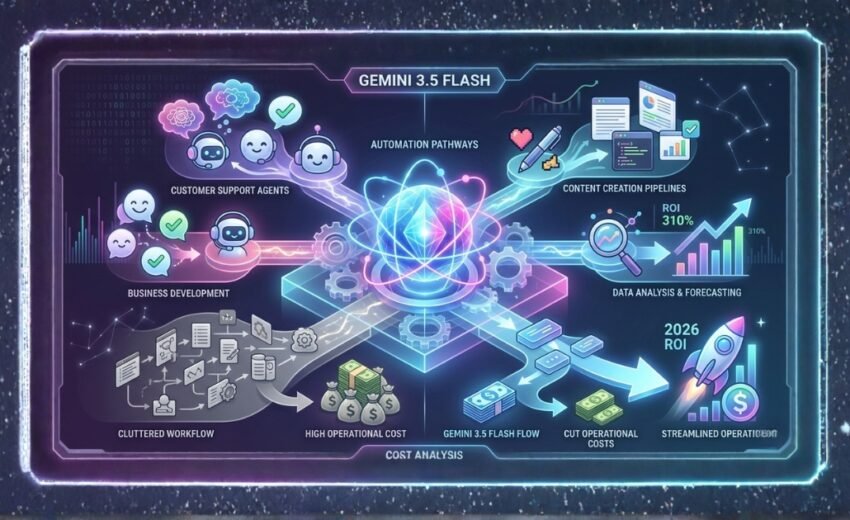
Gemini 3.5 Flash is officially here, and it is completely changing how smart founders approach business automation in 2026. If you are running a business in the US, you are probably tired of hearing the constant AI hype that costs a fortune but delivers very little practical value. Most advanced models are either too slow for real-time customer operations or too heavy on your monthly software budget. This newly released model from Google completely breaks that barrier by delivering elite, multi-step task execution at a fraction of the traditional cost.
When you look at Gemini 3.5 Flash from a business development perspective, you don’t need to worry about the complex coding behind it; you only need to focus on your bottom line. This lightweight powerhouse is engineered specifically for the “Agentic Era”—meaning you can now deploy highly efficient, independent digital agents to handle content pipelines, lead generation, and data analysis 24/7. In this straightforward guide, we will skip the corporate fluff and show you exactly how to integrate this tool into your existing workflow to cut operational overhead and maximize your digital ROI instantly.
The 2026 Efficiency Mandate: Why Speed and Latency are the New Growth Levers
Every second your automation stack hesitates, a customer drifts. In 2026, latency isn’t a technical inconvenience — it’s a revenue problem.
The conversation around AI has shifted decisively. Businesses that once celebrated generative AI for content drafts and summaries are now demanding something harder to build: agentic AI that executes multi-step workflows autonomously, in real time, without human hand-holding. The result is a fundamental rethink of which models actually power daily operations.
Heavy, high-parameter models made sense for research labs. They don’t make sense for your invoice pipeline.
Founders scaling ai business automation across customer support, data routing, and lead qualification are quietly moving away from maximum-capability models toward something leaner and faster. As Josh Woodward, VP of Google Labs, noted via VentureBeat, developers should use Flash-tier models specifically when addressing “quick tasks where low latency matters” — and in agentic workflows, nearly every task qualifies.
This is precisely where Gemini 3.5 Flash enters the picture. Designed to push AI agents deeper into enterprise workflows, it’s emerging as the go-to speed-to-revenue engine for businesses that treat enterprise cost efficiency as a strategic non-negotiable rather than an afterthought. Pairing it with a disciplined sustainable digital growth framework is what separates teams that experiment from teams that scale.
What makes Flash’s pricing structure genuinely disruptive for high-volume operations? That’s exactly where we’re headed next.
Gemini 3.5 Flash vs. The Field: Why it Wins on Enterprise Cost Efficiency
Speed matters — but in 2026, cost-per-task is the metric that separates scalable automation from expensive experimentation. Gemini 3.5 Flash was built specifically to win that battle, delivering frontier-level performance at a price point that makes high-volume deployment genuinely viable.
The numbers are striking. According to Google Cloud’s official data, Flash reduces input token costs by 78% and output costs by 71% compared to its initial launch pricing. That’s not an incremental improvement — it’s a structural shift in what businesses can afford to automate. When you’re running thousands of daily API calls across sales, support, and operations, those reductions compound fast.
Flash vs. Pro: A Practical Cost Comparison
The real strategic question isn’t whether Flash is cheap — it’s whether it’s capable enough to replace heavier models for most business tasks. For document summarization, lead qualification, data extraction, and real-time response workflows, the answer is yes.
| Model | Speed | Relative Cost | Best Use Case |
|---|---|---|---|
| Gemini 3.5 Flash | Ultra-fast | Low | High-volume agentic tasks, real-time responses |
| Gemini Pro (standard) | Moderate | High | Complex reasoning, nuanced research |
| Gemini Ultra | Slower | Very High | Deep multimodal analysis, R&D workflows |
For document-heavy operations — legal teams processing contracts, finance teams reviewing reports — the 1-million-token context window is a decisive advantage. Flash can process over 30,000 lines of code or an entire product knowledge base in a single prompt. That eliminates the chunking workarounds and multi-step retrieval pipelines that slow down alternative approaches.
The bottom line: Flash delivers “Pro-adjacent” intelligence at a fraction of the operational overhead. For teams focused on measuring true return from automation investments, that gap between Flash and heavier models is where real ROI lives. The stabilization of API pricing following Google I/O 2026 announcements has also removed a key planning risk — businesses can now forecast AI infrastructure costs with far greater confidence than even 12 months ago.
That cost efficiency only creates value, however, when it’s connected to action. The next question is how Flash moves beyond retrieval to actually drive decisions across your growth funnel.
From Retrieval to Agentic Action: Automating the Growth Funnel
Speed and cost efficiency only matter if the underlying AI can actually do something useful. That’s the distinction that sets Gemini 3.5 Flash apart from earlier generations of language models — it’s designed not just to retrieve information, but to act on it. As Google’s own blog frames it, Gemini 3.5 focuses on moving from information retrieval to agentic action, enabling models to execute tasks autonomously across complex workflows.
For growth teams in 2026, that shift changes everything.
Agentic action means the model doesn’t wait for a human to interpret output and decide what happens next. It reads a signal, determines intent, and executes — triggering follow-ups, updating records, routing leads, summarizing calls. The growth funnel becomes a self-operating system rather than a series of manual handoffs.
Lead Generation: From Cold Signal to Warm Conversation
Traditional lead capture is a waiting game. A prospect fills out a form; a rep responds hours later — or not at all. Gemini 3.5 Flash closes that gap instantly.
Actions to implement:
- Trigger personalized follow-up emails within seconds of form submission using the Gemini API
- Qualify leads automatically by analyzing submitted data against your ICP criteria
- Route high-intent prospects directly to calendar booking without human intervention
- Flag low-intent leads for nurture sequences rather than wasting rep bandwidth
Instant response doesn’t just improve conversion rates — it signals to prospects that your business operates at a different level.
Sales Operations: Real-Time Intelligence, Not Post-Mortem Recaps
Sales transcripts are typically reviewed after the fact, if at all. Flash enables real-time processing of call data, turning every conversation into a strategic asset.
Actions to implement:
- Summarize sales calls automatically and push key insights directly into your CRM
- Identify buying signals and objection patterns across hundreds of calls simultaneously
- Generate next-step recommendations immediately after each interaction
- Feed transcript data into content strategy frameworks to align messaging with real buyer language
When you factor in Gemini 3.5 Flash pricing — which runs at a fraction of heavier models — processing thousands of sales interactions monthly becomes genuinely affordable at scale.
Customer Success: Proactive Retention Over Reactive Support
Agentic AI transforms customer success from a cost center into a growth engine.
Actions to implement:
- Monitor product usage signals and automatically trigger check-in workflows for at-risk accounts
- Generate personalized expansion opportunity briefs for CSMs before renewal conversations
- Summarize support ticket history before every customer call without manual research
- Surface upsell recommendations based on usage patterns and account health scores
The through-line across all three functions is the same: automation that acts, not just answers. That capability is what makes the practical implementation — covered in the next section — so immediately actionable for teams ready to deploy it today.
Practical Implementation: How to Use Gemini 3.5 Flash to Cut Costs
Knowing that Gemini 3.5 Flash can automate your growth funnel is one thing. Actually deploying it across your business operations is where the real savings materialize. For founders evaluating the best ai tools for business automation, the good news is that the barrier to entry is surprisingly low — and the return shows up fast.
Step 1: Set Up the API for Local Development
Start by accessing Gemini 3.5 Flash through Google AI Studio, which provides a no-cost environment for prototyping. Grab your API key, install the Google GenAI SDK via pip or npm, and run a basic prompt call to confirm your environment is working. In practice, most teams are making their first functional API call within an afternoon. From there, you can begin connecting the model to your existing data sources, CRMs, or document workflows.
Step 2: Automate Invoice Processing and Expense Control
One of the highest-ROI starting points is financial document automation. Gemini 3.5 Flash can ingest invoice PDFs, extract line items, flag discrepancies against budget thresholds, and route approval requests — all without human intervention on routine transactions. What typically happens in manual workflows is that finance staff spend several hours weekly on reconciliation tasks that a well-prompted agent can complete in seconds. Pair this with a scheduled task runner and you have a continuous expense-monitoring system that never sleeps.
Step 3: Reclaim 105 Minutes Per Week, Per Employee
This isn’t a minor efficiency gain — it’s a structural shift in team capacity.
According to a Google Cloud / Gemini at Work Study, enterprise users save an average of 105 minutes per user, per week — translating to 90+ hours of reclaimed productivity annually.
Integrate Gemini with Google Workspace to automate meeting summaries, draft email responses, and generate status reports from raw data. For small teams especially, those recovered hours compound fast. Combine this with a consistent daily visibility strategy and your team shifts from reactive to genuinely strategic.
Step 4: Use Gemini to Optimize Your 2026 Budget
Feed your historical spend data, projected revenue targets, and departmental cost breakdowns into a Gemini-powered planning agent. Prompt it to identify waste patterns, model scenario outcomes at different growth rates, and prioritize investment areas by expected ROI. A common pattern is using Gemini as a “budget stress-tester” — running 10 financial scenarios in the time it once took to build one spreadsheet manually.
Of course, AI-generated financial projections should always be reviewed by a qualified professional before major decisions are made. However, the speed advantage in initial modeling is undeniable.
Getting the implementation right is only half the equation. Turning those operational savings into compounding revenue growth requires something more deliberate — a strategic system designed to convert efficiency into outcomes.
The Strategic Edge: Building Scalable Digital Systems with Tanmoypro
Plugging the Gemini 3.5 Flash API into your workflows is genuinely exciting. But here’s the honest caveat every founder needs to hear: tools alone don’t build businesses. A model that responds in milliseconds still needs a coherent growth strategy behind it to produce revenue — not just activity.
Technology is the accelerant, not the architecture. The founders who extract the most value from AI automation are those who’ve already built clear systems around SEO, conversion, and brand positioning. Without that foundation, automated pipelines simply produce faster noise.
This is where holistic digital strategy becomes non-negotiable. In practice, AI works best when it feeds into — and is directed by — a broader growth system that aligns search visibility, web performance, and brand identity toward a single commercial goal. Automation handles the volume; strategy determines where that volume goes.
Tanmoypro is built on exactly this principle, integrating SEO, web development, and brand identity to solve complex business problems through result-driven digital systems. For founders navigating AI adoption, this closes a critical gap: the distance between what a model can do and what actually converts into sustainable sales.
The core service pillars that make this possible include:
- SEO strategy — ensuring automated content and lead generation lands where buyers are already searching
- High-performance web development — building the infrastructure that turns AI-driven traffic into measurable conversions
- Brand identity — giving automated outputs a consistent, trustworthy voice that builds long-term equity
- Integrated growth systems — combining multi-channel visibility tactics with AI efficiency to create compounding results
The goal isn’t to automate everything — it’s to automate the right things inside a system designed to grow. That distinction shapes everything about how lean businesses will compete heading into 2026 and beyond.
Conclusion: The Future of Lean Business in 2026
The competitive landscape in 2026 rewards founders who move fast and spend smart. Gemini 3.5 Flash delivers exactly that combination — frontier-level intelligence at roughly half the cost of heavier models, with response speeds that make real-time automation genuinely practical. Every section of this guide has pointed toward the same conclusion: the overhead that once defined scaling a business is increasingly optional.
The long-term prize isn’t just cost savings — it’s a compounding operational advantage built on AI-first habits. Founders who embed agentic action into their daily workflows today aren’t just automating tasks; they’re building infrastructure that gets smarter over time. That cultural shift — from reactive hustle to systematic, AI-driven growth — is what separates lean operators from perpetually overwhelmed ones. Pair this mindset with a sustainable organic growth strategy and you have a genuinely durable business model.
Your Next Steps
- Start small: Identify your highest-volume, most repetitive task and connect it to the Flash API first
- Measure ruthlessly: Track time saved and cost-per-output before expanding
- Systematize: Document each automated workflow so your team can audit and improve it
- Scale intentionally: Add new automation layers only after the previous one runs reliably
The window for early-mover advantage is still open — but it won’t stay that way. Reach out to Tanmoypro to build a digital growth strategy engineered for exactly this moment.


May 21, 2026