
Own your market organically—that is the dream of every visionary business owner in the USA. But while most are stuck in the “Pay-to-Play” trap, burning thousands of dollars on temporary Meta and Google ads, the real winners are building digital assets that last. Think about it: why rent your audience with expensive clicks when you can own the entire conversation?
In 2026, the strategy for dominance has shifted. It’s no longer just about showing up on Google; it’s about establishing such a powerful authority that your brand becomes the only logical choice in your niche. From California to New York, smart small businesses are firing their overpriced agencies and switching to organic blueprints that actually scale.
If you are tired of watching your traffic vanish the moment your ad budget runs dry, it’s time for a change. In this guide, I will reveal 10 explosive, zero-ad-spend strategies that will help you own your market organically and turn your website into a 24/7 revenue-generating machine.
The Renter’s Trap: Why Your 2026 Marketing is Broken
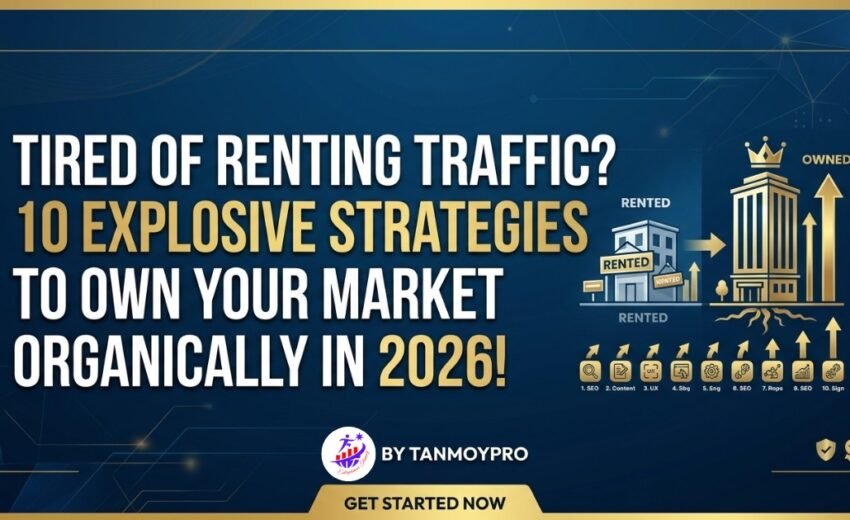
Every dollar you pour into paid ads is a lease payment on an apartment you’ll never own. The moment your budget runs dry, your visibility disappears — completely, instantly, without a trace. If you’re tired of renting traffic and watching your CAC climb while your results flatline, you’re not alone. Millions of B2B marketers are waking up to the same brutal truth.
Ad blocking isn’t a fringe behavior anymore — it’s a lifestyle choice adopted by nearly half of all US users, with younger demographics pushing that number even higher.
This isn’t just a technical workaround. It’s a cultural rejection of interruptive advertising. Audiences have drawn a hard line, and they’re installing the tools to enforce it. Meanwhile, platforms keep raising CPMs, click-through rates keep shrinking, and the performance-only model keeps promising next-quarter results that never quite materialize.
The smarter alternative is digital real estate — content, search visibility, and audience trust that you actually own. Unlike a paid campaign, organic assets compound over time. They work at 2 a.m. They survive budget cuts. As The Prosperity Agent puts it: “Stop renting your business. Start building systems that work when motivation fades.”
The real question isn’t whether organic works in 2026. It’s why so many brands still accept a growth model where they own nothing. The economics of that answer might surprise you.
The Economics of Ownership: Why Organic Wins the Long Game
The case against paid-only growth isn’t philosophical — it’s mathematical. When you stack the numbers side by side, the best organic marketing strategies 2026 has to offer don’t just compete with paid channels; they structurally outperform them across every metric that actually matters to a business.
Start with lead quality. According to HubSpot’s State of Marketing 2026, SEO leads close at 8.5x the rate of outbound leads — 14.6% versus a meager 1.7%. That gap isn’t noise. It reflects a fundamental difference in buyer intent: someone who finds you through organic search is already looking for what you sell. Someone interrupted by an ad is just… interrupted.
| Metric | Paid / Outbound | Organic / Inbound |
|---|---|---|
| Average lead close rate | 1.7% | 14.6% |
| Share of B2B revenue | ~20% | 44.6% |
| 3-year average ROI (B2B SaaS) | Declining with budget | 702% |
| Visibility after budget stops | Zero | Compounding |
| Break-even timeline | Immediate but fragile | ~7 months, then durable |
Organic search doesn’t just edge out paid — it generates 44.6% of all B2B revenue, more than double what paid search contributes, according to BrightEdge. That’s not a niche advantage; that’s where the majority of actual business is being won.
B2B SaaS SEO delivers a 702% average ROI over three years, with campaigns typically breaking even in just seven months — after which every ranking becomes compounding, rent-free revenue. (FirstPageSage, September 2025)
That seven-month break-even point is critical context. Organic growth does require patience upfront — that’s a legitimate caveat. However, once those assets start ranking, they work around the clock without an ongoing media budget attached.
The math makes the argument. Now the question becomes how — and that’s exactly where the ten strategies ahead come in.
10 Explosive Strategies to Own Your Market Organically
The math from the previous section makes one thing clear: owning vs renting traffic is no longer a philosophical debate — it’s a survival decision. And survival in 2026 requires a playbook built for an entirely different game. By some projections, zero-click searches will account for anywhere from 60% to 83% of all queries, meaning attention is fragmenting faster than most marketers realize. As one industry voice put it bluntly: “Stop targeting buyers and sellers! It’s 2026… we literally have to own the attention first.”
Here are 10 strategies to do exactly that.
1. Stop Targeting “Buyers” — Start Owning Intent Through Community-Led Growth
Audience communities — Discord servers, Facebook groups, subreddits, and branded forums — create compounding organic visibility that no ad budget can replicate. When your brand becomes the gathering place for a niche, discovery happens peer-to-peer.
Implementation step: Identify the one forum or group where your ideal customer already hangs out. Contribute genuine value for 60 days before promoting anything. Then launch your own branded community space.
2. Win the Zero-Click SERP With Featured Snippets and AI Overviews
If someone gets their answer without clicking through, your only protection is being the brand that gave it to them. Structuring content to answer specific questions directly positions you inside AI-generated results and snippet boxes.
Implementation step: Identify 10 high-volume questions in your niche. Write a concise 40–60 word direct answer at the top of each content piece, followed by deeper context below.
3. Treat Your Email List as Critical Infrastructure
Your email list is the one channel no algorithm update, platform shutdown, or ad policy change can touch. A healthy list is a direct line to your audience that compounds in value every single month.
Implementation step: Audit your current opt-in offer. If it’s generic, replace it with a hyper-specific lead magnet that solves one urgent problem your audience faces right now.
4. Build Digital Real Estate Through Evergreen Pillar Pages
Pillar pages are the long-form, high-authority hubs that anchor your entire content strategy. They attract backlinks, rank for broad head terms, and funnel visitors into deeper topic clusters over time.
Implementation step: Choose your three core topic categories. Build one 3,000+ word definitive guide for each, then create five to eight supporting cluster posts that internally link back to the pillar.
5. Create a “Next Step” Evergreen Funnel for Every Visitor
Every visitor who lands on your content should have one clear, permanent path forward. Without a deliberate funnel structure, organic traffic leaks out without converting into owned relationships.
Implementation step: Map every top-performing page to a single “next action” — a content upgrade, email opt-in, or free resource. Add that CTA to every page and review it quarterly, not annually.
6. Structure Your Data for LLMs, Not Just Crawlers
AI Visibility Optimization goes beyond traditional SEO. Large language models pull context from structured, authoritative sources, so how you format your content now determines whether your brand appears in AI-generated answers tomorrow.
Implementation step: Implement schema markup (FAQ, HowTo, Article) on every key page. Use clear entity definitions and structured data that explicitly tells both search engines and AI models what your content is about.
7. Own Local Search Trends Before They Peak
Markets boom before the mainstream catches on. Identifying emerging neighborhood or city-level search trends early — and publishing optimized content before competition saturates the space — is one of the highest-ROI organic moves available.
Implementation step: Use Google Trends with regional filters set to your target markets. Publish geo-specific content around rising queries at least six months before you expect local competition to respond.
8. Claim Video Real Estate on YouTube and Short-Form Platforms
YouTube is the world’s second-largest search engine, and Reels are indexed by Google. Video content creates a second layer of organic discovery that compounds separately from your written content footprint.
Implementation step: Repurpose your top five written pieces into explainer videos. Optimize titles, descriptions, and chapters using the same keyword research you applied to the original articles.
9. Deploy the “Anti-Ad” Content Playbook
Content that lives natively on platforms — articles, posts, videos, newsletters — cannot be blocked, skipped, or filtered the way display ads can. Native organic content reaches audiences who have actively opted out of advertising.
Implementation step: Identify the ad formats your audience is most likely to block or ignore. Build organic content that delivers equivalent value in those exact formats and contexts.
10. Build Collaborative Authority Through Niche-Adjacent Partnerships
Backlink equity built through genuine partnerships with complementary brands carries more long-term weight than any link-buying scheme. Co-created content, joint webinars, and resource collaborations generate authority signals that compound over years.
Implementation step: List 20 non-competing brands that serve your same audience. Pitch three of them on a co-authored resource, data study, or joint content series within the next 30 days.
These strategies lay the groundwork for owning your audience’s attention across every touchpoint. But there’s a deeper layer here — one that goes beyond getting the click entirely. What happens when your brand wins the answer before anyone even visits your site? That’s where the real frontier of 2026 organic strategy begins.
Winning the Zero-Click Economy: Beyond the Traditional Visit
The strategies covered earlier assume users eventually click through to your site. In 2026, that assumption is increasingly dangerous. Google’s AI Overviews, featured snippets, and knowledge panels now answer questions directly on the results page — and a growing share of users never go further. This is the zero-click economy, and ignoring it means handing your brand’s visibility to whoever structured their content better.
SERP ownership reframes the objective entirely. If a user gets their answer without clicking, your goal is to be the brand delivering that answer. A mention inside an AI Overview carries real brand impression value — even without a visit, your name is associated with authority and relevance.
Here’s how to optimize for that reality:
- Structure content for AI parsing. AI platforms like ChatGPT often give generic responses because brands fail to provide authoritative, structured content they can parse. Use clear headers, concise definitions, and direct answer formats so AI models can extract and attribute your insights accurately.
- Implement schema markup aggressively. Schema tells AI crawlers exactly what your content means — who you are, what you offer, and why you’re credible. FAQ, HowTo, and Organization schema are non-negotiable in 2026.
- Shift your KPIs. Track branded search volume, AI mention frequency, and share of voice alongside traditional traffic metrics. Your digital real estate organic traffic footprint now includes impressions, not just visits.
Visibility without clicks is still influence — and in a zero-click world, influence is the new currency.
This shift demands more than great content; it requires building infrastructure that captures attention and converts it into something you own permanently — which is exactly what the next section addresses.
Infrastructure Over Interruption: The Owned Attention Playbook
Every strategy covered so far — from zero-click optimization to answer equity — shares a common vulnerability: none of it matters if you don’t capture the audience you earn. Ranking well and winning visibility is only half the equation. Converting that attention into owned data is where sustainable growth actually begins.
“Treat your email list like infrastructure. It is the foundation of owned attention.” — The A Group
That framing redefines email entirely. It’s not a newsletter tool. It’s your only algorithm-proof marketing asset in 2026. Social platforms throttle reach. Search results reshape overnight. Your email list — built on first-party consent — remains yours regardless of what Google, Meta, or any platform decides tomorrow.
The practical path forward is building a “Next Step” evergreen offer: a lead magnet, assessment, or downloadable resource embedded naturally within high-performing organic content. In practice, every blog post should function as permanent lead generation real estate, not a one-time traffic event. This is the digital real estate mindset — each piece of content is an asset that compounds value over time, quietly converting readers into subscribers around the clock.
This shift represents a fundamental change in orientation. Gambler marketing — paying for traffic, hoping for conversions — is inherently fragile. Leader marketing builds owned channels that don’t require constant ad spend to maintain relevance. For businesses tracking B2B SEO ROI 2026, the compounding returns of owned attention consistently outperform rented acquisition models.
With the infrastructure in place, the final question becomes: what does a complete 2026 market dominance roadmap actually look like?
Conclusion: The 2026 Roadmap to Market Dominance
The evidence is clear: rented growth — built on paid clicks, algorithm dependency, and borrowed audiences — is a fragile foundation. Every strategy covered here, from zero-click search optimization to owned infrastructure, points toward the same conclusion. Ownership isn’t a tactic; it’s a business model. According to BrightEdge, organic search remains the single largest revenue-generating channel for B2B brands — and that advantage compounds over time in ways no ad budget can replicate.
The zero-click economy isn’t a threat to marketers who’ve built owned equity. It’s a filter that eliminates those who haven’t.
Next Steps — Audit Your Growth Model Today:
- Calculate your rented vs. owned traffic ratio across all channels
- Identify your top three zero-click opportunities in featured snippets and AI overviews
- Map content gaps where competitors answer questions you should own
- Evaluate your owned channels — email, community, direct — for engagement quality
- Set a 90-day organic investment baseline to measure compounding returns
Stop accepting month-to-month growth you don’t control. The brands that dominate 2026 will be those that started building ownership yesterday.

May 5, 2026