
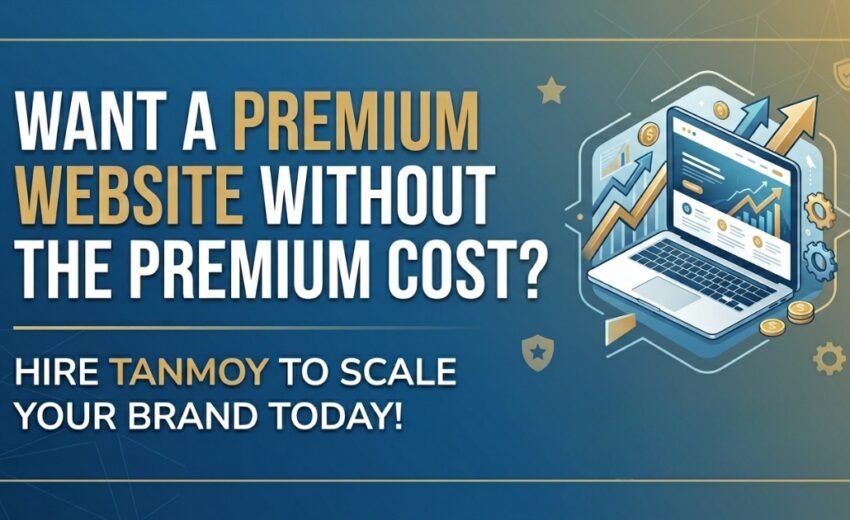
Want a premium website without the premium cost? In today’s hyper-competitive digital landscape, your website is no longer just a digital business card—it is your most powerful sales representative. Whether you are a growing startup in the USA or an established brand in the UK, your online presence determines your market authority. However, many business owners find themselves trapped between overpriced agencies and low-quality DIY templates that fail to convert.
If you are ready to stop settling for mediocrity, you need a high-performance digital asset designed for growth. You can hire Tanmoy to scale your brand today and bridge the gap between world-class design and budget-friendly investment. By focusing on mobile-first architecture, lightning-fast loading speeds, and SEO-driven layouts, I help businesses transform their “invisible” websites into lead-generating powerhouses. It’s time to claim your space on the first page of Google and provide your customers with the premium experience they expect—without the heart-stopping price tag.
The High Cost of a ‘Cheap’ Website: Why Your Current Site is Killing Your Growth
Every day your website looks generic, you’re losing customers you’ll never even know you lost. There’s no invoice for it, no alert in your analytics — just a quiet, steady bleed of revenue walking straight to a competitor whose site simply felt more trustworthy. That’s the brutal reality of cheap web design in 2026.
A striking 94% of first impressions are design-related — and 75% of consumers judge a company’s credibility based solely on its website design. Think about that for a moment. Three out of four potential customers are making a buy-or-bounce decision before they’ve read a single word of your copy, checked your pricing, or evaluated your actual offer. Your design is your pitch.
Generic templates create a credibility gap that’s nearly impossible to close. When your site looks identical to dozens of competitors — same stock photos, same cookie-cutter layout, same forgettable color palette — you’re not just blending in. You’re actively signaling that your brand isn’t worth a second look. Visitors don’t consciously think “this design is mediocre.” They simply feel a vague lack of trust and leave.
The psychological damage compounds quickly. Poor design triggers skepticism. Skepticism kills conversions. Dead conversions strangle growth. It’s a cycle that no amount of ad spend or social media hustle can fully overcome when the destination — your website — is undermining every dollar you invest.
Here’s where the opportunity lives, though. Many business owners assume that escaping this trap requires a $20,000+ agency retainer. That assumption is exactly what the Premium Paradox dismantles. If you want to learn how to get a professional business website without spending thousands, the answer isn’t spending less on design — it’s spending smarter. And that distinction is worth understanding in financial terms.
The 9,900% ROI Reality: Why ‘Premium’ is a Business Strategy, Not an Aesthetic
Most business owners chase a better-looking website when what they actually need is a better-performing one. The distinction matters enormously — and it starts with understanding two terms that get used interchangeably but mean very different things.
UI (User Interface) is how your site looks: the colors, typography, imagery, and layout. UX (User Experience) is how your site works — the journey a visitor takes from landing on your page to completing a purchase, booking a call, or signing up for your list. A site can look stunning and still hemorrhage conversions because the UX is broken. What you’re really investing in when you pursue premium design is the combination of both, engineered with a clear business goal in mind. If you find your current platform isn’t performing, you need to understand why is your website failing to sell and discover the proven secrets to explode your revenue through strategic design.
“Web design is not just about creating pretty layouts. It’s about understanding the marketing challenge behind your business.” — Mohamed Saad, Strategic Brand Consultant
That reframe is critical. Your website isn’t a digital brochure. It’s your highest-leverage sales asset, working around the clock without a salary, benefits, or sick days. A strategically designed site qualifies leads, builds trust, answers objections, and closes sales — all before a human ever gets involved.
The financial case for getting this right is hard to ignore. According to Forrester research, a well-designed UI can increase conversion rates by up to 200%, while superior UX design can push those gains to 400%. That’s not a rounding error — that’s the difference between a business that plateaus and one that scales.
Standard Site vs. Premium UX Site: A Direct Comparison
| Factor | Standard Site | Premium UX Site |
|---|---|---|
| Conversion Rate Impact | Baseline | Up to 400% improvement |
| Visitor Trust Signal | Generic, forgettable | Immediate credibility |
| Sales Function | Passive information | Active lead conversion |
| Brand Positioning | Blends in | Commands premium pricing |
| Long-Term Cost | Frequent rebuilds | Built to scale |
This is exactly why achieving the best premium web design on a budget isn’t about cutting corners — it’s about investing strategically in the elements that directly drive revenue. And understanding what that investment actually looks like in today’s market is where most business owners get lost, which is precisely what we’ll break down next.
The 2026 Cost Landscape: What Should You Actually Pay to Hire a Professional?
If you’ve ever searched “how much does it cost to hire someone to make my website,” you’ve likely landed on a range so wide it’s almost useless — anywhere from $500 to $150,000. That range isn’t misleading. It reflects three very different markets operating under the same label.
The Agency Markup
Full-service digital agencies deliver results, but their pricing model isn’t built around your project — it’s built around their overhead. Account managers, creative directors, project coordinators, and office leases all get folded into your invoice.
Typical mid-tier agency cost: $15,000–$80,000 for a business website What you’re actually paying for: 40–60% of that often covers internal coordination, not execution Timeline: 3–6 months, with significant client involvement still required
For an enterprise brand, that infrastructure has value. For a growing business that needs a high-converting website fast, it’s frequently unnecessary overhead. This is why many savvy owners are looking for the premium web design on a budget blueprint to get elite results without the agency markup.
The DIY Trap
Template-based website builders have democratized web presence — but they’ve also quietly created a technical debt epidemic. Technical debt is what accumulates when you build fast, build cheap, and defer proper architecture decisions. In practice, what starts as a $29/month solution often evolves into a patchwork of plugins, workarounds, and performance compromises. According to Hanurax, it costs 3× more to rebuild a poorly architected application than to build it correctly from the start. That statistic reframes the economics completely.
Slow load times hurt SEO rankings and conversion rates simultaneously
Locked-in platforms limit scalability when growth demands more
Security vulnerabilities increase as plugin stacks grow
Instead of falling into these traps, you must learn how to build a website that actually sells by prioritizing performance and architecture from day one.
The Specialist Sweet Spot
The smartest investment is often a focused, senior independent specialist — someone with deep technical expertise across the full stack, no agency markup, and a direct stake in delivering results.
Typical cost: $3,500–$12,000 for a precision-built professional site
Turnaround: 3–6 weeks with direct communication
Output: Clean, scalable architecture built to grow with your business
A site built correctly from day one isn’t just cheaper long-term — it’s a compounding asset. The real question isn’t what you spend upfront; it’s what you avoid spending on emergency rebuilds later. Which raises the obvious follow-up: how do you get that level of quality without the agency overhead? For many small business owners, finding a high-yield alternative to generic digital agencies is the key to balancing elite quality with sustainable growth.
How to Build a Premium Website Without the Agency Overhead
Understanding the cost landscape is one thing — knowing how to navigate it strategically is another. Building a professional business website without spending agency-level budgets doesn’t mean cutting corners. It means cutting waste. Here’s a practical, five-step blueprint to get you there.
1. Audit what you actually need. Most small business sites need three to five pages maximum. A sharp homepage, a services or product page, an about section, and a contact or booking page. Resist the temptation to build sprawling site architecture before you have traffic to justify it.
2. Prioritize high-converting landing pages over volume. One focused, strategically built landing page outperforms ten generic ones. AI-driven design principles confirm that restraint — clean layouts, intentional copy, clear calls to action — is what actually signals premium quality to visitors.
3. Choose the right tech stack for scalability. In practice, the framework you build on determines your ceiling. Technologies like React, Next.js, and WordPress give you a genuinely modern foundation: fast load times, SEO-friendly architecture, and room to scale without rebuilding from scratch. This isn’t overengineering — it’s future-proofing.
4. Invest in mobile-first design from day one.
A website that underperforms on mobile isn’t a premium website — it’s a liability dressed up in good desktop typography.
In the USA, mobile devices account for the majority of web traffic. Skimping on mobile optimization is one of the most expensive “savings” a business can make.
5. Work with a full-stack specialist, not a siloed team. Agencies charge for coordination overhead. A skilled full-stack developer handles design, development, and performance optimization in one workflow — dramatically reducing cost without sacrificing quality.
The right technical partner doesn’t just execute a brief. They architect a growth engine. That distinction is exactly what the next section unpacks.
Scaling Your USA Brand: Why Tanmoy is the Strategic Choice for Founders
Most web design engagements end at launch. You get the files, the login credentials, and a polite handoff email — then you’re on your own. What founders who want to scale their USA business actually need is something fundamentally different: a partner who understands that a website is a revenue system, not a deliverable.
Strategy First, Design Second
In practice, the most expensive mistake founders make is separating business strategy from technical execution. They hire a strategist, then a designer, then a developer — and the vision loses something at every handoff. Tanmoy’s approach collapses that gap. Business development thinking is baked into the design process itself, so every layout decision, every call-to-action placement, and every content hierarchy choice is driven by conversion logic — not just aesthetics.
The result is the difference between a site that looks premium and one that performs like a growth engine. To make this engine work, you must implement landing page conversion strategies that stop killing your sales and instead turn every visitor into a potential lead.
From “Just a Site” to a Scalable Growth Engine
A common pattern among founder-led brands is launching with a beautiful but passive website — one that impresses visitors without converting them. What typically happens after a strategic redesign is a measurable shift: clearer positioning attracts higher-quality leads, reduced friction in the user journey shortens sales cycles, and a cohesive brand identity commands the price points the business actually deserves.
A website built around your growth goals isn’t a cost center — it’s the highest-leverage asset in your marketing stack.
This kind of transformation doesn’t require a six-figure agency retainer. It requires the right expertise applied with precision.
What Working with a #1 Solution Actually Looks Like
The benefits are concrete: unified strategy and execution under one roof, faster iteration cycles, direct communication with the person doing the work, and a final product calibrated for both human visitors and AI-powered search discovery — an increasingly critical factor as AI-driven web experiences reshape how brands get found.
Ready to move from passive site to active growth system? Book a consultation at tanmoypro.com and start the conversation today.
That momentum, once built, compounds — which is exactly what the next section unpacks.
The 2026-2032 Blueprint for Sustainable Digital Growth
Your website isn’t a line item — it’s a compounding business asset. Every dollar invested in premium design, performance optimization, and strategic positioning pays dividends over time through stronger conversions, higher trust signals, and better organic visibility. Founders who treat their site as a living platform — rather than a finished product — consistently outpace those who rebuild from scratch every few years.
A well-architected website doesn’t just represent your brand; it actively recruits, qualifies, and converts your ideal clients around the clock. One critical factor heading into 2026 and beyond: AI-readiness is no longer optional. Modern frameworks like Next.js and React are essential for AI-driven discovery and performance, ensuring your site loads fast, renders cleanly, and surfaces correctly across AI-powered search experiences. Brands built on outdated stacks risk becoming invisible as discovery shifts. Pairing this technical foundation with high-converting landing pages to scale your business is what separates growing brands from stagnating ones.
The playbook is clear. Build smart now, scale intentionally, and stay adaptive.
Your Scaling Growth Checklist
Use this before your next major brand or website decision:
- Website audit completed — performance, accessibility, and mobile experience reviewed
- Modern framework in place — Next.js, React, or equivalent for speed and AI-readiness
- Brand positioning defined — messaging speaks directly to your ideal client
- High-converting landing pages live — each page has a single, clear conversion goal
- Ongoing growth partner identified — not just a launch vendor, but a strategic collaborator
- Analytics and tracking configured — data informs every future iteration
- Scalability roadmap documented — your site grows as your business grows
The founders who win the next decade won’t just have beautiful websites — they’ll have intelligent, evolving digital platforms built to compound in value. Start building that foundation today.
If you are tired of losing revenue to competitors with better-looking sites, it’s time for a change. I provide the high-end technical expertise of a big-city agency without the bloated costs. My focus is simple: building clean, fast, and high-converting websites that help you dominate your local market and beyond.
Don’t let another lead slip through the cracks due to a generic design. Let’s build a website that truly represents the quality of your work. You can hire me through my official channels below:
Secure Your Project on Fiverr: Order via Fiverr
Let’s Connect on LinkedIn: Tanmoy’s Professional Profile
Direct Inquiry via WhatsApp: Chat with Me Instantly
Key Want A Premium Website Without The Premium Cost? Hire Tanmoy To Scale Your Brand Today! Takeaways
- Typical mid-tier agency cost: $15,000–$80,000 for a business website
- What you’re actually paying for: 40–60% of that often covers internal coordination, not execution
- Timeline: 3–6 months, with significant client involvement still required
- Slow load times hurt SEO rankings and conversion rates simultaneously
- Locked-in platforms limit scalability when growth demands more