
Why digital marketing is essential has become the most critical question for business owners in 2026. Imagine having a world-class product but standing in a dark room where no one can see you. That is exactly what a business without a digital presence looks like today. In an era where 93% of online experiences begin with a search engine, being “invisible” on the web is the fastest way to lose your market share and fall behind competitors.
But why is a digital strategy no longer just an option, but a survival necessity? Whether you are a small startup or an established brand in the USA, why is your USA business invisible on Google? becomes the most important question to answer. Staying relevant requires more than just a website; it requires a strategic digital powerhouse. Here are 10 proven reasons why digital marketing is the foundation of modern digital marketing and the ultimate engine for your business growth.
The Invisibility Crisis: Why Your Business is Ghosting Its Customers
Is your business invisible? It’s a brutal question — but for thousands of small and mid-sized businesses, the honest answer is yes. Not because the product is flawed or the service is poor, but because digital invisibility is silently killing growth before a single customer even gets the chance to care.
The Invisibility Trap is what happens when a business operates without a meaningful digital presence. You’re open, you’re working hard, and you genuinely deliver value — but the market simply can’t find you. As KB Marketing Agency puts it plainly: “Ignoring online marketing is like opening a business but not telling anyone.” That’s not hyperbole. That’s the reality for countless businesses stuck in this trap right now.
There’s a psychological cost to being a best-kept secret. Business owners often rationalize it — “our customers come from referrals,” or “we’ve never needed marketing before.” In practice, that confidence masks a dangerous ceiling. Word-of-mouth is powerful, but it doesn’t scale. It can’t reach a customer searching for your exact solution at 11 PM from across the state.
The modern economy runs on a digital-first mandate. Consumers research before they buy, compare before they commit, and trust what they can verify online. A business without digital visibility isn’t just missing opportunities — it’s actively invisible to the majority of its potential market. Why is your website invisible? Understanding why that invisibility happens starts with one uncomfortable statistic about where customers actually begin their journey — and which businesses they find when they get there.
The 93% Rule: Why Search Engines are the Primary Discovery Gatekeeper
Before a customer walks through your door, calls your number, or clicks “Add to Cart,” they almost always do one thing first — they search. Understanding this single behavior shift is the key to escaping the invisibility trap described above.
93% of all online experiences begin with a search engine. (Search Engine Journal)
That number isn’t just impressive — it’s a strategic reality check. If your business isn’t showing up in search results, you’re essentially absent from the conversation before it even starts.
The First Page Is the Only Page That Matters
Search engines don’t just influence the buyer journey — they control it. Studies consistently show that the vast majority of users never scroll past the first page of results. In practice, ranking on page two or beyond is functionally equivalent to not ranking at all. Organic visibility on page one is the digital equivalent of a prime storefront location; everything else is a back alley.
Customers Search for Solutions, Not Brand Names
Here’s a critical shift that many business owners miss: most people aren’t searching for you specifically — they’re searching for what you solve. Queries like “best accountant near me” or “affordable home renovation contractor” dominate search behavior. This means discoverability depends on aligning your content with the problems your customers are actively typing into that search bar.
The best tools for achieving this — SEO, content marketing, local search optimization — are all pillars of a well-structured digital marketing strategy. Businesses that invest in these areas consistently appear at the right moment, in front of the right person. In fact, understanding why regular high-quality content is the only “ad” your business will ever need can be the turning point for consistent, organic discoverability.
Invisibility to Search Engines Equals Non-Existence to Customers
If a search engine can’t find you, your customers can’t either. It’s that simple. Digital invisibility isn’t a minor inconvenience — it’s a direct revenue leak.
Recognizing why search engines gatekeep discovery is only half the picture. The more powerful question is: what specific advantages does digital marketing unlock once you do show up? The next section breaks down exactly that.
10 Proven Reasons Why Digital Marketing is Essential for Growth
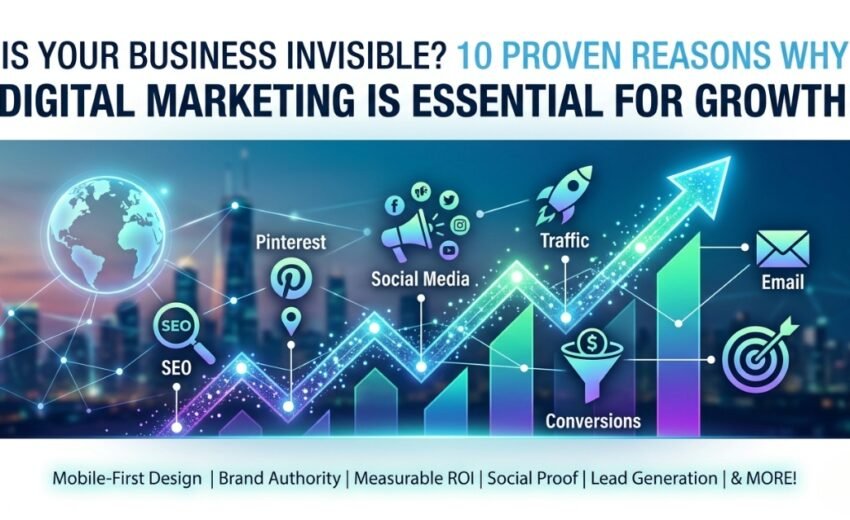
If you’ve been asking yourself, “Is your business invisible?” — the 10 proven reasons why digital marketing is essential for growth will answer that question with uncomfortable clarity. This isn’t a checklist of nice-to-haves. These are the specific, measurable mechanisms that separate businesses that scale from businesses that stagnate. Let’s break them down.
1. Hyper-Targeted Reach: Precision Over “Spray-and-Pray”
Traditional advertising broadcasts your message to everyone and hopes someone relevant is listening. Digital marketing flips that model entirely, letting you target by location, age, behavior, search intent, and even purchasing history. The result is less wasted spend and more qualified conversations.
- Growth Impact: Higher ad relevance scores, lower cost-per-click, and leads that are already pre-qualified before they reach you.
2. Cost-Effectiveness: The Unmatched ROI of Organic Search
For every $1 invested in SEO, businesses see an average return of $22 — a 2,200% ROI. No traditional media channel comes close to that ratio. Organic search builds compounding value over time, unlike paid ads that go dark the moment your budget runs out.
- Growth Impact: Sustainable traffic acquisition with exponentially lower long-term costs compared to paid-only strategies.
3. Real-Time Analytics: Data-Driven Pivots in Hours, Not Months
A print campaign runs for 30 days before you know if it worked. A digital campaign tells you within hours — click-through rates, bounce rates, conversions, and drop-off points are all visible in real time. According to Smart Insights, businesses without a data-driven strategy are essentially flying blind.
- Growth Impact: Faster iteration cycles mean fewer wasted dollars and quicker discovery of what actually converts your specific audience.
4. Global Reach: Breaking Geographic Barriers for Local Startups
A local startup no longer has to stay local. Digital marketing software and platforms allow a business in rural Kansas to sell to customers in California, Canada, or beyond — without opening a second location. Geographic boundaries are a legacy constraint that digital dissolves entirely.
- Growth Impact: Access to national or international markets without the overhead traditionally required to enter them.
5. Brand Awareness: Building the “Rule of 7” Through Digital Touchpoints
The marketing principle known as the Rule of 7 states that a prospect needs to encounter your brand at least seven times before they’ll take action. Digital touchpoints — social posts, search results, email, display ads, and content — make accumulating those impressions affordable and measurable in ways that weren’t possible a decade ago.
- Growth Impact: Faster brand recognition cycles and stronger top-of-mind positioning when a purchase decision arrives.
6. Customer Engagement: Moving From Monologue to Dialogue
Traditional advertising talks at customers. Digital marketing talks with them. Comments, reviews, direct messages, and interactive content create two-way relationships that build loyalty and generate organic word-of-mouth. As Wharton’s Jonah Berger has long argued, social transmission is one of the most powerful forces in modern consumer behavior.
- Growth Impact: Deeper customer relationships that reduce churn and increase lifetime value without additional acquisition costs.
7. Higher Conversion Rates: Optimizing the Digital Sales Funnel
Every stage of the digital sales funnel — from awareness to consideration to decision — can be tested, refined, and optimized. A/B testing landing pages, adjusting calls-to-action, and personalizing email sequences are all levers unavailable in traditional channels.
- Growth Impact: Incremental conversion rate improvements compound significantly; a 1% lift at each funnel stage can double overall revenue output.
8. Mobile Accessibility: Reaching Customers in Their Pockets
Consumers spend more time on their cell phones than on any other device. A mobile-optimized digital presence — fast-loading pages, thumb-friendly navigation, SMS campaigns — ensures your brand is accessible precisely when and where purchase intent peaks.
- Growth Impact: Captures impulse-driven and on-the-go buying behavior that desktop-only strategies completely miss.
9. Competitive Parity: How Small Brands Beat Industry Giants
Digital marketing is the great equalizer. A well-executed SEO strategy or a sharply targeted social campaign can outperform a competitor with ten times the budget. Digital marketing trends from 2020 through 2025 consistently show smaller, more agile businesses outranking legacy brands simply by being smarter with their digital execution.
- Growth Impact: Access to the same audience channels as enterprise competitors, at a fraction of the cost.
10. Future-Proofing: Adapting to AI and Voice Search Trends
Digital marketing isn’t static — it’s an adaptive system that evolves with consumer behavior. AI-driven personalization, voice search optimization, and conversational search queries are already reshaping how customers find businesses. Organizations building these capabilities now will have a significant structural advantage by 2026 and beyond.
- Growth Impact: Early adoption of emerging search behaviors locks in discoverability before competitors catch up.
Understanding why these drivers matter is the foundation — but knowing how fast they need to work is equally critical. The speed at which a visitor decides whether your brand is worth their attention is shorter than most business owners realize, and that timing dynamic is what the next section addresses directly.
The 3-3-3 Rule of Digital Engagement
Once you understand why digital marketing matters — as the 10 reasons covered above make clear — the next question is how to make it work the moment a potential customer lands on your content. That’s where the 3-3-3 Rule comes in, a widely recognized industry benchmark for measuring digital engagement efficacy.
Think of it as three ticking clocks, each one critical:
- 3 Seconds to Hook Attention — Your headline, hero image, or opening line must stop the scroll instantly. In practice, visitors who aren’t grabbed immediately bounce without a second thought.
- 30 Seconds to Deliver Your Value Proposition — Within half a minute, your audience needs a clear answer to: “What’s in it for me?” Vague messaging here is where most businesses lose the sale before it starts.
- 3 Minutes to Drive the First Micro-Conversion — A micro-conversion could be a newsletter signup, a video play, or a product click. Get one small “yes” within three minutes, and deeper engagement follows naturally.
Digital invisibility means you never even reach the first clock. This Is Your Business Invisible? 10 Proven Reasons Why Digital Marketing is Essential for Growth! guide exists precisely to prevent that outcome.
Each stage demands deliberate strategy — and that strategy increasingly depends on something even more fundamental: trust. How credible does your brand look in those first three seconds?
Trust as a Currency: The Stanford Credibility Factor and EEAT
Digital visibility gets people to your door. Trust is what makes them walk through it.
Once your engagement strategy is working — drawing attention, sparking clicks, keeping audiences on the page — the next question consumers ask is deceptively simple: Can I trust this business? The answer, more often than not, is determined in seconds.
A staggering 75% of consumers admit to making judgments about a company’s credibility based on its website design alone, according to research cited by Stanford University. That means your layout, typography, and load speed are doing as much persuasion work as your sales team.
This is the Stanford Credibility Factor in action — and in 2025, it extends far beyond web design.
The 4-Point Checklist for Building Digital Trust
1. Design that signals professionalism A cluttered, outdated, or slow-loading website doesn’t just frustrate visitors — it triggers suspicion. In practice, consumers unconsciously equate poor design with poor service. A clean, mobile-optimized site communicates competence before a single word is read.
2. EEAT signals woven into your content Google’s framework — Experience, Expertise, Authoritativeness, and Trustworthiness (EEAT) — now shapes how content ranks and how audiences perceive it. Businesses that publish credible, well-sourced, author-attributed content consistently outperform those pumping out generic filler. EEAT isn’t just an SEO tactic; it’s a trust architecture.
3. Digital invisibility breeds consumer suspicion What typically happens when someone searches for a business and finds almost nothing? They assume the worst. No reviews, no content, no active social presence — these absences read as red flags, not neutrality. Invisibility is not the same as a clean slate.
4. Content as a ‘Trust Moat’ One practical approach is to treat every blog post, FAQ, and case study as a brick in a defensive wall. Businesses that consistently answer customer questions, showcase real expertise, and maintain an active presence build what’s effectively a trust moat — a protective layer of credibility that competing businesses can’t easily replicate overnight.
Trust, built this way, compounds over time. And as the digital landscape accelerates toward AI-driven search and smarter consumer expectations in 2025, that compounding advantage becomes even more critical — which is exactly where the right tools and technology come in.
Future-Proofing for 2025: Software, Tools, and AI Visibility
Google rankings built your credibility. But in 2025, AI-powered discovery platforms are quietly rewriting the rules — and most businesses haven’t noticed yet.
The AI Visibility Gap is real. Research reveals that 10 major SERP competitors are currently absent from AI-driven discovery platforms, exposing a significant opportunity for businesses willing to act now. Showing up on Google is no longer enough.
Best Tools to Close the Gap:
- AI presence auditors — Identify where your brand appears (or disappears) across AI-generated responses
- All-in-one marketing platforms — Centralize your SEO, social, and email workflows to maintain consistent visibility
- Analytics dashboards — Track engagement signals across channels to optimize strategy in real time
Businesses that ignore AI visibility today are essentially turning off half their storefront lights — customers simply walk past without seeing them.
One practical approach is using a structured audit framework — like the Is Your Business Invisible? 10 Proven Reasons Why Digital Marketing is Essential for Growth guide — to systematically evaluate where gaps exist across search, social, and AI platforms. It transforms abstract strategy into a clear, actionable checklist. With the right tools and audit process in place, you’re not just surviving the current landscape — you’re positioned to own it. And that’s exactly where you need to learn how to skyrocket your business ROI to ensure every effort translates into measurable success.
Key Is Your Business Invisible? 10 Proven Reasons Why Digital Marketing Is Essential For Growth! Takeaways
- Growth Impact: Higher ad relevance scores, lower cost-per-click, and leads that are already pre-qualified before they reach you.
- Growth Impact: Sustainable traffic acquisition with exponentially lower long-term costs compared to paid-only strategies.
- Growth Impact: Faster iteration cycles mean fewer wasted dollars and quicker discovery of what actually converts your specific audience.
- Growth Impact: Access to national or international markets without the overhead traditionally required to enter them.
- Growth Impact: Faster brand recognition cycles and stronger top-of-mind positioning when a purchase decision arrives.
Conclusion: Turning the Lights On for Your Business
The invisibility trap is real — and it’s quietly costing businesses customers, revenue, and long-term relevance. Throughout this article, one truth has emerged consistently: without a deliberate digital presence, your business simply doesn’t exist to the people searching for exactly what you offer.
The good news? Every reason outlined here — from trust-building and engagement to AI visibility — is also an opportunity waiting to be claimed.

May 2, 2026