

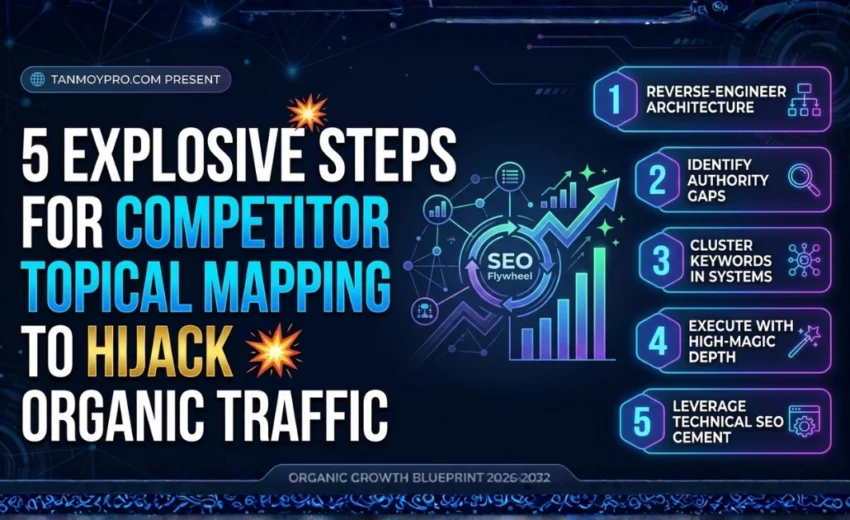
If you want to beat your competitors in modern search, traditional keyword research is no longer enough—you need to master Competitor Topical Mapping to expose the exact content gaps your rivals are using to capture traffic. By identifying their semantic authority and integrating an advanced programmatic SEO engine strategy, you can systematically steal high-intent search visibility. Paired with strong entity authority signals, executing a precise competitor topical mapping strategy provides the fastest shortcut to outranking established competitors and owning your niche organically.
Ranking for a single keyword is no longer a sustainable business strategy — Google has fundamentally shifted from matching words to evaluating whether your entire site deserves to be trusted on a subject.
That shift has created an enormous divide between two types of SEO approaches: keyword chasing and authority building. Early-stage founders are often trapped in the first camp, hunting for individual terms with decent search volume, publishing one page, and waiting. And waiting. The results are inconsistent at best, and the rankings that do appear tend to collapse the moment a better-resourced competitor targets the same term.
Topical authority is the framework that explains why. Google does not rank pages in isolation — it reads your site as a body of work and judges whether that body of work signals genuine expertise. A topical map is the blueprint of that body of work: the structured set of content pillars, supporting clusters, and interconnected pages that, together, tell Google you own a subject. If your strategy relies on driving consistent growth, establishing a sustainable SEO flywheel framework ensures your topic clusters drive approximately 30% more organic traffic and hold rankings 2.5× longer than standalone pieces. That gap is not a coincidence — it is the structural difference between a site Google trusts and one it merely tolerates.
This is where the concept of hijacking enters the picture. Competitor keyword research is commonly used to find gaps in your own content calendar, but its deeper value is something most founders overlook: performing Competitor Topical Mapping to identify precisely where an established competitor has built topical authority in some clusters while leaving adjacent clusters dangerously thin. Those thin spots are exploitable. They represent real search demand with an authoritative site that has, for whatever reason, under-delivered.
The path forward starts with understanding how competitors have structured their information architecture — and that is exactly where the process begins.
Step 1: Reverse-Engineer Architecture for Competitor Topical Mapping
Before you can outrank a competitor, you need to understand the structural logic holding their entire content ecosystem together — not just the individual pages they rank for.
The starting point is identifying what practitioners often call the “Seed Competitor” — the site that does not merely sell what you sell, but actively owns the search results in your space. This is a critical distinction. Your commercial competitors and your search competitors are frequently different entities entirely. A niche blog with no product to sell can dominate a cluster of high-intent keywords simply because it has built deeper, more interconnected content than any brand in the market. Your Seed Competitor is whoever Google trusts most in your topic space, regardless of their business model.
Effective Competitor Topical Mapping begins not with a keyword list, but with a structural audit of how that competitor organizes knowledge. Pull their top-performing pages and look for the underlying content pillars — the broad thematic categories that act as the load-bearing walls of their site. A common pattern is that high-authority sites organize content into four to six core pillars, each supported by a cluster of tightly related supporting pages. Mapping this out reveals the deliberate architecture behind what might appear, on the surface, to be a random collection of articles.
What tends to work better than page-by-page analysis is looking for the “unspoken connections” between their highest-traffic content. Ask why those pages link to each other, which subtopics appear repeatedly across multiple pillars, and where the internal linking structure concentrates the most authority. Implementing an automated structure for your internal links using an AI internal linking strategy helps replicate this authority flow without manual friction.
This is where the real leverage lives. Pages covering roughly 74% of relevant subtopics consistently outperform those covering only 50%, which means your competitor’s structural gaps are not accidental — they are measurable and exploitable through thorough Competitor Topical Mapping. Successful niche sites that dominate specific clusters almost always follow one pattern: they go narrower and deeper than the generalist brands around them, achieving what amounts to encyclopedic coverage on a tightly scoped set of topics.
Once you have reverse-engineered the skeleton of a competitor’s information architecture, the next logical move is locating precisely where that skeleton has missing bones — the subtopic gaps and outdated clusters your competitor never got around to filling.
Step 2: Identify ‘Authority Gaps’ via Competitor Topical Mapping
Effective SEO competitor research is not about copying what already ranks — it is about finding the territory your competitors left completely unguarded.
Once you have reverse-engineered a competitor’s information architecture, the next move is to stress-test it for weaknesses. No content ecosystem is airtight. In practice, even the most dominant sites in a niche carry blind spots — subtopics they skipped, clusters they treated too shallowly, or sections that have simply aged out of relevance. These are your entry points.
Keyword clustering tools are the most direct way to surface these gaps during your Competitor Topical Mapping workflow. By running a competitor’s domain through a clustering analysis, you can map which subtopics they actively cover versus which ones they have only grazed or ignored entirely. The difference between a cluster they “touched” and one they “own” is significant. A single post on a subtopic does not signal topical authority to Google — a network of related, interlinked content does. If you notice an abrupt drop in your current reach while mapping gaps, learning how to recover lost organic traffic will help bring authority back to your core pages.
Content depth is the second axis to evaluate when doing Competitor Topical Mapping. A common pattern is that high-ranking pages on mature topics were written years ago, optimized for an older version of Google’s ranking signals, and never meaningfully updated. Look for thin word counts on complex topics, missing supporting data, or user experience friction like slow load times and poor mobile formatting. These are not minor issues — they are exploitable weaknesses.
“Outdated information in a high-ranking cluster is essentially a vacancy sign for a better-prepared competitor.”
“Surface-level coverage of a high-volume subtopic signals that the competitor ranked on domain authority alone — not genuine expertise.”
“A poor user experience on an otherwise strong page is an open door for any site willing to do the work properly.”
The mindset shift here is critical. Only 15.2% of categories in AI search have a clear brand owner, which means the landscape is far more open than it appears at first glance. To survive this shift, implementing an optimized AEO framework for AI search ensures you capture visibility even when users don’t click traditional blue links. The goal is not to challenge a competitor on their strongest content — it is to claim the subtopics they never bothered to build.
Step 3: Cluster Your Keywords into a Scalable Digital System
Turning a raw keyword list into a topical cluster is not an organizational exercise — it is the architectural decision that determines whether your content compounds in authority or stagnates in isolation.
Once you have executed your Competitor Topical Mapping and mapped competitor gaps (as covered in Step 2), the next move is to impose structure on what can easily become an unmanageable sprawl of keyword data. The instinct is to prioritize by search volume, but volume alone is a poor organizing principle. What actually matters is search intent — the underlying goal a user has when they type a query. Grouping by intent means your content serves a coherent journey rather than a scattered collection of tangentially related pages.
A reliable framework here is the Pillar and Spoke model, which mirrors how well-structured websites are built at a technical level. The pillar page addresses a broad, high-competition topic with comprehensive depth. Spoke pages branch outward, each targeting a more specific intent cluster that supports and reinforces the pillar. A content optimization strategy built on this model tends to work better for long-term ranking than publishing standalone articles with no deliberate hierarchy.
Internal linking is the mechanism that makes the model functional. Each spoke page should pass authority back to the pillar through contextual anchor links, creating a clear signal to search engines about which page holds topical dominance. Without this linking architecture, even well-written content sits in structural isolation, unable to leverage the authority distributed across the cluster.
This is also where a keyword clustering tool earns its place in your Competitor Topical Mapping process. Rather than manually sorting hundreds of keywords by hand, clustering tools group queries by SERP overlap and semantic similarity — a far more reliable signal of intent alignment than keyword phrasing alone.
And this distinction — system versus strategy — is worth dwelling on. A strategy is a plan; a system is a repeatable process. To systematically maintain authority, implementing a consistent daily high-quality blogging routine fuels compounding growth. Websites with topic clusters receive 3.2× more AI citations than single-page competitors, reflecting exactly what a structural system produces.
| Keyword List | Topical Cluster |
|---|---|
| Sorted by volume | Organized by intent |
| No structural hierarchy | Pillar and spoke architecture |
| Pages compete with each other | Pages reinforce each other |
| Authority diluted | Authority consolidated and directed |
| Short-term ranking spikes | Long-term compounding growth |
Step 4: Execute with ‘High-Magic’ Content Depth
Content depth is not about word count — it is about the willingness to answer the questions your competitors quietly avoid.
Once your Competitor Topical Mapping is complete and your authority gaps are identified, the actual execution determines whether you rank or stall. This is where most brands fall short. They find competitor keywords, audit the existing content landscape, and then produce something that mirrors what already ranks. The result is a page that search engines have no real reason to prefer. High-magic content depth means going further — into the uncomfortable, the nuanced, and the genuinely instructive.
Tackling uncomfortable questions is one of the highest-leverage moves available to a content strategist. Competitors tend to avoid failure analysis, edge cases, and direct comparisons because those topics feel risky. But those are precisely the questions your audience is typing into search. A post that honestly examines why a common approach fails — and what to do instead — earns trust in a way that polished promotional content simply cannot.
Moving beyond AI-generated output is equally critical. Generative tools can produce grammatical, well-structured prose at scale, but they cannot replicate genuine expertise, original examples, or nuanced professional judgment. Content derived from rigorous Competitor Topical Mapping that demonstrates real subject-matter depth consistently outperforms thin, templated pages in competitive search categories. Every page you publish within a cluster should add something the map does not already contain. When designed to target potential buyers, focusing on capturing high-intent traffic guarantees your deep content turns readers into leads.
Brand identity plays a structural role in this process. A consistent voice, a recognizable point of view, and a clear editorial standard across your cluster signal to both readers and search engines that a coherent, authoritative source stands behind the content.
Step 5: Leverage Technical SEO to Cement Your Authority
A topical authority map only delivers its full value when the technical foundation beneath it is built to match the ambition of the content sitting on top.
Content depth and cluster architecture can take you far, but technical SEO is what converts your Competitor Topical Mapping work into durable rankings. Search engines evaluate your site on dimensions that have nothing to do with words on a page — and those silent signals can quietly undercut even the strongest content strategy.
Site speed and mobile-first design are among the most underestimated authority signals in modern SEO. A slow-loading page communicates friction to both users and crawlers. What typically happens is that Google deprioritizes pages with poor Core Web Vitals, regardless of how well-structured the content is. Ensuring your site adheres to an optimized Core Web Vitals LCP and INP guide prevents performance bottlenecks from damaging your rankings.
Schema markup is where technical SEO intersects directly with your topical map. Structured data helps search engines parse the relationships between your content — confirming the entities, topics, and hierarchies you have intentionally built. Integrating advanced structured data schema for AI traffic signals to crawlers that your site is organized around a coherent subject area, not a loose collection of articles.
Full-stack development and SEO strategy are no longer separate disciplines. Rendering choices, JavaScript frameworks, internal linking logic, and crawl budget management are architectural decisions that shape how thoroughly your topical map gets indexed and understood.
The technical requirements that tend to matter most include:
- Core Web Vitals compliance — particularly Largest Contentful Paint (LCP) and Cumulative Layout Shift (CLS)
- Mobile-first responsive design across all cluster pages
- Structured data (schema markup) applied to articles, FAQs, and product pages
- Canonical tags and internal linking that reinforce topical hierarchy
- Crawl budget optimization so priority cluster pages are indexed first
Understanding this distinction is also what separates startups that see results from those that stall, which is exactly the pattern worth examining next.
Why Startups Fail at Competitor Topical Mapping (And How to Avoid It)
Building a topical map for SEO is not simply a content exercise — it is a structural commitment that most startups abandon before it has any chance to work.
The most common failure pattern in Competitor Topical Mapping is thin content sprawl. A startup identifies twenty topic clusters, assigns one short article to each, and expects Google to recognize authority. What Google sees instead is a site that gestures at many subjects without mastering any. Depth signals peer-level credibility; volume without depth signals the opposite.
Warning: Publishing five hundred words on a complex topic does not establish expertise — it establishes presence. Presence and authority are not the same signal in Google’s evaluation model.
The second failure is losing the Golden Thread — the connective logic between what your business actually offers and what users genuinely need to know. When those two things drift apart, you produce content that ranks for intent you cannot convert. Every piece in your topical map should trace a clear line from a user’s question back to a problem your product or service solves. Avoiding this requires aligning your architecture with a conversion-first website structure that seamlessly turns visitors into customers.
Timing is the third trap. Topical maps take time to mature. Google builds trust in a domain’s authority incrementally, often over six to twelve months of consistent, well-structured publishing. Startups routinely abandon their Competitor Topical Mapping strategy at month three when rankings have not moved, right before compounding effects would have kicked in.
The Bottom Line: Master Competitor Topical Mapping for Dominance
Topical mapping is not an optional growth tactic — it is the structural foundation that separates startups that compound organic traffic from those that plateau after their first few content pushes.
The earlier sections of this piece have traced a full arc: from diagnosing why competitors dominate, to building a gap-identification system through Competitor Topical Mapping, to reinforcing that system with technical SEO. What connects every step is a single insight — search authority is not won term by term. It is won topic by topic. Topical authority is a primary signal for outranking competitors in both traditional and AI-driven search, which means every piece of content you publish either adds to a coherent authority structure or dilutes it.
Finding the gap is where most of the competitive leverage lives. As outlined earlier, your competitors are rarely dominant across their entire subject matter. There are clusters they have underserved, questions they have left unanswered, and angles they have not addressed with sufficient depth. Your job is to locate those openings systematically and build into them with precision — not with volume for its own sake, but with content that closes the authority loop on a topic your audience genuinely needs covered.
- Topical mapping is structural: It defines the architecture your entire content program must be built around.
- Competitor gaps are measurable: Executing structured Competitor Topical Mapping reveals the authority shortfalls where a calculated content investment produces the highest return.
- Technical and content strategy must run together: Neither layer delivers its full value without the other in place.
- Topic ownership beats keyword chasing: Scalable, defensible organic growth comes from depth of coverage, not breadth of isolated rankings.
Scaling Your Digital System with Tanmoypro
The gap between knowing what topical mapping requires and actually executing it at scale is where most startups lose their momentum — and their search rankings.
The strategy outlined across this article is not abstract theory. Executing advanced Competitor Topical Mapping demands technical precision, content architecture, internal linking logic, and brand-consistent execution happening simultaneously. For most founders, that intersection is exactly where things break down. You can understand the framework completely and still stall because the execution requires both development fluency and growth strategy working in sync.
Tanmoypro bridges that gap. The full-stack approach means that your topical map does not live in a spreadsheet disconnected from your site architecture. It gets built into the technical foundation of your digital system — URL structures, crawl paths, schema markup, and content clusters all aligned from the start. That integration tends to produce compounding results far faster than bolting an SEO strategy onto a site that was never designed to support it.
Founders often need two different partners and then struggle to get them to communicate. One team handles development; another handles content; a third handles brand identity. What typically gets lost in that handoff is coherence — the kind of coherent digital presence that search engines reward with topical authority and that users reward with trust. A partner who understands both the code and the content removes that friction entirely.
And that is the core promise. Whether you are a pre-revenue startup mapping your first content clusters or a scaling brand performing Competitor Topical Mapping to audit a rival’s gaps, the next move is the same: build a result-driven digital system designed for organic dominance. Start that build with Tanmoypro today — and stop leaving search traffic on the table.

September 2, 2026