
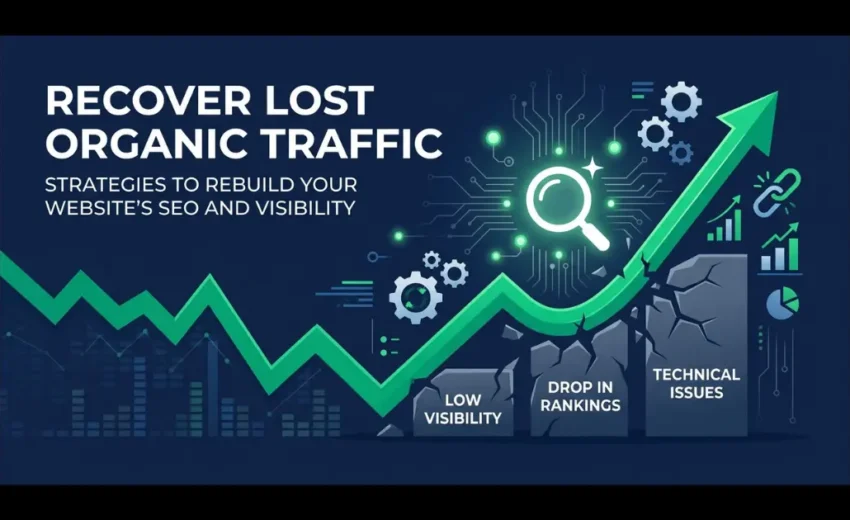
In 2026, experiencing a sudden drop in search visibility can feel catastrophic for any business relying on organic search. Knowing exactly how to recover lost organic traffic is critical to keeping your digital pipeline healthy, recovering wasted revenue, and scaling your bottom line.
When rankings decay, the most expensive mistake you can make is blindly rewriting pages without diagnostic data. The first step is learning how to audit lost website traffic and recover wasted revenue before making structural site changes. By fixing hidden technical bottlenecks and aligning your content with search intent, you can stop relying on skyrocketing ad spend and rebuild a high-converting SEO flywheel to scale organic growth predictably.
Here is a step-by-step roadmap to diagnose traffic decay, execute a precise recovery strategy, and turn your site into a resilient sales engine.
Organic traffic is not just declining in 2026 — it is collapsing, and the sites that refuse to adapt are watching years of SEO investment evaporate in real time. Across dozens of industries, Google organic traffic has dropped by as much as 35% for generic content sites in 2026 alone. If your analytics dashboard looks like a ski slope heading downhill, you are not imagining things, and you are not alone. The drop is real, it is widespread, and it demands a fundamental rethink of how you measure success online.
Google’s shift from portal to answer engine is the core driver behind this disruption. For two decades, Google sent users to websites. Today, Google is the website for a growing share of queries. AI Overviews now surface direct answers at the top of results pages, resolving user intent before a single click ever happens. You build the content. Google keeps the visitor. That arrangement is not a bug in the system — it is the system, by design.
The numbers beneath the surface are even more sobering. Research consistently shows that 96.55% of all published content receives zero organic traffic from search. That statistic predates 2026, which means the old playbook — publish more, target more keywords, build more links — was already failing most sites before AI Overviews accelerated the damage. Attempting to recover lost organic traffic using tactics built for 2018 is like navigating with an outdated map; the roads have changed entirely.
Revenue, not rankings, is the only metric worth protecting now. Lower traffic can coexist with higher revenue if the visitors arriving are the right ones. That is the paradox — and the opportunity — at the center of everything that follows. But before exploring how to pivot, it is worth asking a harder question: is SEO itself finished, or is something more nuanced happening beneath the headline numbers?
Is SEO Dead? The Reality to Recover Lost Organic Traffic in 2026
SEO is not dead — it has fundamentally restructured, and the sites winning in 2026 are those that understand how to recover lost organic traffic while driving predictable revenue.
The “SEO is dead” narrative resurfaces every few years, but the 2026 version carries more weight than previous cycles. The shift to AI-driven search is real, measurable, and accelerating. However, reacting with panic rather than precision is where most site owners go wrong. The smarter response starts with understanding what is actually changing at a structural level.
AI-referred traffic growth tells a revealing story. AI-referred sessions increased by 527% year-over-year, a figure that reframes the entire conversation. Traffic is not disappearing into a void — it is being redistributed. Users are still searching, still clicking, and still buying. But the funnel now runs through platforms like Perplexity, ChatGPT, and Google’s AI Overviews before it ever reaches a traditional search results page.
What matters most is the quality of that redistributed traffic. Research shows that AI search visitors are 4.4x more valuable than traditional organic visitors.
“AI search visitors are 4.4x more valuable than traditional organic visitors.” — Semrush / Search Engine Land
This single data point reframes the entire volume-versus-value debate. A site absorbing 40% less raw organic traffic but attracting higher-intent visitors further down the purchase funnel is not failing — it is evolving. The danger is not lower session counts. The danger is remaining invisible to the AI platforms generating this higher-value traffic in the first place.
Visibility gaps are widening fast for brands that have not adapted their content strategy for machine-readable authority signals. If your site is not being cited by AI platforms, you will struggle to recover lost organic traffic effectively. Running a thorough technical SEO audit checklist is often the first step to diagnosing exactly where those gaps exist — and the next section walks through precisely how to do that.
Diagnosing the Root Cause to Recover Lost Organic Traffic
Before you can recover lost organic traffic, you need to know exactly what is stealing it — and in 2026, the culprit is rarely just one thing.
Running a thorough seo content audit is the logical first move. But the diagnostic process has grown more complex, because a traffic drop today could stem from a Google Core Update penalty, AI Overview cannibalization, or a technical foundation that no longer meets modern crawling standards. Getting the diagnosis wrong means applying the wrong fix when trying to recover lost organic traffic.
Differentiating the cause is your starting point. A Core Update hit typically shows a sharp, date-stamped drop that correlates with a confirmed Google rollout. AI Overview leakage, by contrast, tends to be gradual — impressions hold steady in Google Search Console while clicks quietly erode, because Google is now surfacing your answer directly on the results page before a user ever reaches your site. Pull your Search Console data and compare the click-through rate trend against impression volume. A widening gap between the two is a strong signal that zero-click behavior is at work.
Once you understand the source, work through these core diagnostic checkpoints to prepare your strategy to recover lost organic traffic:
- Thin content exposure: Audit pages that rank for informational queries but offer generic, surface-level summaries. Industry experts increasingly emphasize that technical resilience alone cannot compensate for content that AI models and Google’s quality systems now flag as non-expert.
- Zero-click keyword mapping: Identify which of your target keywords now trigger an AI Overview or featured snippet. These terms require a strategy shift — away from traffic and toward conversion-optimized placements.
- Technical foundations: Verify Core Web Vitals scores, structured data markup compatible with LLM-based search systems, and mobile-first indexing status. A single weak link here can compound other issues significantly.
Once you have a clear picture of what is broken, the next layer of the recovery process becomes apparent — and it starts with confronting how much of your existing content is actively working against you.
Content Pruning: How to Recover Lost Organic Traffic with Less Content
If your primary goal is to recover lost organic traffic, content pruning SEO is one of the highest-leverage recovery tactics available in 2026 — trimming your weakest pages often does more for organic visibility than publishing dozens of new ones.
The 80/20 rule applies here with uncomfortable precision. In practice, roughly 80% of your organic revenue traces back to about 20% of your pages. The remaining 80% of your content — the blog posts nobody visits, the thin category pages, the outdated guides — actively work against you by diluting your site’s topical authority and signaling to Google that your domain is a mixed-quality resource. As Neil Patel notes, Google crushes websites with generic content; the focus must shift to unique, expert-led insights.
Zombie pages are the culprit most site owners overlook when attempting to recover lost organic traffic. These are pages with fewer than 50 organic sessions per month over a trailing six-month period, zero backlinks, no internal link value, and no meaningful conversion contribution. They do not rank, they do not convert, and yet they consume crawl budget and fragment your site’s thematic signals.
Identifying them requires pulling your full page-level performance data — sessions, impressions, average position, and conversions — then applying a consistent threshold to flag candidates. Once flagged, every page falls into one of three actions:
- Delete: No traffic, no backlinks, no unique value. Remove and return a 404 or 410.
- Redirect: No traffic, but a higher-authority page covers the same topic. 301 redirect to the better resource.
- Refresh: Some traffic or backlinks exist, but content is thin or outdated. Rewrite with depth and current data.
| Criteria | Delete | Redirect | Refresh |
|---|---|---|---|
| Monthly organic sessions | Under 10 | Under 10 | 10–200 |
| Backlinks | None | Some | Any |
| Unique topical angle | No | No | Yes |
| Conversion contribution | None | None | Minor |
Consolidation tends to work better than deletion when two weaker pages share overlapping intent. Merging them into one comprehensive resource concentrates authority rather than discarding it entirely.
This disciplined reduction of low-value content is what creates the clean topical signals that both traditional search and AI-powered engines reward. And once your site’s authority foundation is solid, the next challenge becomes ensuring you are visible not just in standard results — but inside the AI-generated answers that are increasingly capturing clicks before users ever reach your pages.
Mastering Generative Engine Optimization (GEO)
Generative Engine Optimization is the discipline of structuring your content so that AI-powered search engines can parse, cite, and help you recover lost organic traffic.
The technical and content pruning work covered in earlier sections cleans up your existing footprint. But GEO takes the next step: it prepares your content for an entirely different kind of reader. Large language models like ChatGPT and Perplexity do not crawl pages the way traditional bots do. They extract meaning, identify entities, and pull citable facts. If your content is not structured to support that process, your brand simply does not appear in AI-generated responses — making it impossible to recover lost organic traffic from modern AI surfaces.
Moving from Keywords to Entities and Citations
Traditional SEO is built around keywords. GEO is built around entities — named concepts, organizations, products, and facts that AI models can anchor to a knowledge graph. What this means in practice is that your content needs to clearly state who you are, what you do, and what claims you are making, with enough surrounding context that a language model can lift that information cleanly. Structured data markup, consistent brand naming across every page, and explicit factual statements all reinforce entity recognition. And when AI systems do cite sources, they overwhelmingly favor content that reads like a primary reference — not a promotional landing page.
Structuring Content So LLMs Can Credit Your Brand
Readability for humans and parseability for AI models are closely related, but not identical. One practical approach is to write answer blocks: tight, self-contained paragraphs of two to four sentences that directly address a specific question. These blocks give AI systems a clean unit to extract and attribute. Beyond formatting, digital PR and unlinked brand mentions signal to AI models that your brand exists as a recognized authority in a specific domain — a factor that tends to work better than raw backlink counts in AI-weighted ranking signals.
Optimizing for AI Overviews
Google’s AI Overviews pull from content that demonstrates concentrated, authoritative expertise on a narrow topic. The pattern that consistently earns inclusion involves a direct question answered in the first sentence, followed by supporting evidence. This is also where long tail seo keywords become structurally important: precise, problem-specific phrases align naturally with the narrow queries that AI Overviews are designed to resolve. Rather than optimizing a single page for a broad head term, content clusters built around specific sub-questions give AI systems more surface area to work with — and give your brand more opportunities for citation.
Getting your brand cited inside AI responses is ultimately a traffic and revenue problem. And that connects directly to how you select and target the keywords driving that traffic in the first place.
Scaling Revenue Through High-Intent Long Tail Keywords
In 2026, chasing high-volume keywords is increasingly a vanity exercise — targeting high-intent terms is the real key to recover lost organic traffic and drive bottom-line sales.
This shift has been building for years, but the rise of AI-generated search results has accelerated it dramatically. When a user types a broad query like “best marketing software,” they often receive a direct AI summary that satisfies their curiosity without a single click leaving the results page. But when someone searches “what marketing platform integrates with Shopify for abandoned cart recovery,” that query carries weight. It carries intent. And AI is far less likely to fully resolve it with a generic answer.
Vanity metrics vs. revenue metrics. High monthly search volumes can look impressive in a report, but if that traffic converts at 0.3%, the number is largely decorative. Long-tail keywords now account for the majority of high-conversion search traffic, making them a core lever when trying to recover lost organic traffic with high business impact.
The most effective targeting approach focuses on “Problem-Solution” long-tail phrases — queries that name a pain point and imply a solution is needed. Think “how to fix slow WooCommerce checkout causing lost sales” rather than “WooCommerce optimization.” These phrases attract visitors who are pre-qualified by their own search behavior.
Building content clusters around a tight niche reinforces this further. A single authoritative pillar page supported by tightly focused supporting articles signals deep expertise to both traditional search engines and the generative engine optimization systems that now influence how AI surfaces and cites content.
Revenue vs. Traffic: A Callout
Metric High-Volume Head Term High-Intent Long-Tail Monthly Searches 40,000+ 200–800 Avg. Conversion Rate 0.3–0.8% 3–8% Revenue Potential Lower Significantly Higher
But targeting the right keywords is only half the equation. Conversion infrastructure determines whether that hard-won traffic actually generates revenue. Funneling long-tail visitors into a system — email capture, a clear offer, a logical next step — transforms a content strategy into a revenue engine. Without that structure, even perfectly targeted traffic leaks away. And that infrastructure question leads naturally into something broader: the role of the digital system itself, and why the platform your content lives on matters just as much as the content you produce.
Building Scalable Digital Systems for Long-Term Growth
Addressing the organic traffic decline of 2026 is not a content problem alone — it is a systems problem, and the businesses that recover fastest are those that treat digital growth as an integrated discipline to recover lost organic traffic.
The distinction matters enormously. A website can rank, attract clicks, and still fail to convert because the underlying infrastructure — page speed, visual hierarchy, brand coherence — is working against the user at every step. In practice, technical excellence and strategic content have to operate together. One without the other leaves revenue on the table.
Website performance is the non-negotiable foundation. Search engines in 2026 weight Core Web Vitals heavily, and users make abandonment decisions within seconds. A slow, poorly structured site undermines every keyword win and every piece of optimized content sitting on top of it. No amount of GEO-readiness or long-tail targeting can compensate for a platform that frustrates visitors before they read a single word.
Brand search volume is becoming one of the clearest signals of digital authority. When people search for your business by name — not just by the category you operate in — algorithms interpret that as a trust signal. Building recognizable brand identity through consistent messaging, design, and content quality is no longer a marketing luxury; it is an SEO asset with measurable ranking impact.
System integration is where professional web development earns its place in a growth strategy. Building a website that drives revenue rather than just traffic requires coordinating technical infrastructure, conversion architecture, and content strategy into one coherent system — not bolting them together as afterthoughts.
The shift, ultimately, is from thinking of SEO as a tactic you run periodically to treating digital growth as a managed system you refine continuously. That mindset is what separates businesses that recover from those that stall — and it is precisely what the roadmap ahead will help you build.
The Bottom Line: Roadmap to Recover Lost Organic Traffic
AI search is reshaping the fundamentals of search so completely that your action plan to recover lost organic traffic demands a full roadmap overhaul, not a handful of quick content fixes.
The previous sections have outlined the individual levers — long-tail keyword targeting, GEO implementation, scalable systems architecture. But strategy only converts to revenue when it is organized into a clear sequence of actions. What follows is the recovery roadmap that ties those threads together into something executable.
The four priorities that demand your attention right now:
- Audit for revenue-driving pages first. Stop chasing vanity traffic metrics. Identify which pages actually generate leads, trials, or purchases, and direct your technical and content resources there before anywhere else.
- Implement GEO best practices to capture AI-referred visitors. Structured answers, schema markup, and quotable content blocks position your site to appear in AI-generated responses — where high-intent traffic is increasingly being routed before users ever reach a traditional search results page.
- Prune generic content that no longer serves users or algorithms. Thin, undifferentiated pages dilute your site’s authority and consume crawl budget without contributing to conversions. Consolidating or removing them tends to produce measurable ranking improvements within weeks, not months.
- Invest in a scalable digital system that unifies technical excellence with strategic growth. In practice, this means treating your website as an interconnected revenue engine — one where site speed, content architecture, internal linking, and conversion optimization are maintained and refined continuously, not updated in one-off bursts.
The businesses that successfully recover lost organic traffic in 2026 will not be the ones that published the most content — they will be the ones that built the most intentional systems.
What this roadmap ultimately points toward is a level of integration that most founders cannot assemble alone. Technical SEO, GEO readiness, content strategy, and web infrastructure each require depth. Combining them into a single, coherent growth system is where genuine competitive advantage is built — and that is exactly the conversation worth having next.
Future-Proofing Your Growth with Tanmoypro
Learning how to recover lost organic traffic in 2026 is not about applying temporary fixes — it is a structural shift that demands professional, systems-level thinking to navigate successfully.
The complexity of this new landscape cannot be overstated. AI-powered search engines, zero-click results, and evolving ranking signals have made it harder than ever for founders to know where to focus when trying to recover lost organic traffic. Applying a single fix — whether that means publishing more content, chasing backlinks, or tweaking meta descriptions — tends to produce diminishing returns when the underlying digital architecture is not built to support sustainable growth. What the moment demands is not more activity but smarter, more deliberate systems.
That is precisely where Tanmoypro operates. At the intersection of technical web development and strategic SEO, the approach centers on building digital infrastructure that works as a cohesive unit — where site speed, structured data, content authority, and conversion architecture reinforce one another. As the Tanmoypro positioning makes clear, solving complex digital problems with simple, smart ideas ensures long-term market success. That principle is not a tagline; it is a functional philosophy applied to every engagement.
For founders, the practical implication is straightforward: the businesses recovering fastest right now are those that moved beyond reactive tactics and committed to scalable, result-driven systems. They audited their technical foundations. They restructured their content around genuine expertise and user intent. And they built frameworks designed to perform across multiple channels — not just traditional search.
If your traffic metrics are declining and your current approach is not moving the needle, this is the inflection point. Do not wait for another algorithm update to force the issue. Build the kind of digital system that converts visitors into revenue, regardless of how search evolves next. Connect with Tanmoypro today and start that conversation.

August 30, 2026
5 Critical Entity Authority Signals to Crush Google...

August 30, 2026