
AI Internal Linking Automation is changing how modern enterprise websites and fast-growing U.S. e-commerce stores scale their organic visibility. For years, American digital marketers have spent endless hours auditing spreadsheets, tracking orphan pages, and manually inserting internal links across thousands of blog posts. It was a tedious, unscalable process that often felt like a losing battle against Google’s limited crawl budgets, especially when your site’s foundational structure is weak. If you don’t fix these architectural gaps early on, your SEO strategy is failing without a technical SEO foundation to support it.
But the digital landscape has shifted. In an era dominated by volatile core updates and changing user behavior across the United States, your internal link architecture is no longer just a structural afterthought—it is the very backbone of your site’s topical authority. Traditional plugins that blindly spam exact-match anchors are dropping ranks overnight because they fail to understand semantic context. Smart USA founders are abandoning those outdated, risky methods to escape the trap of rising ad costs. By leveraging semantic artificial intelligence, you can now build a self-optimizing contextual ecosystem that passes link equity efficiently, indexes cold content faster, and drives high-intent traffic directly to your primary conversion funnels.
Instead of burning your runway on volatile ad platforms, learning to deploy an automated semantic network is the ultimate hack to scale organic growth and escape the ad spend trap forever. In this guide, we will break down the 5 secrets to mastering this advanced framework effortlessly, ensuring your website is fully primed for maximum crawl efficiency and sustained revenue growth.
The Hidden Cost of Manual Tasks vs. AI Internal Linking Automation for Startups
Most startups treat internal linking for SEO as an afterthought — and that single blind spot quietly compounds into a growth ceiling.
As Kevin Indig, a respected growth advisor, puts it: “Internal links are the most important factor for SEO after content and backlinks, yet they are the most neglected part of the SEO process.” That gap between importance and execution isn’t just an oversight. For early-stage teams, it’s an operational tax paid in lost rankings, orphaned content, and stalled momentum. This is precisely why moving toward a systematic AI internal linking automation model becomes vital for survival in competitive niches.
The bottleneck is real. According to Authority Hacker, 51% of SEO professionals report that manual internal linking is one of the most time-consuming tasks in their entire content workflow. For a startup where one person often wears the content, SEO, and growth hats simultaneously, that time cost is devastating. Every hour spent auditing anchor text and chasing down unlinked pages is an hour not spent publishing, optimizing conversions, or building a compounding organic growth engine.
Orphan pages are the silent revenue leak. Early-stage site architectures grow fast and messily. New blog posts go live without anyone looping back to link related content. The result? Pages that exist but receive no internal link equity — invisible to crawlers, invisible to readers, and functionally invisible to Google. A page with no internal links pointing to it may as well not exist, no matter how strong the content. Without deploying a modern workflow like AI internal linking automation, managing this structural leak at scale is practically impossible.
The deeper problem is a mindset one. Most founders treat internal linking as a discrete task — something to handle during a quarterly audit. In practice, that approach can’t scale. What’s needed instead is a systematic, always-on process baked into the content workflow itself. That shift — from isolated task to scalable system — is exactly where the conversation around smart software gets interesting. And before exploring that solution, it’s worth understanding whether internal linking still holds the SEO weight it once did.
Is AI Internal Linking Automation Still Good for SEO in the AI Era?
Internal linking remains one of the highest-leverage, lowest-cost SEO tactics available — and in the AI era, its importance has only grown stronger.
Strong internal linking is the connective tissue that holds a topical cluster together, signaling to both traditional crawlers and AI-powered indexing systems exactly how your content relates, which pages carry authority, and where users should go next. Dismissing it as “basic” is a mistake that quietly suppresses organic growth for years, which is why utilizing AI internal linking automation has become a major competitive advantage.
Crawlability is where the impact is most immediate. Deep-tier pages — product guides, long-form tutorials, niche comparison posts — are often buried three or four clicks from the homepage. Without deliberate internal links, crawlers may never discover them consistently. According to NinjaOutreach research, a well-structured internal linking strategy can increase organic traffic by up to 40% simply by improving how deep pages get crawled and indexed.
The crawlability benefits are concrete:
- Faster discovery of new and updated content by search engine bots
- Reduced crawl waste, ensuring budget is spent on pages that matter
- Improved indexation rates for content sitting below the top navigation tiers
Link equity distribution compounds these gains. When a high-authority page passes signals down to a newer or lower-ranking page through a contextual link, it accelerates ranking velocity for that target page. This is how topical authority actually builds — not through isolated content, but through an interconnected web of pages reinforcing each other.
AI crawlers add another dimension. Systems like Google’s AI-driven indexing increasingly rely on site structure and link relationships to understand content hierarchy. A page that sits in isolation, no matter how well-written, is harder for these systems to contextualize. Internal links provide the relational map that tells AI which page is the pillar, which are the supporting spokes, and how a topic cluster fits together — something especially relevant if you’re building content designed to appear in AI-generated answers.
What most startups miss, though, is that how those links are built matters as much as whether they exist at all — and that’s precisely where the older, keyword-matching approach to automated internal linking starts to show serious cracks.
The old way was fundamentally broken. Generic keyword-matching plugins operate on a simple premise: find a word, insert a link. In practice, this produces over-optimized anchor text, irrelevant link placements, and user experiences that feel entirely unnatural. More importantly, it signals to modern search algorithms that you are trying to game the system, which can result in sudden ranking drops during core quality updates.
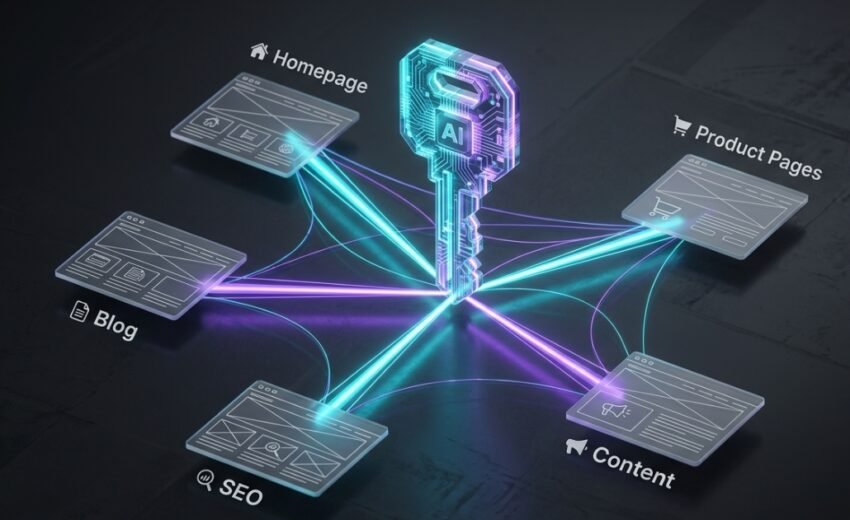
Semantic artificial intelligence fixes this scaling flaw completely. Instead of relying on a rigid string of text, modern AI internal linking automation scans the entirety of your page to comprehend the true intent and core entities of your content. It understands that an article talking about “maximizing revenue” is semantically linked to a guide on “conversion rate optimization,” even if they do not share a single exact-match keyword. This enables a sophisticated network of contextually relevant links that transfer link juice exactly where it is needed most.
Why Semantic Relevance Protects Your Site from Over-Optimization
When you use outdated automation tools, they tend to build exact-match anchors across hundreds of pages simultaneously. For example, linking the phrase “technical SEO” every single time it appears will quickly trigger Google’s spam filters. Advanced AI internal linking automation avoids this footprint by diversifying your anchor text variations naturally based on surrounding sentence structures.
The system mimics the behavior of a human SEO expert by:
- Selecting natural phrase variations rather than forcing exact-match terms
- Analyzing paragraph context to ensure the destination link genuinely adds value for a reader
- Limiting the total number of links per page to keep a healthy distribution of link equity
Unlocking the 5 Secrets to Master AI Internal Linking Automation Effortlessly
To successfully transition away from manual monitoring and build a self-sustaining organic engine, you must implement a structured framework. Below are the core operational pillars of scaling your link architecture without risking your site’s safety.
Secret 1: Audit and Connect Your Google Search Console Data first
True automated optimization cannot happen in a silo; it requires real performance data. By feeding your actual Google Search Console (GSC) metrics into a semantic data engine, the automation system identifies your high-performing “power pages” and maps them against underperforming or newly published posts. This ensures that equity flows from pages that already hold authority down to your fresh content, boosting indexation speeds across your entire U.S. audience base.
Secret 2: Dynamically Eliminate the Orphan Page Epidemic
An isolated post is a dead post in the eyes of search engines. As your digital archive expands, manually auditing every old blog post to link a new piece of content is simply impossible. Semantic automation continuously tracks your entire link graph in the background. The moment a new page goes live, the system instantly calculates where it fits best within your existing topical clusters and dynamically suggests injection points in older, indexed content to prevent orphan pages from leaking revenue.
Secret 3: Establish Multi-Tiered Topical Clusters Automatically
In modern SEO, search engines do not rank isolated pages; they rank entire topical clusters. Advanced AI internal linking automation categorizes your content into parent (pillar) and child (spoke) pages based on semantic relationships. For instance, if you are running a visual campaign to capture U.S. consumer attention, the system will automatically anchor structural content to specialized blueprints like your guide on how visual AEO on Pinterest is driving USA sales. This dynamic grouping forces search engine bots to recognize your site’s complete expertise across a subject matter, lifting the keyword rankings of every post within that specific cluster simultaneously.
Secret 4: Maintain a Natural Anchor Text Diversity Ratio
One of the biggest red flags for algorithmic penalties is over-optimized anchor text. If 90% of your internal links pointing to a page use the exact same target keyword, your footprint looks highly manipulative. True AI internal linking automation software calculates an optimal text diversity ratio. It intelligently blends exact matches with partial matches, synonyms, and conversational phrases (e.g., “read the full analysis” or “check this blueprint”). This programmatic randomness satisfies search quality evaluators while cleanly funneling PageRank across your layout.
Secret 5: Align Internal Links with Lower-Funnel Conversion Pathways
Crawl budget optimization is only half the battle; the ultimate goal of organic traffic is pipeline revenue. Your automated link ecosystem must pass authority not just to informational blog posts, but strategically downward into high-intent landing pages and case studies. By setting conversion routing parameters within your data stack, the system scans informational content and seamlessly bridges the gap toward transactional assets. It positions contextual hooks that guide users from basic search queries into mechanisms built to convert cold traffic, helping you establish a functional conversion flywheel to turn AEO traffic into high-value USA leads seamlessly.
Advanced Synergy: Bridging the Gap Between Search, Social, and Semantic Automation
Once your structural internal link architecture is running on autopilot, its compounding value begins to impact your other acquisition channels. When you drive massive, high-intent referral traffic from external platforms, an optimized internal link structure ensures that those visitors do not bounce after reading a single page.
For example, if you are actively scaling a high-velocity visual funnel, your internal linking system ensures that the incoming traffic is instantly distributed to related business-critical assets. A strategic implementation of turning Pinterest pins into an organic traffic engine works exceptionally well only when the landing infrastructure uses AI internal linking automation to keep users engaged. By trapping traffic within an interconnected web of highly relevant, semantic content, you maximize session duration and dramatically increase the chances of converting a casual visitor into a qualified lead.
Conclusion: Escaping the Manual SEO Debt Forever
Continuing to manage your digital asset architecture via manual audits and outdated string-matching plugins is an operational bottleneck that slows down modern enterprise sites. It drains human resources, creates silent traffic leaks through forgotten orphan pages, and fails to communicate effectively with semantic search algorithms.
Transitioning to a framework powered by AI internal linking automation allows you to treat your content library as a living, compounding ecosystem. It guarantees that every new asset you publish instantly receives ranking equity, every old page retains its crawl efficiency, and your entire domain remains perfectly optimized for both traditional search bots and upcoming answer engines. Stop treating your site’s infrastructure as an operational tax—automate the backend, build a reliable conversion architecture, and let your organic visibility scale effortlessly while you focus on high-level growth strategy.

June 5, 2026
Why is USA Retail Traffic Shifting to Pinterest...

June 5, 2026