
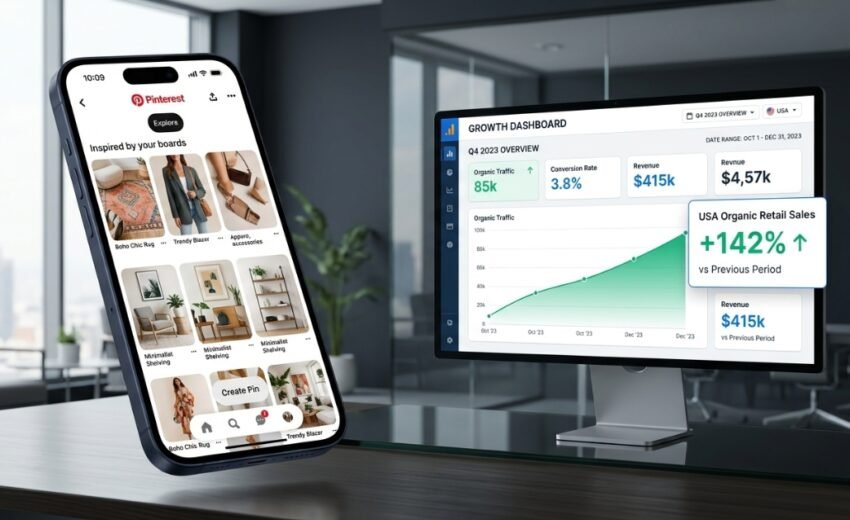
USA retail traffic is rapidly shifting to Pinterest as soaring customer acquisition costs (CAC) continue to crush brand margins on traditional ad platforms. To escape this cash-burning cycle, smart American e-commerce founders are forced to look for sustainable, high-yield organic growth channels. This massive market correction has turned Pinterest into the ultimate visual search engine for high-intent shoppers in 2026. Top-tier brands are no longer treating it as just a social media platform; they are weaponizing it as their primary conversion powerhouse to capture buyers before competitors even realize they are looking.
If your brand is ready to capitalize on this massive shift in buyer behavior and replicate these exact high-yield organic results, you must master the ultimate Pinterest marketing drive massive traffic for free blueprint. Aligning your product catalog with user search intent allows you to turn casual boards into automated, long-term sales funnels. Stop wasting budgets on volatile algorithms that kill your visibility overnight; instead, learn how to adapt to modern visual shopping habits and effortlessly unlock massive free traffic with Pinterest marketing to future-proof your digital storefront today.
The 2026 Retail Migration: Why Pinterest is Winning the Traffic War
USA retail traffic on Pinterest is surging in 2026 because shoppers are no longer browsing — they’re searching with intention, and the platform is built for exactly that.
The scroll is broken. After years of algorithmically driven feeds designed to maximize engagement at any cost, consumers have grown exhausted by the noise of traditional social apps. Doom-scrolling through outrage, ads disguised as content, and manufactured trends has created a deep, measurable fatigue. What’s emerging in its place is a deliberate shift toward platforms that respect the user’s mindset — and Pinterest sits at the center of that migration.
The core distinction is purpose. When someone opens a social feed, they’re reacting. When someone opens Pinterest, they’re planning. That difference in intent reshapes everything about how high-value USA retail traffic behaves on the platform. As Pinterest CEO Bill Ready has noted, “Pinterest is where Gen Z goes to shop… they have been raised on an internet of visual content and like to search visually.” This isn’t a demographic quirk — it’s a structural shift in how discovery works.
Text-based search is losing ground to visual-first shopping, particularly in categories like home décor, fashion, beauty, and food. Consumers increasingly want to find products by appearance, not description. Pinterest’s infrastructure was built for exactly this behavior, making it less of a social network and more of a visual search engine that consistently funnels commercial USA retail traffic into automated sales funnels.
For early-stage startups and lean retail brands, this matters enormously. Unlike paid social, Pinterest functions as a compounding organic system — content published today can drive traffic months or years later, much like sustainable SEO-driven growth without the ongoing ad spend. That dynamic makes Pinterest one of the most capital-efficient ways to capture organic USA retail traffic available in 2026. And the numbers back it up — which brings us to the specific economics driving that advantage, starting with who’s actually buying.
The High-Intent Shopper: Analyzing the $87.40 Average Order Value
Pinterest users don’t stumble onto products — they arrive already sold on a vision, making them among the highest-converting audiences in social commerce today, especially for brands chasing premium USA retail traffic.
Pinterest-referred purchases are projected to hit an average order value of $87.40 in 2026 — 28% higher than the social commerce average of $68.30, according to the Shopify x Pinterest 2026 Report. That gap isn’t accidental. It reflects a fundamental difference in why people open Pinterest versus other platforms.
Planning vs. Reacting
Most social feeds are built around impulse. A product appears mid-scroll, dopamine spikes, and a user either taps “buy” in the moment or forgets it existed within minutes. Pinterest operates on a different psychology entirely. Users arrive with a purpose — planning a kitchen renovation, curating a capsule wardrobe, or mapping out a nursery aesthetic. That pre-committed mindset means they’re not reacting to ads; they’re actively searching for solutions. A common pattern is that high-intent USA retail traffic returns to the same pin multiple times before converting, signaling higher purchase confidence and lower return rates.
This is the structural advantage over hype-based models — where a trending sound drives a product to viral status, conversions spike fast and collapse just as quickly. Pinterest’s discovery cycle is slower, but the shoppers fueling your USA retail traffic have already done the mental work of deciding they want to buy.
ROI for Budget-Constrained Brands
For early-stage startups with limited ad spend, this dynamic is a genuine edge. Investing in pinterest seo for ecommerce — optimized pin descriptions, keyword-rich boards, and consistent visual branding — compounds over time in ways paid hype campaigns simply don’t. As Pinterest Business notes, the platform functions less like an ad channel and more like a persistent storefront. Organic pins continue driving qualified USA retail traffic long after they’re published, lowering effective customer acquisition costs without requiring ongoing budget.
Understanding who is fueling this high-intent behavior, however, reveals an even more compelling layer — and that’s where the platform’s fastest-growing demographic tells a surprising story.
The Gen Z Demographic Shift: From Hype to Aesthetic Discovery
Gen Z is quietly reshaping Pinterest into the dominant visual search shopping platform of the decade — not through accident, but through deliberate rejection of what came before it, fundamentally changing the nature of USA retail traffic.
According to Pinterest Business 2026, Gen Z now accounts for 42% of Pinterest’s global user base and is growing at 30% year-over-year — the fastest of any demographic on the platform. That momentum isn’t a fluke. It reflects a fundamental change in how this generation wants to discover and shop.
The defining shift: aesthetic over algorithm. Where other platforms reward content that shocks, polarizes, or goes viral overnight, Pinterest rewards curation and taste. Gen Z users aren’t chasing trending audio or reactive meme formats — they’re building mood boards for capsule wardrobes, sustainable home setups, and intentional living. The contrast with feed-based discovery is stark:
- Viral culture prioritizes speed, reaction, and disposability
- Aesthetic culture prioritizes longevity, intention, and personal identity
- Pinterest’s model rewards the second category through evergreen search visibility, making it a goldmine for organic USA retail traffic
Sustainable fashion and home curation are two of the clearest signals. Gen Z users actively search for thrifted outfit formulas, eco-friendly material guides, and room layouts rooted in specific aesthetics — cottagecore, quiet luxury, brutalist minimalism. These aren’t impulse searches. They’re research sessions that often culminate in valuable USA retail traffic that converts made weeks later.
For brands, this behavioral pattern has serious long-term implications. A demographic that pins with purpose — and returns to those pins repeatedly — creates compounding engagement that feed-based platforms simply cannot replicate. Understanding how to convert that intent into action becomes the real competitive advantage.
That depth of intent also raises an important question: if Gen Z is searching with such precision, what exactly does their search look like — and how does the visual layer of a pin influence whether it surfaces at all?
Image Composition is the New SEO: Mastering Visual Search
The pinterest retail traffic shift isn’t just about audience demographics or purchase intent. Underneath it all, there’s a technical transformation happening at the infrastructure level that directs USA retail traffic.
Pinterest’s Lens 3.0 is projected to hit 380 million monthly queries in 2026, identifying 2.5 billion product SKUs with 94.7% accuracy — a level of precision that blurs the line between visual browsing and direct product search. When a shopper photographs a lamp in a coffee shop or screenshots a jacket from a video, Lens 3.0 doesn’t just find “similar items.” It finds your item, capturing high-converting USA retail traffic if your image and metadata are structured correctly.
This is what founders need to understand: image quality is no longer just a branding concern. It’s a critical ranking signal for capturing USA retail traffic.
Visual SEO combines three interdependent layers that Pinterest’s AI evaluates simultaneously:
- Image clarity and resolution — high-contrast, well-lit product shots with clean backgrounds rank higher in visual search results
- Metadata accuracy — alt text, board titles, Pin descriptions, and product titles must align with how shoppers naturally search
- Compositional intent — lifestyle images that show a product in context generate stronger engagement signals, which feed Pinterest’s ranking algorithm
- Rich Pins and structured data — enabling real-time price, availability, and product detail sync directly from your store to pull commercial USA retail traffic
Lens 3.0’s 94.7% SKU identification accuracy means there’s almost no margin for poor image tagging — your product either surfaces cleanly to high-intent USA retail traffic or disappears entirely.
In 2026, large language models also play a growing role in how Pinterest interprets Pin content. Descriptive, semantically rich captions help the platform’s AI understand product context, connecting your listings to broader search intent. Trust factors — consistent posting cadence, engaged boards, and verified merchant status — further signal authority to the algorithm. A deep review of your store’s technical foundation often reveals exactly where these signals break down before they ever reach Pinterest.
Getting the visual layer right is only half the equation, though. The other half is building a system that sustains it — which is exactly where smart founders are focusing next.
Scalable Systems: How Startups Can Automate Pinterest Growth
The real reason why high-converting USA retail traffic is shifting to Pinterest is simple: it compounds, while social feeds reset every 24 hours. A well-optimized pin from six months ago can still drive qualified visitors to a product page today — something an Instagram story or a TikTok post simply cannot do.
That compounding behavior is what separates Pinterest from every other platform in a founder’s marketing stack. In practice, most startups waste their biggest asset — time — by treating Pinterest like a daily social posting obligation. The smarter approach is to build it as a compounding engine for USA retail traffic: create once, optimize for search, then let the algorithm do the distribution work over weeks and months.
Systemizing Pinterest growth comes down to three foundational steps:
- Audit and align. Map your product categories to keyword-rich board structures before you publish a single pin. Pinterest’s visual search, now integrating LLM signals for 2026, rewards technical site standards — meaning your metadata, alt text, and structured data need to be clean to capture organic USA retail traffic from the start.
- Build a content pipeline. Batch-create pin graphics tied to evergreen search terms, then schedule them across a rolling 30-day window. This removes daily dependency and lets you stay consistent without constant attention.
- Close the loop with a frictionless destination. Every pin is a promise. If the landing page is slow, cluttered, or confusing, the traffic evaporates. Founders who are serious about scaling their USA retail traffic ROI invest in a site built to convert — because a seamless Pin-to-Cart experience is where intent becomes revenue.
The final piece is integration. Pinterest SEO doesn’t live in a silo — it belongs inside a broader digital growth strategy alongside organic search, email capture, and retargeting. Founders who treat it as a standalone profile miss the compounding effect entirely. A system connects the dots. As that infrastructure solidifies, the next logical question becomes whether the platform itself has the audience depth to justify the investment — and the numbers may surprise you.
Is Pinterest Still Relevant in 2026? The Competitive Reality
Pinterest isn’t declining — it’s filtering out casual browsers and concentrating the most purchase-ready USA retail traffic in social search history.
The “Pinterest is dying” narrative resurfaces every year, and every year the data kills it. As of 2026, Pinterest commands 98 million active users in the US alone, a figure that dwarfs most niche search engines and puts it firmly in the same conversation as major discovery platforms. This means that if you want to dominate your niche, tapping into this massive pool of USA retail traffic is a non-negotiable step.
The ‘too much shopping’ complaint is actually the pitch. When retailers grumble that Pinterest has become too commerce-focused, they’re describing the exact condition that makes it valuable. Users arrive on Pinterest with intent already formed — they’re planning a kitchen remodel, a wardrobe refresh, or a birthday setup. The platform’s shift toward shoppable content doesn’t alienate buyers; it removes friction between discovery and purchase. For any retail brand still treating Pinterest as a mood board tool, that misread is costing real revenue from high-intent USA retail traffic.
Compared to other niche visual search engines, 98 million US-based monthly actives is a commanding position. The platform sits in a unique middle ground: too visual for traditional search, too intentional for social feeds. That gap is exactly where high-converting USA retail traffic lives in 2026. Founders building scalable marketing systems — the kind explored in growth frameworks for startup founders — consistently find Pinterest underpriced relative to the purchase intent it delivers.
The risk of ignoring Pinterest while competitors pivot isn’t hypothetical. Every month a brand delays optimization, a competitor is locking in the long-tail visual keywords that compound over time. Pinterest’s evergreen content model means early movers build durable traffic advantages that late entrants simply cannot close quickly. The numbers backing all of this — reach, ad conversion, and projected visual search growth — tell an even sharper story, which the next section addresses directly.
Pinterest Statistics 2026: The Numbers Every Founder Must Know
The pinterest statistics 2026 paint a clear picture: this platform has quietly become the highest-intent commercial search engine to capture premium USA retail traffic in the social media landscape.
Pinterest users don’t browse — they shop with purpose. Consider these figures that should anchor your channel prioritization decisions:
- 522 million monthly active users globally, with USA users representing the largest single-market revenue segment and driving the highest density of USA retail traffic
- 80% of weekly Pinterest users have discovered a new brand or product on the platform, according to Printful’s 2026 analysis
- $87.40 average order value for Pinterest-referred traffic — significantly outpacing other social referral sources
- Visual search queries are projected to grow faster than text-based queries on Pinterest through 2026 and into 2027, driven by younger mobile-first users looking for interactive store layouts
- Gen Z now accounts for 42% of global Pinterest users, and this demographic over-indexes on shopping intent compared to its behavior on short-form video platforms
- Pinterest Predicts 2026 identifies 21 core retail trends anchored by nonconformity, self-preservation, and escapism — categories with direct commercial applications in fashion, wellness, and home décor
On market distribution, the USA dominates ad revenue but the platform’s international growth is accelerating — particularly in markets where visual discovery supplements limited local retail infrastructure. That dynamic reinforces USA retailers’ first-mover advantage: the audience is still predominantly domestic, commercially primed, and actively driving valuable USA retail traffic.
The trend forecast carries its own strategic weight. When nonconformity and escapism drive consumer desire, boards that speak to identity over transaction convert harder than promotional content. That’s a content strategy signal, not just a demographic footnote.
For founders building scalable digital brands, these numbers aren’t background context — they’re the strategic foundation. Everything from your keyword architecture to your image composition choices connects back to what these figures reveal about where purchase decisions are actually forming. Before condensing this into a clear action plan, it helps to see how each data point maps to a specific, repeatable tactic — which is exactly what the final takeaways will walk through.
The Bottom Line: Key Takeaways for Your 2026 Strategy
Pinterest is no longer a mood board — it’s the highest-intent visual search engine driving measurable USA retail traffic and retail revenue in 2026, and founders who treat it otherwise are leaving real money on the table.
The data points covered throughout this article converge on five strategic truths every retail brand needs to internalize right now:
- Pinterest is a search engine, not a social network. Users arrive with buying intent, not scrolling habits. That distinction changes everything about how you capture and convert USA retail traffic on the platform.
- Gen Z is the growth engine. Pinterest Audience Insights 2026 report a 30% year-over-year increase in Gen Z engagement — the highest of any major platform. This demographic isn’t a future opportunity; it’s an active, purchase-ready audience right now.
- The economics are impossible to ignore. An average order value of $87.40 makes Pinterest the most efficient social commerce channel available. No other platform delivers this combination of intent, reach, and organic USA retail traffic per transaction.
- Technical SEO and image composition determine visibility. Keyword-rich descriptions, alt text, and vertical image formatting aren’t optional extras — they’re the foundation of discoverability inside Pinterest’s algorithm.
- Sustainable growth demands a systemized approach. Sporadic pinning produces sporadic results. Brands that win are those integrating consistent publishing cadences with tight web infrastructure, ensuring every click lands on a fast, conversion-optimized page.
Putting these principles into practice requires more than a content calendar. It requires a coherent growth system — one where brand identity, technical web performance, and visual SEO all reinforce each other. Explore practical growth strategies for digital founders to see how these layers connect in real brand-building contexts.
The shift toward visual search isn’t slowing down. The question is whether your brand architecture is built to capture it — or still optimized for a feed-based world that’s rapidly fading. That’s exactly where the right strategic partner makes all the difference.
Building Your Visual Growth Engine with Tanmoypro
The Pinterest shift isn’t a trend to monitor — it’s a structural change in how American consumers discover and buy products, and founders who delay are already losing ground to competitors who moved first to capture organic USA retail traffic.
Ignoring Pinterest in 2026 means leaving high-intent buyers on the table. With over 500 million monthly active users and 96% of top searches unbranded, the platform rewards new brands willing to show up with the right visuals and technical foundation. That window of low-competition, high-intent traffic won’t stay open indefinitely. As Pinterest’s own research confirms, the strategies producing results right now combine consistent content output with a site that can actually convert the USA retail traffic it receives.
Technical readiness is where most founders stumble. Driving Pinterest traffic to a slow, poorly structured website is like filling a leaking bucket. Sustainable digital growth requires a blend of high-level strategy and technical execution — and that means your site needs to pass an SEO audit, load fast on mobile, and deliver a brand experience that matches the polished visuals users clicked from. Explore proven organic growth frameworks to understand how these pieces connect across your full digital presence.
Brand identity design is the often-overlooked engine beneath Pinterest success. Cohesive typography, on-brand color palettes, and professionally designed Pin templates don’t just look better — they drive higher save rates, more profile follows, and stronger brand recall at the moment of purchase. Pinterest is a visual search engine; the brands winning on it treat every Pin as a brand asset, not an afterthought.
Tanmoypro exists precisely at this intersection of strategy and execution — offering SEO audits, technical web development, and brand identity design built for founders who need measurable results, not guesswork. If the data in this article has made one thing clear, it’s that the time to act is now. Book a growth strategy consultation and turn your Pinterest presence into a compounding traffic asset.

June 5, 2026