
A Startup Marketing Engine shifts you from renting traffic to owning your market through a scalable system that grows on its own. It’s time to stop chasing one-off customers and start building a SEO Flywheel that generates leads long-term.
Most local businesses aren’t failing at marketing because they’re doing it wrong. They’re failing because they’re not really doing local business marketing at all — they’re doing occasional marketing, reactive marketing, hope-based marketing. There’s a critical difference between doing marketing and building an engine, and that gap is quietly killing your growth potential.
Consider the classic small business playbook: a few flyers, a Facebook page that gets updated sporadically, maybe a Google Business Profile that hasn’t been touched in months. Add a healthy dose of “we mostly get customers through word-of-mouth,” and you’ve described thousands of local businesses right now. Word-of-mouth feels safe and authentic, but it’s fundamentally unscalable. You can’t predict it, optimize it, or accelerate it when you need more revenue fast.
“The biggest threat to your company’s growth isn’t your competitors. It’s a bad customer experience.” — Brian Halligan, Co-founder of HubSpot
That quote stings for a reason. Traditional marketing tactics keep you passive — waiting for customers to find you rather than building systems that consistently pull them in. The businesses winning locally today have made a decisive shift: from passive presence to active digital dominance.
This is where the startup mindset changes everything. Startups don’t wait for momentum — they engineer it. They build repeatable, measurable systems designed to grow. There’s no reason a brick-and-mortar business can’t operate with that same discipline.
The real question isn’t whether you can afford to think like a startup. It’s whether you can afford not to — and understanding why the traditional funnel model is burning your budget is exactly where we need to start.
From Funnels to Flywheels: The Anatomy of a Marketing Engine
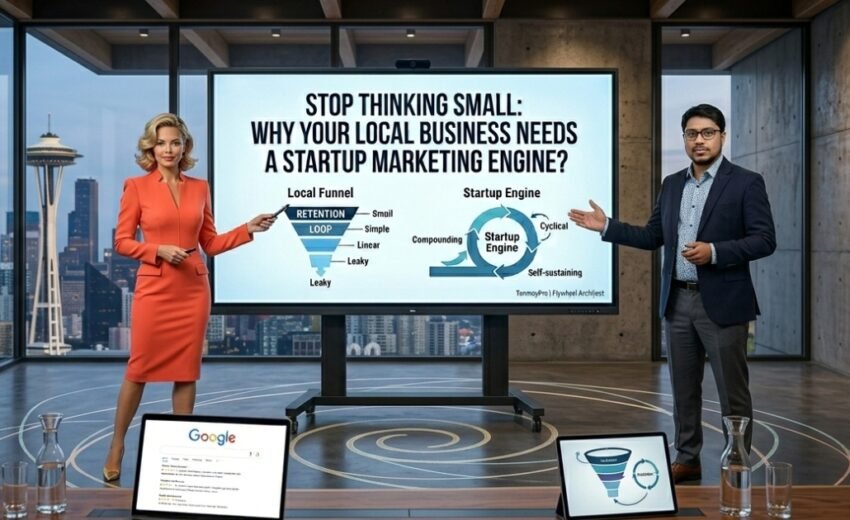
The previous section exposed a hard truth: traditional local marketing keeps businesses small by design. A big reason why comes down to the model itself. Most small businesses are still running on a linear funnel—spend money on ads, attract a stranger, convert them, then start over. Every new customer requires new spending. That’s not a growth engine. That’s a leaky bucket.
Why the Traditional Funnel Works Against You
The funnel treats customers as an endpoint. Once someone buys, their value to your marketing is essentially zero. What typically happens is that local businesses pour budget into the top of the funnel—flyers, boosted posts, radio spots—while ignoring the customers they already have. The result? High acquisition costs, low retention, and a business that flatlines the moment ad spend drops.
The Flywheel Flips the Model
According to the HubSpot Flywheel Model, the flywheel represents a circular process where customers feed growth, replacing the traditional linear funnel. Instead of momentum stopping at the sale, it compounds. Delighted customers refer new ones, post reviews, and return. Each rotation of the wheel gets easier—and cheaper.
The flywheel doesn’t just replace the funnel. It eliminates the budget drain the funnel depends on.
Here’s how the two models compare at a glance:
| Traditional Funnel | Startup Flywheel |
|---|---|
| Linear, one-time journey | Circular, self-reinforcing cycle |
| Customer = endpoint | Customer = growth driver |
| Requires constant new spend | Compounds with existing customers |
| High churn tolerance | Retention is central to the model |
Attract, Engage, Delight: The Three Stages
Attract means drawing in the right local audience—not just anyone. Think targeted content, local SEO, and community presence.
Engage is where you convert interest into action, using clear offers and frictionless follow-up.
Delight is the stage most local businesses skip entirely—and it’s the one that powers the wheel. A five-star review, a referral, a repeat visit: these are free marketing, generated by the experience you deliver.
Applying growth hacking principles to a local context means finding low-cost, high-leverage moments inside each stage. These are the small business growth strategies that don’t require a bigger budget—just a smarter system. And building that system is exactly where a structured framework becomes essential.
The 3-3-3 Rule: A Framework for Local Business Growth
The flywheel model from the previous section only works if you’re consistently feeding it. That’s where most local business owners fall apart — not because they lack effort, but because their marketing activity is scattered and unsustainable. The 3-3-3 rule is an emerging framework designed to fix exactly that.
Here’s how it breaks down:
- 3 Platforms — Choose three channels where your target customers actually spend time. For most local business digital marketing, that means a combination of Google Business Profile, Facebook or Instagram, and one email or SMS platform. Spreading yourself thinner than this dilutes focus and burns resources.
- 3 Posts Per Week — Consistency beats volume. Three purposeful, well-crafted posts per week builds brand recognition far more effectively than a burst of daily content followed by weeks of silence. Building a sustainable marketing rhythm is foundational to any marketing engine worth running.
- 3 Engagement Actions Per Day — Reply to a comment, respond to a review, or start a conversation in a local community group. These micro-interactions compound over time into genuine brand authority.
How does this compare to the 5-5-5 rule? The 5-5-5 social media approach — five posts, five stories, five direct messages daily — is designed for brands with dedicated social teams. For a local business owner wearing multiple hats, it’s a fast track to burnout.
The 3-3-3 rule wins because sustainability is a competitive advantage. A business that shows up consistently for six months outperforms one that goes viral once.
Pro Tip: Block 30 minutes every Monday to batch your three weekly posts. Schedule them using a free tool, then spend five minutes each morning on your three daily engagement actions. That’s under three hours of structured marketing effort per week — achievable for any business owner.
Once you have the 3-3-3 rule running as your consistency baseline, the next logical question is: which specific strategies should you be executing on those platforms? That’s exactly what the next section covers.
5 Startup Strategies Every Local Business Must Adopt
The 3-3-3 Rule gives you a rhythm. These five strategies give you the actual playbook. Borrowed directly from the startup world, each one is engineered for compounding growth—not just a one-time bump in foot traffic.
1. Data-Driven Market Research: Move Beyond Gut Feeling
Why it works: Startups don’t guess who their customers are—they research obsessively until they find an underserved niche they can own.
How to do it:
- Use Google Trends and free keyword tools to identify what your local market is actively searching for
- Survey your top 10 existing customers to uncover the exact language they use to describe their problems
- Identify gaps in competitor reviews (what are people consistently complaining about?) and position against those weaknesses
2. Aggressive Brand Development: Big Brand Identity, Local Budget
Why it works: Perception drives revenue. A polished, consistent brand signals credibility before a single word is read.
How to do it:
- Develop a clear brand voice, color palette, and logo that look intentional across every touchpoint
- Apply that identity consistently across signage, packaging, social media, and your website
- Treat your brand as a promise—every customer interaction should reinforce it
3. Hyper-Local SEO: The Compounding ROI of Organic Search
Why it works: Organic SEO delivers a 500–600% ROI compared to the 200% typically seen with pay-per-click advertising. Traffic compounds over time instead of stopping the moment you stop paying.
How to do it:
- Optimize every page on your website for location-specific keywords
- Build citations across local directories and keep your NAP (name, address, phone) consistent everywhere
- Publish locally relevant content that answers real questions your customers are asking
4. Conversion Rate Optimization (CRO): Stop Leaving Money on the Table
Why it works: Driving traffic is expensive. Squeezing more conversions from existing visitors costs almost nothing by comparison.
How to do it:
- Test different calls-to-action, headlines, and page layouts on your website
- Add trust signals—reviews, certifications, and guarantees—near every decision point
- Simplify your contact forms and booking processes to reduce friction
5. Automated Lead Nurturing: Build the Engine That Works While You Sleep
Why it works: Most prospects aren’t ready to buy immediately. Automated follow-up keeps you top-of-mind until they are—without requiring your daily attention.
How to do it:
- Set up an email welcome sequence for every new lead captured through your website or social media marketing local business campaigns
- Use simple automation tools to send follow-up offers, reminders, and educational content on a schedule
- Segment your list by interest or behavior so messages stay relevant
Together, these five strategies form the mechanical core of a real marketing engine. But before any of them can run at full speed, you need a rock-solid foundation underneath them—and that’s exactly where most local businesses need to start.
Building Your Engine from Zero: The Foundation
The strategies and frameworks covered so far assume you have something already in place. But what if you’re starting from scratch — or your current presence is so thin it might as well be nothing? That’s where Minimum Viable Marketing (MVM) comes in.
Borrowed from the startup concept of the Minimum Viable Product, MVM means building only what’s essential to start generating traction — then layering on complexity later. For local businesses, that translates into three non-negotiable pillars: a credible website, an optimized Google Business Profile, and a focused social core on one or two platforms where your customers actually spend time.
Why Your Website Is Your #1 Credibility Signal
Before anything else, get your website right. According to Stanford Web Credibility Research, 75% of a company’s credibility is judged based on website design alone. That’s not a minor detail — that’s your first impression doing the heavy lifting before you ever say a word.
It goes even deeper: Adobe research found that 94% of a user’s first impression is design-related. A clean, mobile-responsive site with clear calls to action isn’t optional for modern local business marketing strategies — it’s the foundation everything else is built on.
Your MVM Launch Checklist
Use this as your starting point before investing in paid ads or content:
- ✅ Google Business Profile — claimed, verified, and fully filled out with photos, hours, and services
- ✅ Website — fast-loading, mobile-friendly, with a clear value proposition above the fold
- ✅ Social Core — one primary platform, posting consistently (not everywhere, poorly)
- ✅ NAP Consistency — your Name, Address, and Phone number identical across every listing
Applying the 4 P’s and 5 C’s at the Foundation Stage
The classic 4 P’s (Product, Price, Place, Promotion) and the 5 C’s (Company, Customers, Competitors, Collaborators, Climate) aren’t just frameworks for big brands. Applied locally, they help you prioritize. What’s your positioning versus the shop two blocks away? Who exactly is your customer, and where do they search first?
A business with a weak foundation can’t be saved by clever tactics. Build the base correctly, and every strategy you layer on top — including the high-intent local search opportunities covered next — will compound far more effectively.
Capturing High-Intent Leads: The Power of Local Search
All the engine-building work you’ve done — your content, your systems, your startup-borrowed frameworks — ultimately needs to drive one thing: qualified people walking through your door or calling your number. That’s where local search becomes your most powerful revenue lever.
Here’s what separates local search from social media traffic: intent. Someone scrolling Instagram might see your ad and think, “that looks interesting.” Someone searching “best HVAC repair near me” at 7 PM is ready to hire someone tonight. That urgency gap is enormous, and it’s why local SEO consistently outperforms paid social when it comes to actual conversions.
Key Stat: According to Google, 76% of people who conduct a local search on their smartphone visit a related business within 24 hours. That’s not a slow funnel — that’s a same-day sales cycle.
The 24-hour window is the critical concept here. When someone searches with “near me” intent, they’ve already made up their mind to act. Your job isn’t to convince them — it’s simply to appear. That means owning the Map Pack (the three local business listings that appear above traditional organic results) is arguably more valuable than ranking number one in standard search. Map Pack visibility drives phone calls, directions requests, and website clicks from buyers who are already in motion.
Key Stat: Research from Hashmeta shows that 28% of local searches result in a purchase — a conversion rate that paid channels rarely match at comparable cost.
The long-term math also favors this channel. Unlike paid ads that stop the moment your budget runs out, local SEO compounds. Over time, the cost per lead drops 30–50% compared to paid acquisition, reinforcing exactly the kind of durable growth engine the 3 3 3 rule in marketing is designed to build.
Action Items:
- Claim and fully optimize your Google Business Profile
- Collect reviews consistently — Map Pack rankings are heavily review-influenced
- Ensure your Name, Address, and Phone (NAP) data is consistent across every directory
- Add location-specific landing pages to your website for each service area
Build this channel right, and it becomes the engine that keeps running — even when you’re ready to shift from survival mode to true scale.
Conclusion: Ditch the ‘Marketing’ and Build the Engine
The shift described throughout this article isn’t a tactical upgrade — it’s a fundamental change in how you think about growth. Small business marketing is reactive. A startup marketing engine is proactive, compounding, and scalable. Every piece of content, every local SEO signal, every automated follow-up sequence builds on the last, creating a system that grows stronger over time without proportional increases in effort or spend.
The businesses that win long-term aren’t necessarily the ones with the biggest budgets. They’re the ones that stop treating marketing as a cost center and start treating it as infrastructure.
Key Takeaways:
- Think in systems, not campaigns — build assets that work while you’re focused elsewhere
- Capture local intent aggressively — high-intent searches are your highest-ROI opportunity
- Compound your efforts — content, reviews, and automation reinforce each other over time
Stop doing marketing. Start building growth.

May 7, 2026
The SEO Flywheel: How to Scale Organic Growth...

May 7, 2026