
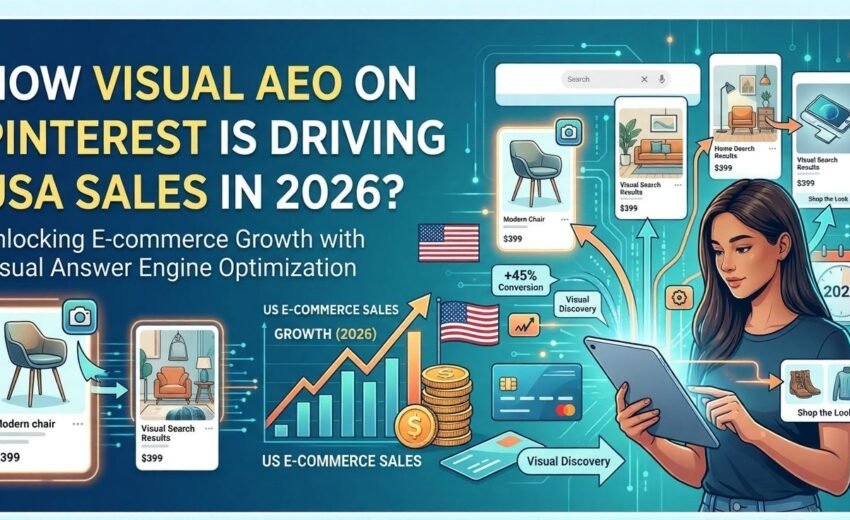
In 2026, the battle for USA market dominance is no longer fought on the text-heavy pages of yesterday. It is being won in the silent, high-speed processing of image-based citations. Visual AEO on Pinterest has officially transcended its role as a “mood board” to become the primary data source for AI Answer Engines. When a decision-maker in New York or a homeowner in California asks an AI assistant for a solution, they aren’t just getting words—they are receiving trusted visual recommendations sourced directly from optimized Pinterest ecosystems.
The reality is stark: if your brand’s imagery isn’t “AI-Readable,” you are effectively invisible to the most affluent buyer demographic in the world. While most marketers are still chasing clicks, the top 1% are building a Conversion Flywheel fueled by visual data. By mastering Visual AEO on Pinterest, you aren’t just uploading pins; you are feeding semantically rich blueprints to ChatGPT, Perplexity, and Google’s AI Overviews.
This isn’t about vanity metrics; it’s about owning your market organically. In this guide, we’ll dive into how you can engineer your visual assets to become the “Preferred Citation” for AI, ensuring your brand is the first thing a high-intent USA lead sees—and trusts—in 2026.
Search is changing faster than most small brand owners realize. The decade-long playbook of stuffing text keywords into product listings is losing its edge — and a new discipline called Visual Answer Engine Optimization (Visual AEO) is quietly replacing it. This change is the primary reason behind Google’s zero-click search growth, which is forcing brands to rethink their revenue strategies. At the center of this shift is Pinterest, where Pinterest visual search isn’t a novelty feature anymore. It’s rapidly becoming the dominant way consumers discover and buy products online.
Traditional Pinterest marketing focused on board organization, pin frequency, and text-heavy descriptions. Visual AEO goes deeper. It means engineering your images, metadata, and content signals so that an algorithm interprets your visual intent — what something looks and feels like — not just what you’ve typed about it.
Pinterest’s own technology is built for exactly this moment.
“When a user knows what they want but cannot quite describe it, an image can do what text cannot. At the center of this is our Taste Graph, which captures visual intent and curation signals.” — Bill Ready, CEO of Pinterest
The Taste Graph is Pinterest’s proprietary system for mapping visual preferences, moods, and aesthetic signals across billions of saved Pins. It doesn’t just match keywords — it understands context, style, and desire in ways that text-based search engines structurally cannot.
By 2026, analysts and platform insiders alike are treating visual search as a primary — not supplementary — e-commerce driver. For small brands willing to adapt, the implications are significant.This data-driven approach is what allows you to scale organic growth and escape the ‘ad spend’ trap forever. And the opportunity, as you’ll see next, is hiding in plain sight within a single remarkable statistic about how people actually search on Pinterest.
The 97% Opportunity: Why Small Brands Win on Pinterest
Here’s a fact that should reshape how you think about Pinterest entirely: approximately 97% of top searches on Pinterest are unbranded. Users aren’t typing “West Elm” or “Nike” into the search bar. They’re searching for “coastal living room,” “minimalist gym outfit,” or “boho wedding table.” That single reality levels the playing field in a way no other platform currently does.
The search bar isn’t a brand directory on Pinterest — it’s a mood board waiting to be built.
Text Search vs. Visual AEO: A Different Kind of Competition
On Google or Amazon, brand recognition is practically a prerequisite for visibility. Established players dominate the first page through massive ad budgets, decades of domain authority, and thousands of backlinks a startup simply can’t match overnight. The barrier to entry isn’t just high — it’s intentionally reinforced by the algorithms.
Pinterest operates on an entirely different logic. Here’s how the two environments compare:
| Factor | Text-Based Search (Google/Amazon) | Visual AEO (Pinterest) |
|---|---|---|
| Ranking Signal | Domain authority, backlinks, ad spend | Visual relevance, engagement, Pin quality |
| Brand Advantage | Significant — established names dominate | Minimal — unbranded searches are the norm |
| Discovery Style | Users know what brand they want | Users discover products by feeling and aesthetics |
| Startup Barrier | Very high | Comparatively low |
| 2026 Trend Alignment | Slow to adapt | Pinterest Predicts 2026 maps emerging consumer aesthetics in real time |
Visual Relevance Beats Brand Recognition
What this means practically is that a small candle brand with precisely optimized imagery can appear alongside — and outrank — a household name, simply because its Pin better matches the visual intent of a search like “dark academia home scents.” The algorithm rewards aesthetic match, not marketing budget.
That shift from brand authority to visual authority is the core competitive advantage Pinterest offers small businesses right now. This is exactly why smart USA founders are switching to SEO flywheels instead of relying on expensive, traditional local ads that no longer convert.
The Science of the Click: Why Visual Search Converts 62% Higher
Understanding why visual search outperforms text search is just as important as knowing that it does. The previous section established that Pinterest’s unbranded search landscape gives small brands a genuine competitive foothold. Now, here’s the mechanism that turns that opportunity into actual revenue: visual AEO fundamentally rewires the path from discovery to purchase.
Discovery: Removing the Friction From “I Want That”
Traditional text search asks shoppers to translate a feeling into words — an imprecise, frustrating process. Visual search skips that translation entirely. A user who spots a lamp with a specific woven texture can find it, along with 20 similar products, in seconds.
- Eliminates the “what do I even call this?” barrier
- Surfaces products before buyers have fully articulated their need
- Reaches shoppers earlier in the purchase journey, when intent is still forming
- Creates serendipitous discovery that text results simply can’t replicate
Precision: Textures, Silhouettes, and Buyer Confidence
What makes a shopper hesitate before buying online? Uncertainty. Visual search attacks that uncertainty directly by matching the specific qualities — fabric drape, color undertone, edge profile — that written descriptions routinely fail to capture. Pinterest marketing research consistently shows that when a product visually answers a query rather than merely ranking for it, buyer confidence rises sharply.
- Precise visual matches reduce return rates and buyer regret
- Silhouette and texture recognition builds trust that text specs can’t
- Accurate visual representation shortens the consideration phase
- High-quality imagery signals product quality before a single word is read
Conversion: Visual Answers vs. Search Results
Visual search on Pinterest leads to a 62% higher conversion rate compared to traditional text-based searches, according to Pinterest internal data via Searchlab. The reason is structural. A traditional search result says, “here are some relevant pages.” A visual answer says, “here is the exact thing.” That shift from relevance to precision is what collapses the decision timeline.
- Intent and fulfillment align in a single moment
- Less comparison-shopping because the match feels definitive
- The pin becomes the product — discovery and desire merge
That conversion edge doesn’t happen by accident, though. It’s amplified enormously when brands align their visual content with what shoppers are about to want — which is exactly where Pinterest’s trend forecasting capabilities become a powerful strategic lever.
Pinterest Predicts 2026: Leveraging the 88% Accuracy Rate
Trend forecasting is only useful if the forecasts are actually right. That’s what makes Pinterest Predicts genuinely different from the vague seasonal guides most platforms publish.
Pinterest Predicts has maintained an 88% accuracy rate over the last six years — a track record that transforms it from an interesting read into a legitimate strategic planning tool for small brands.
“Pinterest Predicts isn’t a trend report. It’s a 12-month sales calendar hiding in plain sight — and most small brands aren’t using it that way.”
The numbers back that up. According to Pinterest, checkouts on content tied to 2025 trend predictions increased 68% year-over-year. That’s not passive browsing — that’s purchase behavior directly linked to content that was built around forecasted demand.
The Early Mover Advantage: Q1 Content, Q4 Sales
The mechanism behind this is timing. Pinterest’s visual search algorithm rewards content longevity. A Pin created in January has months to accumulate saves, clicks, and engagement signals before peak shopping season arrives in Q4. By the time holiday buyers are actively searching, your content is already indexed, trusted, and surfacing at the top of unbranded results.
One practical approach is to treat the Pinterest Predicts report like a production schedule. Map each identified trend to a specific product category, build your Pins in Q1 and Q2, and let the algorithm do the compounding work through Q3. This compounding effect is the reason why quality content is your best long-term sales representative, working for your business while you sleep. Brands that wait until October to create trend-aligned content are essentially starting from zero.
Connecting 2026 Trends to Product Categories
The 2026 report highlights themes like Nonconformity — unconventional aesthetics, rule-breaking personal style — and Escapism, centered on maximalist travel, fantasy interiors, and sensory experiences. For small brands, these aren’t abstract concepts. Nonconformity maps directly to indie fashion, bold home décor, and alternative wellness products. Escapism translates to travel accessories, statement furniture, and experiential gifting.
The brands asking “can you still make money on Pinterest in 2026” are often the ones approaching it like a traditional ad platform. The smarter question is: which 2026 trend fits my catalog — and how early can I start building for it? That forward-thinking mindset is exactly what the next section unpacks in detail.
Can You Still Make Money on Pinterest in 2026? The Creator Business Guide
Is Pinterest still worth it for small brands? Absolutely — and the numbers back that up. Pinterest has grown to over 570 million monthly active users, and the platform’s ad revenue continues to climb year over year. For anyone building a pinterest marketing guide 2026 strategy, the more accurate question isn’t whether to invest, but how to structure that investment for maximum return.
What makes 2026 different from previous years? Pinterest’s entire brand positioning has shifted. As Pinterest’s newsroom notes, its 2026 campaign centers on “living your life, not just scrolling” — a deliberate signal that the platform is engineering higher purchase intent at every touchpoint. That’s a meaningful distinction for small brands competing for attention.
The 2026 Monetization Pillars
Structuring your revenue approach around proven channels is essential. Here’s where the real opportunity lives:
- Affiliate Linking — Pinterest now supports direct affiliate links on organic Pins, making it one of the lowest-barrier monetization tools available. A well-optimized Pin can generate passive commissions for months after it’s published.
- Shop-the-Look Ads — These shoppable formats let brands tag multiple products within a single image. According to ICYMI by Lia Haberman, this format consistently drives stronger purchase behavior compared to standard display placements.
- Video Ads — Short-form video is rapidly becoming a cornerstone of the Pinterest performance mix, with engagement rates outpacing static formats in several product categories.
Personalization as a Sales Driver
The Pinterest Spring 2026 Trend Report highlights personalization as a dominant consumer theme — shoppers aren’t just browsing; they’re actively searching for products that feel tailored to their specific identity and lifestyle. For small brands, this is a genuine advantage. Niche audiences respond more strongly to hyper-specific visual storytelling than broad campaigns ever could.
Personalization isn’t a feature — it’s the foundation of the 2026 Pinterest sales model.
Getting the strategy right conceptually is only half the equation. Executing it technically is where most brands leave real money on the table — which is exactly what the next section addresses.
The Evolution of Search: From Text to Visual Intent
Search is changing faster than most small brand owners realize. The decade-long playbook of stuffing text keywords into product listings is losing its edge — and a new discipline called Visual Answer Engine Optimization (Visual AEO) is quietly replacing it. This shift is a primary reason behind Google’s zero-click search growth, forcing brands to rethink their digital footprint.
Why Visual AEO on Pinterest is the New Marketing Gold Standard
At the center of this revolution is Pinterest. Today, Visual AEO on Pinterest isn’t just a novelty feature; it’s the dominant way consumers discover and buy products. Traditional marketing focused on board organization and pin frequency, but a modern Visual AEO strategy goes much deeper.
Understanding the Core of Visual Answer Engine Optimization
Implementing Visual AEO means engineering your images and metadata so an algorithm interprets visual intent—what something feels like—not just what you’ve typed. Pinterest’s technology is built for this, making Visual AEO on Pinterest a necessity for 2026.
1. The Power of Pinterest’s Taste Graph
The Taste Graph is Pinterest’s proprietary system for mapping visual preferences across billions of Pins. It understands context in ways text search cannot. By 2026, Visual AEO is treated as a primary e-commerce driver, allowing you to scale organic growth and escape the ‘ad spend’ trap forever.
2. Competitive Edge: Visual Authority vs. Brand Budget
A small brand with optimized Visual AEO imagery can outrank household names. The algorithm rewards aesthetic matches like “dark academia home scents” over massive marketing budgets. This is why smart USA founders are switching to SEO flywheels to gain a competitive advantage.
Execution Strategy: Timing Your Visual AEO on Pinterest
The mechanism behind this success is timing. Pinterest’s visual search algorithm rewards content longevity, which is why your Visual AEO assets need months to accumulate signals before peak seasons.
Maximizing ROI with Pinterest Predicts and Production Schedules
One practical approach is treating the Pinterest Predicts report as a production schedule for your Visual AEO on Pinterest campaign. Build your pins in Q1, and let the algorithm compound the work through Q3.
Why Long-Term Thinking Wins the Sales Race
This compounding effect is exactly why quality content is your best long-term sales representative. Brands that integrate Visual AEO early in the year own the market, while those who wait until October are essentially starting from zero.
The Visual AEO Playbook: Technical Optimization for 2026
Understanding trends and monetization strategies is only half the equation. Execution is where small brands actually win — and on Pinterest, technical optimization determines whether your content gets surfaced or ignored. Here’s a practical checklist to sharpen your Visual AEO approach right now.
- Optimize your image alt text and file names for Pinterest’s AI vision — Pinterest’s visual search engine reads metadata before a human ever sees your pin, so descriptive, keyword-rich file names (e.g.,
terracotta-kitchen-canister-set.jpg) give the algorithm a clear signal about your content. - Write keyword-forward pin descriptions using natural language — Pinterest’s AI parses descriptions for context, so write conversationally but include the specific visual and product terms your target audience actually searches, such as colors, materials, and use cases.
- Use the Pinterest Trends tool to validate visual concepts before production — before investing in a photoshoot or video, confirm the visual style or product category is trending upward; this eliminates guesswork and protects your production budget.
- Organize boards with strategic, descriptive titles — board names function as contextual signals to Pinterest’s algorithm, helping it categorize your content accurately and match it to relevant search queries.
- Incorporate video pins into every campaign — Pinterest video advertising has quietly become a top-tier performance channel for driving direct sales in 2026, making it a non-negotiable element of a balanced content mix.
- Enable Rich Pins to sync real-time product data — Rich Pins automatically pull updated pricing and availability from your site, building shopper trust and reducing friction at the point of decision.
- A/B test pin formats across static, video, and idea pins — in practice, different audiences respond to different formats, and consistent testing surfaces which creative approach generates the highest click-through rates for your specific niche.
The brands that treat Pinterest as a technical platform — not just a creative one — are the ones building durable, compounding organic traffic. These steps aren’t one-time tasks; they’re habits that compound over time. And as visual search continues to evolve, that technical foundation becomes the bedrock of a future-proof sales strategy — which is exactly what we’ll bring together in the final section.
Key Takeaways
- Eliminates the “what do I even call this?” barrier
- Surfaces products before buyers have fully articulated their need
- Reaches shoppers earlier in the purchase journey, when intent is still forming
- Creates serendipitous discovery that text results simply can’t replicate
- Precise visual matches reduce return rates and buyer regret
Conclusion: Future-Proofing Your Sales with Visual Intent
Visual search isn’t a trend on the horizon — it’s already reshaping how consumers discover and buy products. Pinterest sits at the center of that shift, serving as a visual intent engine that connects ready-to-buy shoppers with brands that optimize for how people actually search in 2026. Small brands that act now, before the space becomes crowded, hold a genuine first-mover advantage.
Pinterest rewards early adopters: the brands that align with platform trends before they peak are the ones that own the traffic — and the sales — that follow.
Adopt the 2026 trend signals now. Build your visual AEO infrastructure today. Your future customers are already searching.

May 12, 2026
The Conversion Flywheel: How to Turn AEO Traffic...

May 12, 2026