
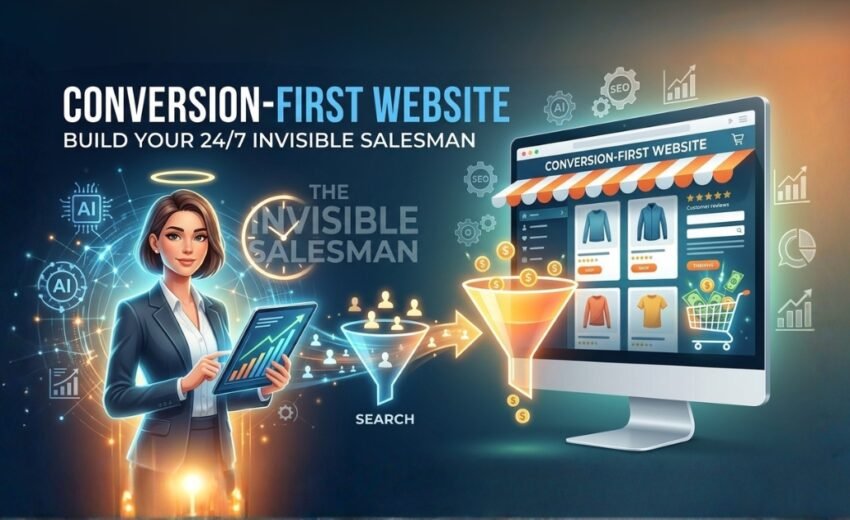
Conversion-First Website design is no longer a luxury in 2026—it is the baseline for digital survival. For years, businesses focused on “getting to the top of Google,” believing that massive traffic would naturally lead to massive revenue. But as we enter the era of AI-driven search and zero-click results, the game has changed. High traffic is vanity; conversions are sanity. If your website attracts thousands of visitors but fails to turn them into paying customers, you are essentially wasting your traffic.
The concept of the “Invisible Salesman” is simple: your website should be working 24/7, identifying user pain points, building trust through psychological triggers, and guiding prospects toward a decision without a single human intervention. In this guide, we will break down how to transition from a traditional informational site to a conversion-first website that functions as your highest-performing employee. The goal is to build a website that actually sells, ensuring you don’t just rank, but actually generate revenue while you sleep.
You wake up, grab your phone, and check your inbox. Nothing. No leads. No sales notifications. No sign that the website you spent thousands of dollars building did anything overnight while you slept. If that feeling is familiar, the problem almost certainly isn’t your product — it’s that your website is a digital brochure, not a selling machine.
A pretty website that doesn’t convert is just an expensive placeholder.
The brochureware trap is one of the most costly mistakes businesses make online. A site can look polished, load fast, and earn genuine compliments — yet still generate zero revenue at 3 AM when no one’s available to answer a chat, follow up on a form submission, or walk a hesitant prospect across the finish line. Design without strategy is decoration, not distribution. This is exactly why regular high-quality content is the only “ad” your business will ever need, as it transforms a static brochure into a living, breathing sales representative that builds trust automatically.
This is where the concept of the Invisible Salesman becomes essential. Think of it as a conversion-first system — a structured, automated framework that qualifies visitors, builds trust, and moves prospects toward a decision without any human intervention required. As Peter Drucker put it, “The aim of marketing is to know and understand the customer so well the product or service fits him and sells itself.” That’s the standard your website should be held to, and it is the exact reason why modern founders are moving away from linear funnels and instead learning how to build an SEO Flywheel that generates leads while you sleep.
The shift from traffic-first to conversion rate optimization thinking is what separates sites that impress from sites that perform. More visitors mean nothing if the system underneath isn’t built to convert them.
And here’s the deeper problem: most sites aren’t just failing to convert — they’re actively repelling the majority of potential buyers before those visitors ever raise their hands.
The Psychology of the ‘Silent Buyer’: Capturing the 97% Who Aren’t Ready to Buy Yet
Most visitors landing on your site right now aren’t ready to buy. Research consistently shows that roughly 97% of website visitors are in research mode — browsing, comparing, and quietly evaluating options before they ever consider opening their wallet. These are silent buyers, and the hard truth is that most websites are completely invisible to them.
Silent buyers don’t click “Buy Now.” They don’t fill out contact forms. They absorb information, disappear, and either return later with intent — or, more likely, find a competitor whose site spoke to them at exactly the right moment. The problem isn’t your product. It’s your funnel’s blind spot.
Traditional websites are built for the 3% who are already primed to purchase. Every element — the bold CTA buttons, the pricing tables, the “Get Started Today” banners — is aimed at conversion-ready visitors. For early-stage researchers, this aggressive posture feels premature. It’s like proposing marriage on a first date. The pressure doesn’t accelerate trust; it destroys it.
This is precisely where ecommerce conversion optimization breaks down for most businesses. They optimize for the bottom of the funnel while ignoring the vast majority of visitors who need nurturing first, often missing out on those “silent buyers” who could have been their most loyal customers.
Ryan Deiss’s framework, outlined in the Invisible Selling Machine, offers a cleaner model. The philosophy is simple but powerful: automate the transition from stranger to friend to customer through three deliberate phases.
- Indoctrination: Introduce your brand’s values, voice, and unique perspective to a new visitor. Build familiarity before asking for anything.
- Engagement: Deliver consistent, relevant value through content, email sequences, or resources that keep your brand top-of-mind over time.
- Ascension: Guide warmed-up prospects naturally toward a purchase decision — on their timeline, not yours.
This is permission marketing in practice. Rather than demanding a commitment from someone who just met you, you earn the right to keep the conversation going. You capture an email address in exchange for genuine value. You nurture quietly in the background.
What you’re really building isn’t just a website — it’s an automated relationship engine. And before that engine can do its job, there’s one critical threshold every visitor crosses the moment they land on your page. How fast you clear it determines everything.
The 50-Millisecond Rule: Designing for Instant Trust
Your website conversion optimization strategy could be flawless on paper—compelling offers, smart sequencing, strategic calls to action. None of it matters if visitors bail before any of it registers.
And they will bail. Fast.
Research from Hostinger and Stanford’s Web Credibility Project confirms that users form an opinion about a website in approximately 0.05 seconds—that’s 50 milliseconds, a timeframe so short the conscious mind hasn’t even caught up yet. The judgment is visceral, automatic, and almost entirely visual.
Which brings us to the second number worth burning into memory:
94% of first impressions are design-related, not content-related—meaning your words, your offer, your carefully crafted value proposition don’t get a fair hearing until your design earns the visitor’s trust first.
Design isn’t decoration. It’s your credibility on display.
Visual Hierarchy: The Silent Guide
What the eye follows, the mind considers. A well-structured visual hierarchy does the job of a skilled salesperson—it directs attention from headline to benefit to call to action without the visitor consciously realizing they’re being guided. When that hierarchy breaks down, visitors stall, get confused, and leave. The “Invisible Salesman” needs a clear path to walk prospects down, and that path is built with contrast, spacing, and intentional flow. This is why mastering landing page conversion strategies is critical; it ensures that your layout isn’t just “pretty,” but strategically engineered to lead the eye toward the ultimate goal—conversion.
Credibility Triggers: Lowering the Buyer’s Guard
The silent buyers discussed earlier arrive skeptical. Professional aesthetics signal competence before a single word is read. Layering in credibility triggers accelerates that trust:
- Social proof — client logos, testimonials, case study snippets
- Trust badges — security seals, industry certifications, media mentions
- Consistent brand identity — cohesive colors, typography, and imagery
- Clear contact information — visible phone numbers or addresses signal legitimacy
- Real photography — authentic images outperform stock photos every time
A website that looks trustworthy gets read. A website that gets read gets the chance to convert.
Of course, even the most visually polished homepage loses the sale if it takes four seconds to load. That’s where the technical foundation of your invisible salesman comes in.
The Technical Foundation: Speed as a Sales Tool
Trust is built in milliseconds—and so is it destroyed. As covered in the previous section, first impressions form within 50 milliseconds of a page loading. But here’s the uncomfortable follow-up: if your site takes too long to finish loading, that trust evaporates just as fast.
Speed isn’t a developer concern. It’s a revenue concern.
The High Cost of a One-Second Delay
The numbers here are unambiguous. According to Forbes, a one-second delay in page load time can reduce conversions by 7% and spike bounce rates by 90%. Flip that around: improving loading speed by just one second can increase conversion rates by as much as 27%. That’s not a marginal gain—that’s a meaningful shift in revenue, driven entirely by a technical fix.
Slow pages don’t just frustrate visitors—they actively disqualify your site from the consideration set entirely.
| Load Time | Conversion Impact | Bounce Rate Risk |
|---|---|---|
| Under 2 seconds | Optimal — highest conversion potential | Low |
| 2–4 seconds | Noticeable drop-off begins | Moderate |
| 4+ seconds | Significant conversion loss (7%+ per second) | High (up to 90% increase) |
Core Web Vitals: What Founders Actually Need to Know
Google’s Core Web Vitals are the three metrics that measure real-world page experience. For non-technical founders, two matter most:
- LCP (Largest Contentful Paint): How quickly the main content of your page loads. Aim for under 2.5 seconds.
- CLS (Cumulative Layout Shift): How much your page “jumps around” as it loads. A high CLS score destroys credibility instantly.
These aren’t just SEO signals—they’re direct levers to improve website conversion rate across every device and audience segment.
Mobile-First Is Non-Negotiable
The silent buyer browsing your site at 9 PM isn’t sitting at a desktop. In practice, the majority of research-phase browsing happens on mobile. A site that loads cleanly on desktop but lags on a phone is silently turning away the very prospects you’re trying to nurture.
Getting the technical foundation right is the prerequisite. Once it’s in place, you’re ready to build the conversion architecture on top of it—and that’s exactly what comes next.
Building the Machine: 5 Steps to a Conversion-First Architecture
Understanding speed and design is only half the battle. The real question—the one that determines how to increase website conversions over the long term—is how you structure the journey a visitor takes once they land. A conversion-first website isn’t a single page or a clever headline. It’s a sequenced system, each step engineered to move the right person closer to a buying decision. If you are tired of inconsistent results, you must learn how to build a high-converting website for your business that doesn’t just display information but actively guides the user through a pre-planned psychological journey.
Here’s how to build it.
Step 1: The Irresistible Lead Magnet
Your lead magnet exists to solve one specific problem: getting anonymous “silent buyers” to identify themselves. Offer something genuinely useful—a checklist, a calculator, a short guide—that delivers immediate value in exchange for an email address. The lower the friction, the higher the opt-in rate.
- Pro Tip: Specificity outperforms generosity. “Reduce your ad spend by 20%: a 5-step checklist” converts far better than a vague “free guide.”
Step 2: The Indoctrination Sequence
Once someone opts in, don’t go straight for the sale. The indoctrination sequence is an automated series of emails designed to answer two questions every new lead is silently asking: Who are you? and Why should I care? According to The Invisible Selling Machine, the entire system relies on automated email sequences triggered by specific user actions—this is where that automation begins.
- Pro Tip: Send three to five emails over seven to ten days. Share your origin story, establish credibility, and address common objections before they’re even raised.
Step 3: The Tripwire Offer
A tripwire is a low-cost, high-value offer—typically between $7 and $49—designed to convert a lead into a paying customer. The psychological shift from “subscriber” to “buyer” is enormous. It builds reciprocity and signals genuine intent.
- Pro Tip: Price the tripwire to cover ad costs, not to generate profit. Its job is conversion, not revenue.
Step 4: The Core Offer
With trust established and a transaction completed, your core offer now lands in fertile ground. Present your primary product or service clearly, reinforcing the transformation it delivers rather than its features.
- Pro Tip: Use testimonials and case studies at this stage—social proof is most persuasive immediately before a major purchase decision.
Step 5: The Ascension Path
One sale is a transaction. Ascension turns that transaction into a relationship. Upsells, loyalty programs, and exclusive communities give satisfied buyers a natural next step—and convert customers into advocates who refer others organically.
- Pro Tip: Map your ascension path before you launch. Knowing where a customer can go next shapes how you communicate at every earlier stage.
This five-step architecture creates the backbone of a site that sells consistently—but the most exciting evolution in this space is what happens when you layer intelligent automation on top of it.
AI and the Future of the 24/7 Sales Agent
The five-step architecture built in the previous section creates structure. AI brings it to life. What was once a static funnel is now an invisible selling machine capable of adapting, qualifying, and closing—around the clock, without a single human hand.
“The most powerful sales team you’ll ever build won’t clock out at 5 PM. It’ll be the AI layer embedded quietly inside your funnel.”
Beyond Chatbots: Real-Time Lead Qualification
Modern AI agents go far beyond scripted chatbots. AI agents can now be deployed on any website within minutes, handling complex customer queries and qualifying leads based on intent signals, behavior, and responses—in real time. A visitor asking about enterprise pricing gets different follow-up than one browsing a beginner’s guide. That distinction, made instantly and automatically, is where revenue is won or lost.
Personalization Without the Overhead
AI also enables personalization at scale—surfacing tailored offers, content, and CTAs based on traffic source, browsing history, and on-site behavior. What typically happens is that visitors feel understood rather than marketed to, dramatically lowering resistance.
“AI doesn’t replace the human touch—it protects it, reserving real conversations for the moments they matter most.” Maintaining authenticity is critical. The smartest implementations use AI to handle volume and humans to handle nuance. That balance is what separates a transactional funnel from a trusted brand. This is a core pillar of a modern AEO Strategy 2026, where you optimize your website for AI overviews to ensure your brand remains the authoritative voice in an automated search landscape. When these systems compound over time, the returns become extraordinary—which is exactly what the next section explores.
The Compounding ROI of an Automated Sales Engine
Paid ads stop the moment you stop paying. A conversion-optimized website doesn’t. That’s the fundamental difference between renting attention and owning it—and it’s why the architecture described throughout this article isn’t just a design exercise. It’s a long-term business asset.
SEO delivers an average long-term ROI of 748%, compared to just 36% for PPC, according to Outpace SEO. Every optimized page, every trust signal, every well-placed CTA compounds over time. This is the core reason to scale organic growth and escape the ‘ad spend’ trap forever. Traffic builds. Rankings hold. The 24/7 sales machine keeps running without an ad budget feeding it.
The math of CRO reinforces this further. A 1% lift in conversion rate on 10,000 monthly visitors—without adding a single new click—can meaningfully double revenue when margins are factored in. That’s founder freedom: more output from the same input. To achieve this, you must understand how to calculate true marketing ROI for your small business, shifting your focus from raw traffic to Revenue Per Visitor (RPV)—the metric that tells the real story.
| Metric | Brochure Site | Invisible Salesman |
|---|---|---|
| Works after hours | ✗ | ✓ |
| Compounds over time | ✗ | ✓ |
| Guided by behavior data | ✗ | ✓ |
| Measured by RPV | ✗ | ✓ |
Your website should be your hardest-working employee. Build it that way.
The Psychology of the Click: Why Being “On Top” Isn’t Enough Anymore
Many SEOs celebrate the moment they hit the first page of Google. But in 2026, ranking is only the entry fee. The real battle is winning the “mental click.” If your website looks like every other generic template in your industry, the human brain—already fatigued by AI-generated noise—will simply skim past you.
Building a conversion-first website means understanding that people don’t just buy products; they buy solutions to their frustrations. When a visitor lands on your site from a search result, they are subconsciously asking: “Does this person actually understand my problem, or are they just trying to sell me something?” To win, you must break the “sea of sameness” and establish an immediate emotional connection.
Breaking the “Sea of Sameness” with Authority
To transform your current site into a high-performing digital asset, you must first identify your “Unique Sales Signal.” For my clients at TechEra IT, we don’t just focus on technical metrics; we focus on storytelling.
The Pattern Interrupt: Use headlines that challenge the status quo. Instead of “We Provide SEO Services,” try “Why Your SEO Strategy is Bleeding Cash.”
The Authority Anchor: Show, don’t just tell. Use your own growth milestones or search console data to prove that your conversion-first website strategy actually works.
The Truth About Digital Trust in 2026
Trust is no longer built with a simple SSL certificate badge or a “Secure Payment” icon. In the age of deepfakes and AI-generated spam, trust is built through transparent expertise and addressing customer fears before they even have to ask.
The Anatomy of an Invisible Salesman: Moving Beyond Static Pages
Think of your website not as a collection of static URLs, but as a living, breathing sequence. Every conversion-first website follows a specific psychological rhythm: Curiosity leads to Education, which builds Logic, and finally triggers Action. This is the blueprint of the “Invisible Salesman.”
The “Mid-Scroll” Crisis: How to Stop the Bounce
Most visitors leave a site halfway through an article because they lose the “thread” of the story. You can fix this by using internal linking that acts as a guide rather than a distraction. When you strategically link to relevant case studies or deeper guides, you aren’t just improving SEO—you are nurturing the lead.
Visual Breathing Room: The Power of White Space
A cluttered website is a conversion killer. Your “Invisible Salesman” needs a clear path to walk prospects down. By using intentional spacing and contrast, you guide the visitor’s eye exactly where you want it to go—usually toward your primary call to action.
Micro-Copy: The Tiny Words That Drive Big Sales
Never underestimate the power of the small text on your buttons or form fields. Instead of a boring “Submit,” try “Start My Growth Journey.” These small human touches are what separate a transactional funnel from a trusted brand.
Why Your Content is Actually Your Best Long-Term Sales Rep
I often tell my partners that a well-optimized article is like a salesperson who never sleeps, never complains, and never misses a follow-up. This is the heart of a conversion-first website.
The “Education-Based Selling” Framework
When you teach someone how to solve a complex problem—like optimizing for AI Overviews—you aren’t just giving away free information. You are performing a live audition for the role of their future business partner. You prove your value before a single dollar is ever exchanged.
Capturing the “Research-Mode” Audience
Remember the 97% of visitors who aren’t ready to buy today? Your content is the bridge that keeps them connected to your brand. By providing value during their research phase, you ensure that when they are finally ready to open their wallet, yours is the only name on their mind.
The Math Behind the Magic: Calculating Your New Reality
Let’s talk numbers, because, at the end of the day, a conversion-first website must be a profitable investment, not just a design project.
Moving from Vanity Metrics to Sanity Metrics
Stop obsessing over “Total Visits” or “Daily Hits.” These are vanity metrics. Instead, start looking at “Revenue Per Visitor” (RPV) and “Goal Completions.” If you can calculate true marketing ROI, you can stop guessing and start scaling with total confidence.
A 1% increase in your conversion rate can often result in a 50% or 100% increase in net profit, especially when your traffic is already coming in through an SEO Flywheel. That is the ultimate goal: more output from the same input.
Why Every Modern Business Needs a Conversion-First Website to Survive 2026
The digital landscape has become incredibly crowded, and the cost of acquiring a customer is higher than ever. If you are still relying on a traditional site, you are leaving money on the table every single day. Shifting to a conversion-first website is no longer just an “option” for those who want to grow; it is a defensive necessity. When your competitors are focusing only on aesthetics, your conversion-first website focuses on results, providing a clear and friction-free path for your potential clients to follow.
The Compounding Effect of a Conversion-First Website Strategy
One of the biggest advantages of a conversion-first website is how it amplifies every other marketing effort you make. Whether you are driving traffic from Pinterest, SEO, or Social Media, the efficiency of a conversion-first website ensures that your marketing budget goes much further. Instead of constantly needing more traffic to hit your sales goals, a conversion-first website allows you to hit those same goals with your existing audience by simply being better at closing the deal.
Scalability: A conversion-first website grows with your business, handling increased volume without increased human overhead.
Trust Building: By prioritizing the user’s needs, a conversion-first website builds instant credibility in the eyes of the consumer.
Data-Driven Growth: With a conversion-first website, every click and interaction provides valuable data that you can use to further optimize your sales funnel.
Ultimately, the decision to invest in a conversion-first website is a decision to invest in the long-term health and stability of your brand. It is the difference between a site that is a cost center and a site that is a profit center.
Key Takeaways
- Indoctrination: Introduce your brand’s values, voice, and unique perspective to a new visitor. Build familiarity before asking for anything.
- Engagement: Deliver consistent, relevant value through content, email sequences, or resources that keep your brand top-of-mind over time.
- Ascension: Guide warmed-up prospects naturally toward a purchase decision — on their timeline, not yours.
- Social proof — client logos, testimonials, case study snippets
- Trust badges — security seals, industry certifications, media mentions
Frequently Asked Questions (FAQ)
1. What exactly is a Conversion-First Website? A conversion-first website is a site specifically engineered to guide visitors toward a predefined action, such as a purchase or lead submission, rather than just providing information. Every design element, headline, and internal link is strategically placed based on user psychology to reduce friction and maximize ROI.
2. Is SEO still relevant for conversions in the age of AI Overviews? Absolutely. In 2026, SEO has evolved into AEO (Answer Engine Optimization). While AI summaries might answer quick queries, users seeking high-value services still click through for depth and trust. By optimizing for both, you ensure your invisible salesman remains the top choice in search results.
3. How long does it take to see results from a Conversion-First strategy? While technical SEO changes can show results in weeks, a true conversion-first system compounds over time. Most businesses see a significant lift in Revenue Per Visitor (RPV) within 3 to 6 months as the SEO Flywheel begins to gain momentum and organic trust builds.
4. Can I turn my existing website into a “Sales Machine” without a full redesign? Yes. You can start by fixing the “brochureware trap”—improving your site’s visual hierarchy, sharpening your headlines, and adding clear landing page conversion strategies. Often, small psychological tweaks yield bigger revenue jumps than a purely aesthetic makeover.
5. Why should I focus on organic growth instead of paid ads? Paid ads are a “rental” strategy; the traffic stops when the budget ends. A conversion-optimized organic strategy is an “owned” asset. Once you own your market organically, your website continues to generate high-value leads 24/7 without the recurring cost of ad spend.

May 14, 2026
The Death of Clicks: How to Force AI...
May 14, 2026