
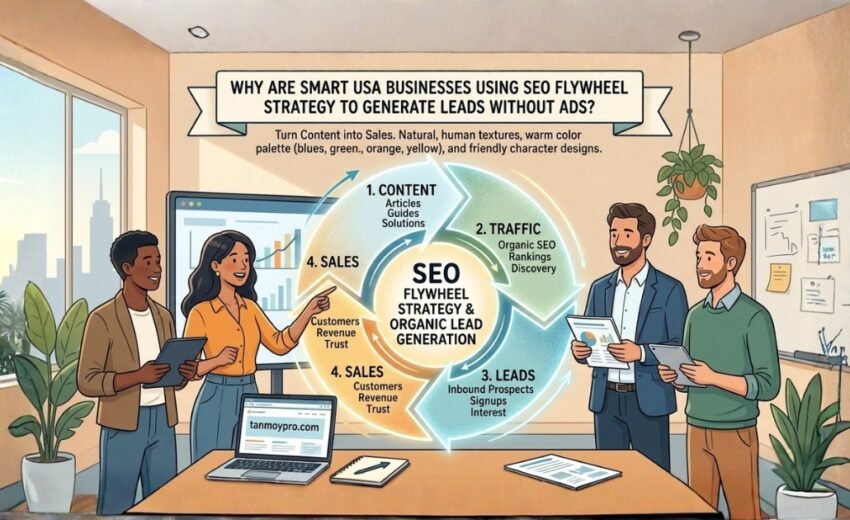
SEO Flywheel Strategy is the secret weapon for smart USA businesses today. Many founders are tired of paying for expensive ads that stop working the moment you stop paying. That is why they are switching to the flywheel model. Unlike a traditional funnel, the SEO flywheel builds momentum over time. Every piece of content you create and every visitor you get makes the system spin faster and stronger.
If you have already built a conversion-first website, you know that a good design is only half the battle. You need a consistent flow of organic traffic to keep the engine running. This strategy helps you generate high-quality leads without spending a single dollar on Google or Facebook ads. It is about working smarter, not harder, to own your market for the long term.
Every dollar you spend on paid ads disappears the moment your campaign pauses. No residual value. No compounding returns. Just a receipt and silence. For thousands of US businesses, that reality is becoming impossible to ignore — and the scramble to find a better model is accelerating fast.
The core tension comes down to mindset: the ‘Ad Tax’ vs. ‘Asset Building’. Paying for clicks is essentially renting traffic — you never own the audience, you never build equity, and the landlord (the ad platform) can raise rates whenever it wants. What was profitable at a $20 cost-per-click in 2022 may be unsustainable at $40 today. Linear growth models that depend entirely on paid acquisition scale costs at the same rate they scale revenue, creating a ceiling that’s getting harder to break through.
The numbers tell a stark story. According to Terakeet, organic search leads cost an average of just $14 compared to $44 for PPC — a significant reduction in customer acquisition cost. That gap isn’t a rounding error; it’s a strategic opportunity.
Smart businesses don’t just cut ad spend — they redirect it toward assets that generate returns long after the investment stops.
This is where flywheel marketing enters the conversation. Rather than a linear funnel that burns budget at every stage, the flywheel model aims to build momentum over time — each piece of content, each backlink, each organic lead feeding energy back into the system.
That mechanism deserves a much closer look.
What is the SEO Flywheel? Moving Beyond the Funnel
SEO Flywheel Strategy is the secret weapon for smart USA businesses today. Many founders are tired of paying for expensive ads that stop working the moment you stop paying. That is why they are switching to the flywheel model. Unlike a traditional funnel, the SEO flywheel builds momentum over time. Every piece of content you create and every visitor you get makes the system spin faster and stronger.
If you have already built a conversion-first website, you know that a good design is only half the battle. You need a consistent flow of organic traffic to keep the engine running. This strategy helps you generate high-quality leads without spending a single dollar on Google or Facebook ads. It is about working smarter, not harder, to own your market for the long term.
Funnel vs. Flywheel: A Direct Comparison
| Traditional Funnel | SEO Flywheel |
|---|---|
| Linear, top-to-bottom flow | Circular, self-reinforcing loop |
| Resets after each conversion | Compounds over time |
| Paid input required at every stage | Organic momentum reduces ongoing spend |
| High cost per lead remains constant | Cost per lead decreases as authority grows |
| Stops when budget stops | Continues generating traffic without active spend |
The Zero Marginal Cost Effect: A mature SEO flywheel operates on ‘zero marginal cost,’ meaning additional leads cost nothing once a content asset ranks. Your 1,000th organic lead this month costs the same to acquire as your 10,000th — essentially zero.
Many small business owners in the USA assume that an SEO Flywheel Strategy is only for giants like Amazon. They think you need thousands of dollars to see results. But here is the truth: you don’t need an enterprise-level budget to make the wheel spin. In fact, a smaller operator often has the advantage of being more niche and personal.
The key isn’t how much money you spend, but how you build the foundation. When you focus on solving specific problems for your customers through quality content, the wheel starts moving. As your content ranks, it brings in traffic. That traffic turns into leads, and those leads provide the revenue to create even better content. You are essentially building a startup marketing engine that scales with you. Instead of renting traffic from ads, you are building an asset that you own forever.
Why Every Small Business and Startup Needs a Content Flywheel
If the previous sections established what the SEO flywheel is, this one answers who it’s actually for. The short answer: any business that doesn’t have an unlimited ad budget — which is virtually every small business and startup in America.
The Moat
Large incumbents can outspend you on paid ads tomorrow. They cannot, however, retroactively publish three years of authoritative, trust-building content. That historical depth is the moat — and it’s one competitors simply can’t buy overnight.
Building a defensible content moat means:
- Ranking for high-intent keywords before better-funded rivals even notice the opportunity
- Earning backlinks and domain authority that accumulate over time, not overnight
- Creating brand recognition with your audience that paid impressions rarely replicate
The Compounding Effect
Content is the closest thing to compounding interest that marketing offers. A blog post published today can generate traffic in month one, rank higher in month six, and attract backlinks in year two — all without additional spend. Starting early is the only way to win this game, because every month you wait is a month your competitors are building their own lead.
According to HubSpot, SEO-generated leads close at a 14.6% rate — nearly nine times higher than the 1.7% close rate of traditional outbound tactics. That’s not a marginal advantage. That’s a structural one.
The Capital Efficiency
For startups operating on lean budgets, capital efficiency isn’t optional — it’s survival. Paid ads require continuous funding to produce results. Content, once created and optimized, works indefinitely.
The case for content over ads on a tight budget:
- Lower cost-per-acquisition over a 12-to-24-month horizon
- Assets that retain value even when marketing budgets contract
- Organic traffic that doesn’t spike and crash with campaign schedules
In practice, a single well-researched pillar page can outperform months of paid spend on the same keyword. That’s the real promise of the SEO flywheel for resource-constrained businesses.
Of course, generating this kind of organic momentum requires your sales team to be ready to act on it — and that’s exactly where the next piece of the puzzle comes in.
The 3-3-3 Rule: Aligning Your Sales Team with the Flywheel
The flywheel generates momentum — but momentum only converts when your sales process is sharp enough to catch it. That’s where the 3-3-3 rule comes in.
The 3-3-3 rule is a high-intensity follow-up strategy designed to capture lead intent before it cools. It works like this:
The First “3” — Three Follow-Ups: Reach out at least three times after initial contact. Most leads don’t convert on the first touch, and persistence signals professionalism, not desperation.
The Second “3” — Three Platforms: Spread those follow-ups across three channels — email, phone, and social (LinkedIn is particularly effective for B2B). Meeting prospects where they already spend time dramatically increases response rates.
The Third “3” — Three Days: Execute all three follow-ups within a three-day window. Lead intent degrades fast. A prospect who downloaded your guide on Tuesday is far more receptive on Wednesday than the following Monday.
The real magic of an SEO Flywheel Strategy is the quality of the leads. When a lead enters your pipeline, they aren’t a stranger. They have already spent time with your brand. They’ve read your guides, watched your tips, and learned from your expertise. Your sales team doesn’t have to struggle with “cold-calling.” Instead, they are talking to people who already trust you.
This creates a perfect loop. When your sales team shares what customers are asking, your content team can write exactly what the market needs. For example, if a customer asks about costs, you write a pricing guide. This integration is the only way to stop burning cash on ads that don’t convert. When your sales and content work together, the flywheel spins faster, making every dollar of your effort worth much more than a temporary paid click.
SEO vs. Paid Ads: The Financial Reality in 2025
The 3-3-3 rule helps your sales team convert flywheel momentum into revenue — but that momentum only makes financial sense if the underlying acquisition model is sound. So let’s get specific about the numbers.
| Metric | Paid Ads | SEO Flywheel |
|---|---|---|
| Cost structure | Variable (scales with spend) | Fixed investment + compounding returns |
| Lead cost over time | Increases as competition rises | Decreases as authority builds |
| Traffic when budget stops | Drops to zero immediately | Continues generating visits |
| Average cost per lead | ~$44 per lead (PPC) | Declines significantly over 12–24 months |
| Time to results | Immediate | 3–12 months |
| Long-term asset value | None | High (domain authority, content library) |
According to Terakeet, PPC leads average $44 per lead — a cost that doesn’t shrink as your business grows. In fact, it typically rises. As more competitors bid on the same keywords, your cost-per-click climbs, your margins compress, and you’re running faster just to stay in place. That’s the Ad Spend Trap in its simplest form: a variable cost that scales directly with revenue ambition.
Organic lead generation operates on an entirely different economic logic. The content you publish in month one is still working in month twenty-four, without an additional invoice attached. In practice, the cost per lead from SEO drops over time as your content compounds — more pages, more backlinks, more authority, more traffic from a fixed base of investment. That’s margin protection, not just marketing strategy.
However, this doesn’t mean paid ads have no place. One practical approach is using PPC to generate immediate pipeline while the flywheel builds momentum — treating ad spend as a bridge, not a foundation. The critical distinction is intent: ads as a temporary accelerant, not a permanent crutch.
As you optimize your acquisition mix for 2025, it’s also worth asking where search itself is heading — because the definition of “ranking” is changing faster than most businesses realize.
Future-Proofing: AEO and the Rise of Zero-Click Searches
The financial case for SEO over paid ads is clear — but the search landscape itself is shifting beneath everyone’s feet. Optimizing for traditional blue-link clicks is no longer enough. The next evolution of the flywheel demands that smart businesses adapt to a world where the search engine becomes the answer.
The Zero-Click Reality
Zero-click searches — where users get their answer directly on the results page without clicking through — jumped from 56% in 2024 to 69% in 2025, according to CXL. That’s a staggering shift. For businesses still measuring SEO success purely by click volume, this trend looks alarming. In practice, however, it represents a massive opportunity for brands willing to adapt. Visibility is the new currency, and Answer Engine Optimization (AEO) is how you earn it.
Mastering AEO
AEO is the practice of structuring your content so that AI-powered engines — Google’s AI Overviews, ChatGPT, Perplexity, and others — pull from your material when generating answers. The goal isn’t just to rank. It’s to become the cited source. Businesses that achieve this earn brand impressions at scale, often without a single click being exchanged. A common pattern is that brands appearing consistently in AI-generated responses see downstream increases in direct search and branded traffic — both signals that lower customer acquisition cost over time. To master AEO, prioritize clear, structured answers within your content: use concise definitions, FAQ formats, and authoritative data that AI systems can easily parse and attribute.
Measuring Success Beyond the Click
The flywheel mindset requires a broader measurement framework. Track brand search volume, AI citation frequency, and share-of-voice alongside traditional traffic metrics. What typically happens is that businesses clinging to click-through rate as their north star miss the compounding brand authority being built in the background.
Adapting now positions your flywheel to spin even faster — which is exactly the foundation you’ll need as you map out your first 90 days of momentum.
Conclusion: How to Build Your First 90 Days of Momentum
The flywheel isn’t just a metaphor — it’s also a financial strategy. Across every section of this guide, one truth has emerged consistently: when you weigh SEO vs paid ads, you’re really choosing between renting attention and owning it. The compounding authority and the AEO positioning — none of it happens overnight. But as the saying goes, “The hardest part of a flywheel is the first turn; after that, the weight of your authority does the work for you.”
Here’s how to make that first turn count:
Your First 90-Day Flywheel Checklist:
- Audit your Ad Tax exposure — Calculate what percentage of your traffic disappears if you pause paid spend today.
- Identify your Hub content — Pick one cornerstone topic your audience genuinely searches for.
- Publish consistently — Commit to a realistic content cadence you can sustain for 6–12 months.
- Track compounding signals — Monitor organic impressions, not just rankings.
Consider building assets instead of solely buying leads. Investing in SEO can be seen as building equity — not an expense that expires at midnight.


May 14, 2026