

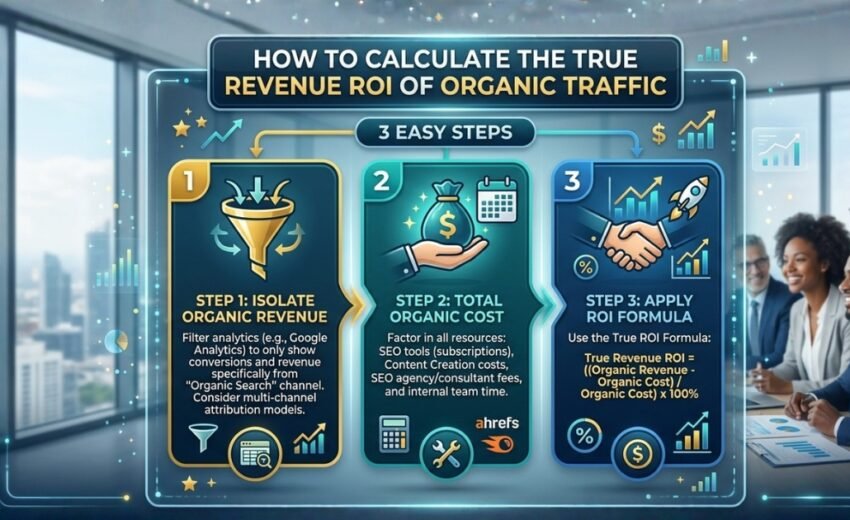
Organic Traffic revenue tracking is the single most important metric that separate amateur bloggers from high-level growth strategists in 2026. While many USA founders obsess over day-to-day impressions in Google Search Console, they fail to connect those numbers directly to actual dollar values. Renting temporary attention from ad networks feels fast, but it constantly destroys your long-term capital efficiency. If you want to break free from these unpredictable paid acquisition channels, learning how to build a compounding seo flywheel to escape the ad spend trap is your best strategic move. Measuring your search value transforms your web presence from a passive cost center into a predictable pipeline. However, if your data tracking setup is inaccurate, your entire inbound engine will fall flat. In fact, driving raw visitors to a slow or broken site is completely pointless, which is why your strategy will always fail without a solid technical seo foundation to back it up. Let’s break down the 3 easy steps to accurately calculate, monitor, and prove the real revenue impact of your organic search visitors.
Why Vanity Metrics Are Killing Your Startup’s Growth Strategy
Ranking on page one means nothing if the Organic Traffic it sends you never spends a dollar.
Thousands of founders celebrate a spike in organic visits, only to watch their revenue flatline. The culprit is almost always the same: a growth strategy built around visibility rather than value. Converting your raw Organic Traffic into reliable sales pipelines isn’t a technical exercise — it’s the difference between a business that scales and one that simply looks busy.
Ghost traffic is one of the most quietly destructive forces in early-stage growth. These are visitors who land on your pages, satisfy a curiosity, and leave — no sign-up, no purchase, no intent to return. They inflate your analytics dashboard while contributing nothing to your bottom line. As Neil Patel puts it directly: “The goal of SEO is not just to rank, but to generate revenue. If you aren’t tracking conversions back to specific organic landing pages, you aren’t measuring ROI.” Founders who skip this step are essentially navigating with a broken compass.
The deeper problem is a mindset trap. When visibility becomes the primary goal, the question shifts from “is this generating revenue?” to “are we ranking higher?” Those two questions lead to fundamentally different strategies. High-intent Organic Traffic should function as a sustainable engine for business growth — one that compounds over time precisely because it’s built around what your buyers actually need, not what looks impressive in a monthly report.
Shifting from rankings to revenue requires treating SEO as a business development system, not a traffic acquisition game. That reframe starts with one honest question: how do you actually calculate what your Organic Traffic is worth? To answer it properly, you need a formula — and that means getting clear on every dollar going in before you can measure what comes back out.
The Foundational Formula: Calculating Net SEO Profit
To calculate SEO ROI accurately, you need one equation and three honest inputs — anything less is just measuring noise.
Most founders fixate on traffic volume or keyword rankings without ever asking the harder question: after paying for everything, did our Organic Traffic actually make money? That shift in thinking starts with the formula.
Net SEO ROI = (Organic Revenue − Total SEO Cost) ÷ Total SEO Cost
Total SEO Cost is where most calculations go wrong. It isn’t just your agency retainer. It includes content creation fees, copywriter rates, SEO tooling subscriptions, internal staff hours, and any technical development work tied to optimization. According to Search Engine Journal, businesses must subtract all of these costs from organic revenue before dividing — not just the most visible line item on the invoice. Undercount your costs and your ROI looks flattering; undercount it consistently and you’ll make investment decisions on bad data.
Organic Revenue sounds straightforward but carries its own traps. Gross traffic value — the estimated worth of your clicks if you’d paid for them via ads — is a popular metric that means very little for small and mid-sized businesses. A startup capturing 10,000 monthly visitors in an informational niche may generate a fraction of the revenue that 800 high-intent visitors produce for a competitor. Revenue, not traffic replacement value, is the number that matters when auditing your Organic Traffic funnel. The nuances of assigning accurate dollar figures to different traffic types are worth exploring carefully, and that’s exactly where the next step in this framework picks up.
Tracking period is the third variable people consistently misconfigure. SEO compounds over time — a piece of content published today may not reach peak revenue contribution for six to twelve months. A 90-day window will almost always understate ROI. Set your measurement period to a minimum of six months, and compare consistent windows year-over-year to surface the compounding effect rather than obscure it. As customer acquisition costs climb across paid and organic channels alike, getting this baseline math right becomes non-negotiable.
Step 1: Assigning Real Value to Your Organic Traffic
Organic Traffic only becomes a business asset when you can attach a dollar figure to it — and that process starts with three concrete data points.
With organic search driving 53.3% of all trackable web traffic on average, according to BrightEdge, it’s clearly the dominant acquisition channel for most startups. Yet most founders rely on raw visitor counts in their seo reporting metrics rather than translating that Organic Traffic into meaningful revenue potential. Fixing that starts with knowing what your clicks are actually worth.
| Metric | How to Find It |
|---|---|
| Search volume for core keywords | Google Search Console, keyword research tools |
| Cost-per-click (CPC) for equivalent terms | Google Ads Keyword Planner, paid campaign data |
| Organic click-through rate by ranking position | Google Search Console performance report |
| Estimated traffic replacement value | CPC × monthly organic clicks |
The replacement value method is the most grounded approach available: pull the CPC for your top commercial keywords from any PPC platform, then multiply that figure by your monthly organic click volume. The result is what you’d pay in paid ads to receive the same traffic. For a keyword with a $4.50 CPC and 800 monthly organic clicks, that’s $3,600 in equivalent paid spend — every month, for free.
The “Optimist” method builds on this by weighting your traffic toward high-intent pages. Not every visitor carries equal value. A user landing on a pricing page or a product comparison post is far closer to a purchase decision than someone reading a general how-to article. Separating transactional traffic from informational traffic — and assigning different dollar values to each — produces a far more honest picture of your Organic Traffic ROI. If you’re also running a technical audit of your commercial pages, that segmentation data becomes even more actionable.
Understanding what your traffic is worth per click is only half the equation, though. The other half is knowing how many of those clicks actually become customers — which is exactly where most funnels quietly fall apart.
The Conversion Gap—From Clicks to Customers
Organic Traffic converts differently than any other channel — and understanding that gap is central to how to calculate SEO ROI with real precision.
Organic leads close at 14.6%, compared to just 1.7% for outbound tactics like direct mail or print advertising, according to HubSpot via Disruptive Advertising. That’s not a marginal difference — it’s a structural advantage built into how search intent works. Someone who finds your page through a targeted keyword is already mid-funnel before they read a single word.
Track: Establishing Your Baseline Conversion Data
Before you can close the gap, you need to measure it. Start by isolating Organic Traffic as its own segment in your analytics platform and attaching specific conversion goals — form fills, purchases, trial sign-ups — to that segment exclusively. Generic site-wide conversion rates will dilute your SEO signal.
- Set up goal completions filtered by organic source/medium
- Compare organic conversion rate against paid and direct traffic benchmarks
- Monitor landing page conversion rates for your top-ranking URLs separately
Analyze: Why Organic Leads Outperform
Brand trust is the invisible multiplier in organic conversion. A visitor who found you on page one of search results arrives with implicit credibility already attached — they didn’t click an ad, they were earned. That perception lowers friction throughout the funnel. Thoughtful web design choices — load speed, visual hierarchy, clear CTAs — compound this trust further, making each organic session more likely to convert.
- Cross-reference keyword intent with on-page messaging alignment
- Identify pages where organic sessions are high but conversions are low
- Flag trust signals: testimonials, certifications, and social proof placement
Optimize: Tightening the Gap
Once you’ve identified where organic visitors drop off, you can act systematically. High CTR from search doesn’t guarantee conversion — the handoff between the SERP promise and the landing page experience matters enormously to your total Organic Traffic health.
- A/B test headlines that match the search query language exactly
- Reduce steps between landing and conversion action
- Use heatmaps to locate friction points on high-traffic organic pages
Fixing the conversion gap at this stage dramatically sharpens your revenue attribution — which matters even more when you factor in what each converted customer is actually worth over time.
Factoring in Customer Lifetime Value (LTV)
The first transaction from an organic visitor is only the tip of the ROI iceberg — the real revenue story unfolds over months and years of repeat purchases, referrals, and upsells.
Most founders make the mistake of measuring SEO success against a single sale. When you do that, you’re evaluating a long-game channel with short-game math. The Organic Traffic conversion rate matters, but what happens after that conversion matters just as much.
Organic vs. paid cohorts tell different LTV stories. In practice, organic visitors who find your content through genuine search intent tend to arrive better informed and more motivated. That translates to higher average order values and stronger retention compared to cold paid traffic. To calculate LTV by acquisition channel, pull cohort data from your CRM: segment customers by source, then multiply average purchase value by purchase frequency by average customer lifespan. When you run that math separately for organic and paid cohorts, the gap is often significant — and almost always favors organic.
“SEO is the only channel where you can own the real estate permanently — and that compounds into customer relationships, not just clicks.” — Siteimprove on long-term SEO value
The 80/20 rule applies directly here. According to Megrisoft, the 20% of organic content driving 80% of revenue usually targets high-intent, high-LTV segments. Identifying those pages and doubling down — rather than spreading effort thin across hundreds of low-value keywords — is where your Organic Traffic strategy gets truly profitable.
This compounding effect also reshapes your Customer Acquisition Cost. As organic rankings stabilize, CAC begins to fall because you’re no longer paying per click to reach the same audience. Brands that invest consistently in SEO often see CAC reductions that make paid channels look unsustainable by comparison.
“Organic search builds an asset — paid search rents one.” — A principle reinforced by virtually every sustainable growth model.
Common Pitfalls: Why Your ROI Calculations Might Be Lying
Knowing how to calculate the value of Organic Traffic means nothing if the numbers feeding your formula are distorted from the start. As Google Research notes, marketing ROI becomes actively misleading when it doesn’t account for total campaign costs weighed against genuinely incremental sales — and SEO reporting is especially prone to this kind of quiet distortion.
The most dangerous ROI errors aren’t big mistakes — they’re small, systematic biases that compound over time.
Here are four pitfalls that routinely skew organic ROI calculations:
- The attribution model trap. Last-touch attribution assigns 100% of conversion credit to the final click — often a branded search or a retargeting ad — while completely erasing the organic article that started the buyer’s journey three weeks earlier. If your analytics defaults to last-touch, SEO will always look undervalued. Fix it: switch to a data-driven or linear attribution model so organic content gets credit for the awareness it generates.
- Ignoring assisted conversions. SEO frequently acts as the first touchpoint in multi-session journeys, warming up prospects who convert later through other channels. Stripping out assisted conversion value can cut your reported organic revenue by 40% or more. Fix it: audit your assisted conversions report in Google Analytics and fold that figure into your total SEO revenue estimate.
- Unfiltered traffic geography. A spike in organic sessions looks impressive — until you realize a third of those visitors are from countries you don’t serve and can’t convert. Fix it: segment traffic by target geography before reporting, and build your ROI model on qualified sessions only.
- Brand-name searches inflating organic totals. When branded queries sit inside your organic report, you’re partially crediting SEO for recognition that advertising or word-of-mouth created. Fix it: filter branded keywords out of your non-branded organic metrics so you’re measuring true discovery-driven traffic.
Correcting these four biases transforms organic ROI from a vanity number into a reliable signal — the kind a sustainable organic growth strategy can actually be built around. With clean inputs in place, the next challenge is deciding who interprets that data and turns it into action.
The Growth Strategist’s Edge: Building Scalable Systems
True SEO ROI isn’t unlocked by better data alone — it’s unlocked when that data is connected to a strategy built to compound over time.
Technical execution must serve business strategy, not the other way around. Too many startups treat SEO as a checklist: fix crawl errors, compress images, build a few links, repeat. But technical improvements that aren’t tied to revenue goals are just maintenance, not growth. For example, improving your site’s core performance metrics like LCP and INP isn’t just about search rankings — it directly reduces bounce rates, improves conversion probability, and lowers your effective customer acquisition cost. That’s the difference between a technician running audits and a growth strategist building systems.
A growth strategist’s job is to interpret ROI signals, not just report them. Raw data — traffic, rankings, goal completions — tells you what happened. A strategist tells you why, and more importantly, what to do next. This is where smaller teams can actually outmaneuver larger competitors with bigger budgets. A lean startup that analyzes which landing pages drive the highest LTV customers, then doubles down on those pages, will consistently outperform a bloated team running generic campaigns. As Siteimprove notes, understanding SEO ROI requires moving beyond vanity metrics toward business-level outcomes — exactly the lens a growth strategist applies.
Moving from one-off audits to continuous growth loops is what separates sustainable digital systems from short-term wins. A growth loop means your ROI data feeds back into your content and technical strategy each month, creating compounding returns. Tanmoypro is built on this principle — combining high-level business development strategy with technical execution to create systems that don’t just rank, they convert and retain. When you reach the point of tying every strategic decision back to measurable revenue output, you’re ready to step back and assess the full picture — which is exactly where the key takeaways ahead will land.
The Bottom Line: Key Takeaways for Founders
Organic Traffic is not a marketing expense — it’s a compounding asset, and measuring it correctly changes every budget decision you make.
With 53.3% of all trackable web traffic coming from organic search, the channel isn’t optional for founders who want scalable, cost-efficient growth. But traffic alone is a vanity metric. What separates high-performing SEO programs from underperforming ones is how rigorously the revenue math gets applied.
Here are the core principles this article has built toward:
- SEO ROI starts with a clean formula. Revenue generated from organic traffic, minus total SEO costs, divided by those costs — that’s your baseline. Without this number, you’re guessing.
- Organic leads convert at a fundamentally different rate. A common pattern in the data shows organic leads close at roughly 14.6%, nearly nine times higher than outbound leads. That gap belongs in every board-level conversation about channel investment.
- True revenue tracking requires connecting your landing pages to CRM outcomes. Pageviews don’t pay salaries. Mapping specific entry points to pipeline stages and closed deals is the only way to attribute real dollars to organic effort.
- Customer Lifetime Value reframes the entire investment. When you calculate SEO ROI through LTV rather than first-purchase revenue, the compounding nature of the channel becomes impossible to ignore. A customer acquired for $40 in organic cost who spends $2,400 over three years is a fundamentally different number than any single-session metric reveals.
Understanding these four principles isn’t the finish line — it’s the starting point for an honest assessment of where your current system is leaking. Building a site that converts organic visitors into measurable revenue is the structural work that makes all of this math actually matter. In the next section, you’ll find a practical framework for auditing exactly that.
Next Steps: Auditing Your Digital Growth System
Knowing the formulas is only half the work — the other half is systematically finding where your current system is bleeding revenue before you can fix it.
Use this checklist to begin:
- Baseline SEO audit first. Identify crawl errors, thin content, and broken conversion paths before you touch anything else. You cannot measure improvement without knowing your starting point.
- Map your funnel leakages. Pinpoint pages where organic visitors are landing but not converting. High traffic with low conversion rate signals a messaging or UX problem, not an SEO problem.
- Set a 90-day tracking window. SEO ROI rarely shows up in 30 days. A 90-day window gives you enough data to separate trend lines from noise and make confident budget decisions. Proving marketing ROI requires patience and clean attribution — build both into your process from day one.
- Track revenue, not just rankings. Connect organic sessions to pipeline value in your analytics setup so every optimization has a dollar figure attached.
- Expand beyond Google. Organic search increasingly means diversified discovery. Understanding how retail-driven platforms are gaining ground helps you capture demand across the full digital landscape.
When your audit reveals systemic issues — technical debt, poor site architecture, or misaligned content strategy — that’s when a specialist pays for itself. Tanmoypro offers SEO audits and professional web development built specifically for startups that need scalable systems, not one-off fixes.
Organic search is one of the few channels where effort today creates compounding returns for years. Every optimized page, every properly tracked conversion, every strategic content decision builds an asset your competitors cannot simply outspend overnight. Start the audit, run the numbers, and treat your organic presence for what it truly is — a long-term growth engine worth investing in seriously.
Ready to Turn Your Organic Traffic into a Predictable Revenue Engine?
Stop wasting capital on temporary ad campaigns. Let’s audit your current digital systems, fix your conversion leaks, and build a scalable SEO flywheel tailored for long-term startup growth.

June 6, 2026
5 Proven Ways to Align Enterprise Sales Pipeline...

June 6, 2026