
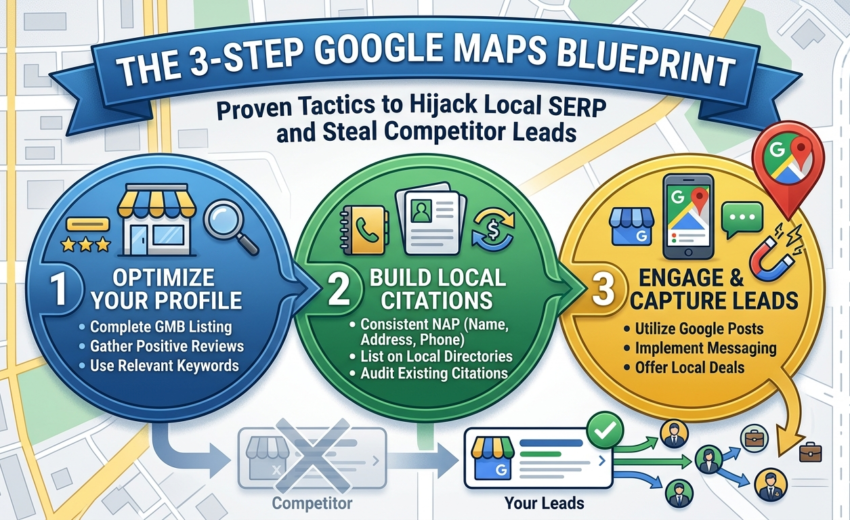
Implementing a bulletproof Google Maps Blueprint is the fastest way for USA businesses to dominate local search results and capture high-intent buyers before competitors even get a chance. In an era where the death of local ads has forced smart founders to abandon expensive paid campaigns, securing a spot in the local 3-pack is no longer optional—it is a survival requirement. If you want to stop chasing clients and build an automated lead generation machine, this 3-step guide will show you exactly how to hijack the local SERP and scale your revenue organically.
Why Proximity Isn’t Destiny in the Local 3-Pack
Your business could be one block away from a potential customer and still lose the lead to a competitor miles across town. That’s the uncomfortable reality of local SEO — and it’s exactly why understanding the Map Pack is worth your full attention.
42% of local searchers click on a result within the Google Map Pack — not the organic results below, not a paid ad. That three-slot display at the top of Google’s local results is prime real estate, and whoever owns it controls a massive share of inbound leads in any given market.
Google determines who earns those three spots using three core pillars: Proximity, Relevance, and Prominence. Proximity is how close your business is to the searcher. Relevance is how accurately your digital presence signals what you do and who you serve. Prominence reflects your authority — reviews, backlinks, citations, and engagement signals that tell Google you’re the real deal.
Here’s the critical insight most business owners miss. As Darren Shaw, Founder of Whitespark, puts it: “Proximity is the #1 ranking factor for local search, but relevance and prominence are the levers businesses can actually control to outrank closer competitors.”
Proximity is fixed. You can’t move your office. But relevance and prominence? Those are entirely engineerable. A business with stronger digital signals — tighter category alignment, richer content, and authoritative reviews — can consistently outrank a geographically closer competitor. Understanding how your digital signals convert into actual leads makes the difference between a map listing and a booked appointment.
This is the concept of “hijacking” leads: systematically building superior signals until Google has no choice but to show your business first. The question is how to do it efficiently — and that’s exactly what the blueprint ahead addresses.
The 3-Hour Local Maps SEO Blueprint: A Strategic Overview
Winning the Local Pack isn’t about a months-long overhaul — it’s about executing the right moves, in the right order, faster than your competition does.
The core insight: structured, phased execution beats scattered effort every time. Here’s how to compress meaningful google business profile optimization work into a focused three-hour window:
- Phase 1 — Technical Foundation and Profile Audit (Hour 1). Start by auditing your Google Business Profile for accuracy gaps, duplicate listings, and category misalignment. Verify your NAP (Name, Address, Phone) consistency across every directory that feeds Google’s data ecosystem. This phase is non-negotiable — everything built on a shaky foundation collapses under competitive pressure. According to the Whitespark Local Search Ranking Factors Study, profile completeness and primary category selection rank as the top two signals influencing Local Pack placement.
- Phase 2 — Content and Relevance Layering (Hour 2). Add keyword-informed service descriptions, upload geo-tagged photos, and publish at least one GBP post. This signals active engagement to Google’s algorithm. Relevance is built through specificity — generic descriptions don’t differentiate; detailed, service-rich content does. Brands embracing structured content frameworks consistently outpace competitors still relying on thin, outdated profiles.
- Phase 3 — Authority and Prominence Building (Hour 3). Solicit recent reviews with response templates ready, build citations on high-authority local directories, and identify local backlink opportunities. Prominence is Google’s measure of how well-known your business is — and it’s actively influenced by off-profile signals.
In competitive local markets, speed of execution creates a compounding advantage. The business that completes this framework first establishes ranking momentum that becomes progressively harder for slower competitors to displace. The specific profile-level decisions made in Phase 1 — particularly category selection — carry disproportionate ranking weight, which is exactly where we’ll go next.
Mastering the Top 3 Ranking Factors for Google Business Profiles
Three profile elements drive the majority of Google Maps SEO outcomes — and most businesses get at least one of them wrong from day one.
Primary Category Selection is the single highest-leverage decision you’ll make on your Google Business Profile. According to the Whitespark Local Search Ranking Factors Study, primary category selection is the most influential on-page factor for local rankings — yet a common pattern is choosing a category that feels intuitive rather than one that matches actual search demand. Example scenario: a remodeling company selects “Contractor” when “Kitchen Remodeler” maps directly to their most profitable service. That mismatch quietly bleeds rankings every single day.
Business Name Optimization is where founders frequently overreach. Adding keyword-heavy descriptors to your business name can trigger a suspension or a quality review flag. The smarter approach is ensuring your brand name reflects what you do without manufactured stuffing. If your real business name is “Apex Home Services,” that’s what belongs in the name field — keywords belong in your description, services, and posts.
Profile Completeness functions as an algorithmic trust signal. Google rewards businesses that provide a complete picture: hours, attributes, service areas, photos, and a populated Q&A section. A sparse profile signals uncertainty to the algorithm. In practice, profiles with complete information are significantly more likely to surface across a wider range of local queries.
Pro-Tip: Profile completeness also strengthens your visibility on AI answer engines. A well-structured profile gives platforms parsing local data — from Google’s own AI Overviews to third-party tools — clean signals about who you serve and where.
How your website reinforces these signals is equally critical, which is exactly where structured data on your site connects everything together — and leads directly into the technical layer covered next.
The Technical Edge: A Super Simple Guide to Local Schema
Schema markup is the silent translator that tells Google — and AI platforms — exactly who you are, what you do, and where you do it. Most businesses competing for google maps ranking skip this step entirely, handing a quiet technical advantage to whoever gets it right first.
LocalBusiness Schema is structured data embedded in your website’s code. Think of it as a machine-readable business card. While your visible webpage content communicates with human readers, Schema communicates directly with search engines — removing any ambiguity about your business identity. According to Authority Echo, structured data helps search engines verify the accuracy of your GBP data, directly increasing prominence scores.
Why this matters for AI: Platforms like ChatGPT and Google’s AI Overviews increasingly pull local business data from structured sources. A properly marked-up site gives these systems the confidence to surface your business in conversational and visual queries — areas where optimizing for AI-driven discovery is becoming a real competitive edge.
The core Schema properties you must implement:
- name — Your exact business name, matching your GBP exactly
- address (streetAddress, addressLocality, postalCode) — Your full NAP, consistent across every platform
- telephone — Primary local phone number
- openingHoursSpecification — Days and hours formatted correctly
- geo (latitude/longitude) — Precise coordinates that anchor your physical location
- areaServed — Defines your service radius for non-storefront businesses
On-site technical health and Map Pack performance are directly connected. A mismatch between your Schema NAP and your GBP listing creates conflicting signals that erode trust scores. Consistency is the mechanism — not complexity.
Once your technical foundation is locked in, the next lever that separates Map Pack winners from also-rans is something far more visible to customers: your review presence and the momentum behind it.
Stealing Competitor Leads Through Review Velocity and Volume
Reviews aren’t just social proof — they’re a direct ranking lever that converts Google Business Profile SEO performance into measurable revenue growth.
Businesses with more than 80 Google reviews earn 54% more annual revenue than the average business — a finding from Womply that reframes how founders should prioritize review generation. That number alone justifies treating reviews as a core growth function, not an afterthought.
Review Velocity matters more than raw volume over time. A competitor sitting at 200 reviews but collecting just two per month is actually vulnerable. A newer profile earning 15–20 reviews monthly signals active customer engagement to Google’s algorithm — and that freshness factor compounds. In practice, consistent velocity communicates that a business is relevant right now, which directly influences local pack placement.
Responding to reviews is an underused keyword optimization opportunity. When you reply, naturally weave in your service category, neighborhood, or location — phrases like “glad we could help with your HVAC repair in downtown Austin” do quiet but real work for topical relevance. It’s a habit that costs nothing and compounds over months. If you’re still unsure why your profile isn’t gaining traction, this breakdown of local visibility gaps covers several overlooked culprits.
Fake review attacks — a tactic some bad actors use against competitors — should immediately trigger a defensive audit. When a cluster of low-rated, unverifiable reviews appears suddenly, flag them for removal through Google and document the pattern. More importantly, use the incident as motivation to accelerate your own legitimate review velocity. A high volume of authentic, recent reviews is the best buffer against manipulation.
As the local signals get stronger, the next question becomes whether map visibility alone is enough — and increasingly, it isn’t.
Beyond the Map: Integrating AEO for Sustainable Visibility
Winning the local 3 pack in 2025 is no longer a standalone goal — it’s the entry point to a much larger visibility battle playing out inside AI-generated answers.
Traditional SEO tactics — keyword stuffing, basic citation building, a few reviews — delivered results in a simpler era. Today, AI platforms like Google’s Search Generative Experience and ChatGPT’s browsing mode actively synthesize local business information from multiple signals. Critically, AI platforms often fail to surface brands that lack structured data or authoritative local mentions. If your business isn’t engineered for this new layer, competitors who are will own the conversation before a user ever clicks anything.
Answer Engine Optimization (AEO) is what bridges the gap between showing up on the map and showing up in the answer.
Here’s how traditional SEO and AEO differ in practice:
| Signal | Traditional SEO | AEO |
|---|---|---|
| Primary goal | Blue-link ranking | AI summary inclusion |
| Content format | Keywords + backlinks | Structured, quotable answers |
| Schema usage | Optional enhancement | Core requirement |
| Review signals | Ranking factor | Trust validation for AI |
| Success metric | Page position | Brand mention in AI output |
The ‘Digital Growth’ framework connects web performance — fast load times, clean architecture, structured data — directly to local discovery outcomes. A technically sound website doesn’t just satisfy Google’s crawlers; it gives AI platforms the clean, reliable signals they need to confidently recommend your business over a competitor’s.
For founders ready to move beyond reactive fixes, this means partnering with a technical team that understands both layers. You can explore how this integrated approach works inside a founder-focused growth system built for exactly this environment.
The next frontier, however, goes even deeper — into hyperlocal content strategies that can multiply your keyword footprint across every neighborhood you serve.
Hyperlocal Content: Ranking for Thousands of Keywords
Hyperlocal content lets a single business location compete for hundreds of distinct keyword variations by signaling deep geographic authority across neighborhoods, landmarks, and service corridors.
The “Driving Directions” strategy is one of the most underused tactics in local SEO. By weaving in nearby landmarks — “two blocks from Riverside Park,” “serving clients near the downtown transit hub” — your page content mirrors the exact language real searchers use. Hyperlocal website optimization involves creating content that signals geographic authority to the algorithm, and landmark references do exactly that without sounding forced.
Tactic 1: Drop three to five neighborhood-specific landmarks into every service-area landing page. Use them in body copy, image alt text, and your meta description to reinforce geographic relevance at every signal layer.
Service-area pages are powerful — but Google penalizes thin “doorway pages” that exist purely to rank. The difference is depth. A legitimate service-area page includes a local case study, a genuine customer outcome tied to that zip code, and unique supporting copy. That combination builds what Google formally classifies as Prominence, the measure of how well-known and trusted a business is in a specific area.
Tactic 2: Publish one local case study per service area. Include the neighborhood name, the problem solved, and a measurable result. This is content that earns citations, backlinks, and trust simultaneously.
Tactic 3: Treat every local landing page as a performance asset. Slow load times kill conversions before rankings even matter — high-performance web development is non-negotiable for local pages competing in dense markets.
For businesses investing in AEO consulting, this same hyperlocal content framework feeds AI answer engines with structured, place-specific context — compounding your visibility well beyond the Map Pack.
Done right, these tactics form a content foundation that transforms your local footprint into a lead-capture network — exactly the kind of integrated system the next section will show you how to activate immediately.
The Bottom Line: Your Local SEO Action Plan
Winning the Map Pack comes down to five compounding actions — each one builds on the last, and ignoring any single layer leaves the door open for a competitor to walk through it.
- Audit your Primary Category and GBP completeness first. This is the highest-leverage starting point. A misaligned primary category silently disqualifies your listing before proximity or reviews even factor in. Check every attribute, service, and photo — a structured audit can identify and fix 80% of local ranking bottlenecks in a matter of hours.
- Implement Local Schema on your website. Your GBP doesn’t operate in isolation. Structured data on your site reinforces NAP consistency, communicates service areas, and bridges the trust gap between your web presence and your Map Pack listing. Without it, you’re leaving signals on the table.
- Prioritize review velocity, not just review count. Businesses with a steady cadence of fresh, keyword-rich reviews consistently outrank those with older review histories. In practice, review momentum correlates directly with conversion lift — making this one of the most measurable actions in your entire local strategy.
- Invest in AEO to protect your visibility from AI search shifts. As covered earlier, AI-generated answer panels are already reshaping how users interact with local results. Structured, quotable content positions your business to appear in those answers before competitors even know the format has changed.
- Monitor what your competitors are doing — consistently. Ranking positions shift. Track their category changes, new reviews, and backlink acquisitions at least monthly.
The businesses that own the Map Pack aren’t just optimizing — they’re running an integrated digital growth system. That’s exactly where the next and final section picks up.
Scaling Your Digital Growth with Tanmoypro
Winning the Map Pack is not an isolated tactic — it’s the entry point to a complete Digital Growth Strategy that compounds over time.
The previous sections mapped every layer: a fully optimized Google Business Profile, consistent citations, strategic review generation, hyperlocal content, and a five-action compounding plan. Each element reinforces the others. In practice, founders who treat these as separate checklists stall out. Those who unify them inside a single system accelerate.
That unification is exactly what a holistic Digital Growth framework delivers.
Tanmoypro’s approach combines three disciplines that most agencies keep siloed:
- Technical web development — fast, conversion-ready infrastructure that satisfies both users and Google’s ranking signals
- Advanced SEO — on-page, off-page, and local authority building that feeds the Map Pack directly
- AEO consulting — structuring your content so AI-powered search engines surface your business as the trusted answer, not just a listed option
Together, these form a scalable digital system — not a monthly task list. When your website, your GBP, and your content architecture all speak the same language, lead generation becomes predictable rather than accidental.
For founders ready to move beyond basic tactics, the question is no longer what to implement but how fast can the system scale. That shift in thinking — from reactive fixes to proactive digital infrastructure — is what separates businesses that occasionally appear in the Map Pack from those that own it indefinitely.
The Step-by-Step Google Maps Blueprint for 2026
To dominate local search engine result pages (SERPs) in highly competitive Western markets like the USA and UK, relying on basic profile optimization is a losing strategy. You need a data-driven Google Maps Blueprint that addresses Google’s core proximity, relevance, and prominence algorithms simultaneously. This operational roadmap forces your business into the coveted Local 3-Pack, functioning as a high-yield client acquisition machine while drastically lowering your customer acquisition costs (CAC).
Executing this comprehensive Google Maps Blueprint means looking beyond standard business name and category setups; it requires an aggressive alignment of your local on-page signals with off-page behavioral entity authority.
Phase 1: Advanced Google Business Profile (GBP) Entity Structuring
The foundation of any successful Google Maps Blueprint begins with transforming a passive Google Business Profile into a hyper-active entity asset. Google’s local algorithm treats your business as a node in a massive knowledge graph. To optimize this node, every single field in your GBP dashboard must provide unambiguous contextual data.
Primary Category Dominance: Never guess your primary category. Analyze the top 3 ranking competitors in your specific USA zip code and mirror their primary categorization exactly. Secondary categories should be used to support your sub-services, not to dilute your core offering.
The Business Description Hook: Craft a description that front-loads your main service area and city. Do not fill this space with generic marketing fluff; instead, seamlessly integrate the term Google Maps Blueprint to signal topical alignment directly to Google’s indexing spiders.
Phase 2: Hyper-Local Schema and Geo-Targeted On-Page Signals
A critical reason why generic local campaigns fail is the lack of a bridge between the website infrastructure and the physical Google Map listing. Our specialized Google Maps Blueprint fixes this disconnection by deploying advanced Local Business Schema markup across your site’s technical foundation.
Why Your Business Fails Without a Proper Google Maps Blueprint
Most USA startups and service businesses waste thousands of dollars renting traffic through expensive social media ad networks or outdated directories. They completely overlook the reality that high-intent buyers looking for local solutions prioritize map results over traditional links. Without a structured Google Maps Blueprint, your website remains completely invisible to the consumers who are closest to your physical location and ready to convert today.
The Myth of Natural Proximity Ranking
Many founders assume that simply having an office in a specific city guarantees visibility when locals search for their services. This is a massive misconception. Proximity is only one-third of the ranking algorithm. Without an elite Google Maps Blueprint, a competitor located miles further away can easily hijack your local SERP real estate simply by maintaining stronger citation velocity and better behavioral signals.
Overcoming the Zero-Click Search Trap
Google is continuously optimizing its search results to keep users within its own ecosystem, frequently answering queries directly through AI Overviews and map interfaces. By implementing a high-converting Google Maps Blueprint, you successfully bypass the zero-click crisis. You position your brand so securely in the Local 3-Pack that users can call, get directions, or book a consultation directly from the map interface without even needing to browse your traditional organic web pages.
Maximizing Lead Velocity Through Your Local Map Asset
Once your profile is systematically climbing the rankings, the final step of our Google Maps Blueprint focuses entirely on maximizing your conversion rates and turning cold map impressions into high-ticket retainer clients.
Behavioral Signal Optimization (The Secret Sauce)
Google monitors how users interact with your map pin. If real users click your listing, check directions, spend time reading your reviews, and make phone calls, your prominence score skyrockets. An advanced tactic in this Google Maps Blueprint is to encourage your local clients to open Google Maps while physically at your location and leave a review containing your main service keywords. This creates an authentic geo-tagged signal that pushes your map radius further into neighboring competitive territories.
Maintaining Long-Term Content Momentum on Maps
Treat your map profile like a social media feed. Regularly publishing geo-targeted updates, product offers, and high-quality images directly into your GBP dashboard signals to Google that your business is highly active. When you couple this consistent local activity with the core guidelines laid out in our comprehensive Google Maps Blueprint, you build an organic barrier that local competitors simply cannot scale or out-rank.
Frequently Asked Questions (FAQ)
Q1: How long does it take to see organic traffic results with this Google Maps Blueprint?
A: While traditional technical SEO or global blogging can take 3 to 6 months to mature, implementing this targeted Google Maps Blueprint yields much faster results. Most USA and UK local businesses notice a significant bump in their Local 3-Pack impressions and phone call volumes within 2 to 4 weeks, depending on the current competition in their specific zip code.
Q2: Can I execute this Google Maps Blueprint if I run a service-area business without a physical storefront?
A: Absolutely. This Google Maps Blueprint is specifically designed to help service-area businesses (like hybrid digital agencies, consultants, or home services) dominate their target locations. You can easily hide your home address in the Google Business Profile dashboard and use geo-targeted landing pages to signal relevance to Google’s local algorithm.
Q3: Does the Google Maps Blueprint require buying expensive local citations or automated backlinks?
A: No, generic automated spam will actually hurt your map entity authority. This modern Google Maps Blueprint focuses on citation velocity, brand tracking, and authentic behavioral signals—such as geo-tagged reviews from real local clients—rather than purchasing thousands of low-quality directory links that Google completely ignores in 2026.
Q4: Why is my business still invisible in the Local 3-Pack despite filling out my entire profile?
A: Filling out a profile is just basic data entry, not search engine optimization. If you are still invisible, your profile lacks the structural connection to your main website. Without an elite Google Maps Blueprint that syncs your local JSON-LD schema, on-page content momentum, and user interaction metrics, Google will always favor competitors who have a more active local entity footprint.
Ready to stop losing leads to competitors who simply have a better system?
Book a strategic consultation with Tanmoypro and get a clear roadmap for turning your local presence into a full-scale Digital Growth engine — built to rank, convert, and compound.


May 29, 2026