
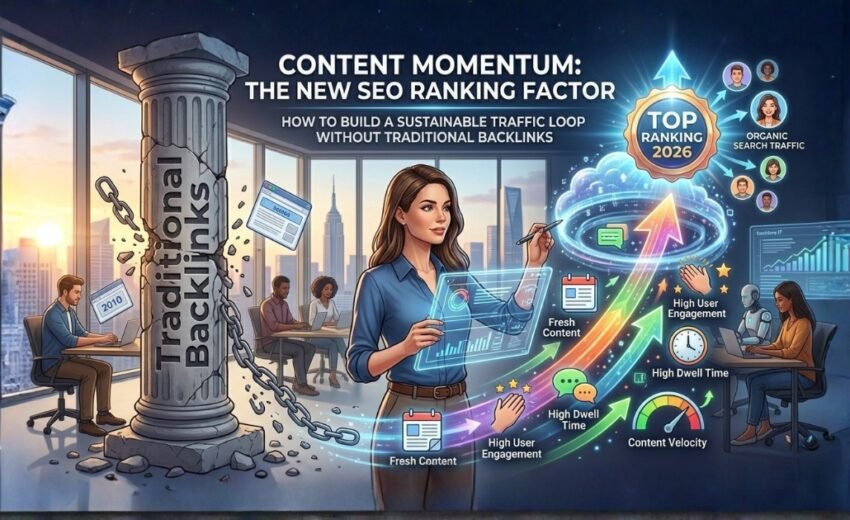
Content Momentum is quickly becoming the ultimate ranking factor that is redefining the future of search. For over a decade, digital marketers have been obsessed with a single metric: building as many links as possible. However, as we move through 2026, the old playbook is officially broken. Google’s latest core updates have made it clear that artificial link-building schemes no longer guarantee success. Instead, the algorithm is shifting its focus toward how consistently your website produces high-quality topical authority and how deeply users interact with your brand.
If you have already integrated an SEO flywheel strategy into your business, you already know that organic growth is all about creating a continuous loop of traffic. This is exactly where your content’s speed and consistency come into play. By maintaining a steady publishing velocity, you signal to search bots that your platform is a living, authoritative resource in your niche. In this guide, we will break down why traditional backlinks are losing their power and how you can leverage this new shift to dominate the search engine results pages (SERPs) this year.
The 2026 Search Paradox: Why Your Rankings are Up but Clicks are Down
Your keyword rankings look great. Traffic is down anyway. If that contradiction sounds familiar, you’re not imagining things — you’re experiencing the defining tension of modern content marketing SEO.
The numbers tell a stark story: Ahrefs research shows Google’s AI Overviews reduce organic click-through rates by up to 34.5% on informational queries — even when your page ranks in position one.
The search landscape has fundamentally shifted. Google no longer simply points users toward answers — it delivers them. AI Overviews now occupy prime real estate above the traditional blue links, synthesizing content from multiple sources into a single, self-contained response. Users get what they need without ever clicking through. Rankings and revenue have quietly decoupled.
Meanwhile, Gartner projects that traditional search engine volume will drop by 25% by 2026 as users migrate toward AI-powered chatbots and answer engines. The old playbook — target keywords, build links, earn traffic — is losing its predictive power fast.
This is the rise of the Answer Engine era, where AI visibility matters more than a page-two ranking ever did. The question isn’t whether your content ranks; it’s whether AI systems cite, surface, and trust it.
Navigating this shift requires a different framework entirely — one built around Content Momentum rather than static metrics. And that starts by understanding why the backlink, long the backbone of SEO authority, is no longer the whole story.
The Death of the Traditional Backlink: From Link Equity to Citation Momentum
For decades, backlinks were the backbone of every SEO strategy. The logic was simple: more links from authoritative domains meant higher rankings. But the seo ranking factors that defined success in 2015 are rapidly losing their grip on visibility in 2026. As the previous section established, rankings and clicks have decoupled — and the backlink monoculture is a major reason why.
The core problem is that large language models don’t crawl the web the way traditional search crawlers do. They don’t count links. They analyze meaning, context, and the relational weight of information across vast training datasets. As SolidAppMaker and iSearchSolution have noted, “the days when keyword density and backlink quantity could manipulate rankings are definitively over.” LLMs reward sources that demonstrate genuine expertise on a topic — not sources that have simply accumulated the most inbound votes.
The Citation Gap No One Talks About
This shift has created a striking phenomenon worth naming: the Citation Gap. High domain-rating sites with enormous backlink profiles are consistently absent from AI-generated answers, while smaller, more focused publishers dominate those responses. Why? Because AI systems prioritize contextual depth and topical authority over mechanical link counts. A site that thoroughly covers a narrow subject will outperform a general authority site that mentions that subject in passing. According to Exploding Topics, topical relevance and content comprehensiveness are now among the most critical signals for AI-driven discovery — a direct challenge to the old domain-authority hierarchy.
User Interaction as the New Link
Where links once served as proxies for trust, Content Momentum is emerging as the new currency. Think of it as three interlocking forces: velocity (how consistently fresh content is published), depth (how comprehensively a topic is covered), and interaction (how meaningfully audiences engage with that content). Dwell time, return visits, and social amplification now function as trust signals in ways that anonymous backlinks never could.
In practice, this points to a clean 80/20 rule for SEO in 2026: roughly 80% of your strategic effort belongs in building genuine topical authority and earning real audience engagement, while 20% handles traditional technical hygiene. For brands willing to make that pivot, Answer Engine Optimization becomes not just a tactic but a compounding growth engine — one that, as you’ll see next, delivers a quality of traffic that organic search simply can’t match.
Why LLM Citations are 4x More Valuable Than Organic Clicks
Traditional SEO metrics were built around volume. More impressions, more clicks, more traffic. But as the previous section established, the nature of that traffic is shifting — and the quality of a visitor now matters far more than the quantity.
Here’s the business case in plain terms: someone using an AI assistant to research a purchase decision is not casually browsing. They’re already deep in the decision-making process. They’ve asked a specific question, evaluated the AI’s synthesized answer, and followed a citation to your site. That’s a fundamentally different visitor than someone who clicked a blue link on instinct.
Visitors referred by LLMs convert at a rate 4.4x higher than traditional organic search visitors, according to research from Semrush and Loudface — a difference that makes AI citation a genuine revenue lever, not just a vanity metric.
The intent gap explains everything. Organic search captures users at every stage — awareness, curiosity, research, and purchase. LLM referrals skew heavily toward the latter two. When an AI summarizes your content as the authoritative answer, it has already done the trust-building work for you.
This is the compounding value of becoming a “summarized source.” When an AI model pulls your brand into its response, it’s essentially a third-party endorsement delivered at exactly the right moment. Brand authority doesn’t just grow — it arrives pre-validated.
That’s why the ROI of Answer Engine Optimization (AEO) is increasingly difficult to ignore. While many businesses are still asking how to improve Google rankings through conventional link-building tactics, forward-thinking teams are reallocating effort toward structured, AI-readable content that earns citations instead of just clicks. The shift toward AEO as a core growth strategy is already reshaping how ambitious founders think about organic channels entirely.
Understanding why this matters sets the stage for the more practical question: what exactly does a winning AEO strategy look like in 2026?
The 3 Pillars of Content Momentum: A 2026 Strategy Framework
Understanding why LLM citations outperform traditional clicks is only half the battle. The real question is how to engineer your content so that AI systems consistently choose you as the source worth citing. That answer comes down to three interlocking pillars — and together, they replace what an outdated link building strategy once tried to accomplish.
Pillar 1: Topical Authority — Own the Semantic Cluster
Keywords alone no longer cut it. AI systems don’t rank individual pages; they assess whether a domain genuinely understands a subject. Topical authority means building interconnected content that covers every angle of a subject area — definitions, comparisons, how-tos, and edge cases — so that both Google and generative AI recognize your site as the definitive resource.
ChatGPT’s own AI visibility analysis recommends building topical authority as the primary defense against ranking volatility. That’s not coincidental — it’s a signal of where search is heading.
Topical Authority Action Checklist:
- Map out semantic clusters around your core topics, not just individual keywords
- Publish supporting content that answers related questions at every stage of intent
- Interlink cluster content deliberately to reinforce thematic depth
- Audit for gaps competitors haven’t filled yet
Pillar 2: Technical AEO — Make Your Site AI-Readable
Answer Engine Optimization (AEO) is the technical backbone of content momentum. If an AI can’t cleanly extract, interpret, and trust your content, it won’t cite you — regardless of how well-written your articles are. Structured data, schema markup, and clear content hierarchy aren’t optional extras anymore; they’re table stakes. Learn how structured content gets cited to understand the specific formatting choices that move the needle.
Technical AEO Action Checklist:
- Implement FAQ, Article, and HowTo schema across relevant pages
- Use clear H2/H3 hierarchies that mirror how AI systems parse information
- Optimize meta descriptions to function as concise, citable summaries
- Ensure page speed and Core Web Vitals meet 2026 benchmarks
Pillar 3: Engagement Velocity — Let User Signals Do the Heavy Lifting
Engagement velocity is the new link juice. Dwell time, scroll depth, return visits, and social shares collectively signal to algorithms that your content delivers genuine value. One practical pattern is that content earning strong engagement signals gets surfaced more frequently in AI overviews — creating a compounding effect that no one-time link acquisition can replicate.
Engagement Velocity Action Checklist:
- Track time-on-page and scroll depth as primary KPIs alongside organic traffic
- Use internal linking to pull readers deeper into your content ecosystem
- Refresh high-performing content quarterly to sustain engagement signals
- Monitor visual content performance as image-based engagement increasingly influences AI visibility
A scalable digital system ties all three pillars together — a repeatable, measurable process where authority, technical readiness, and engagement reinforce each other continuously. That kind of infrastructure doesn’t just help you rank today; it positions you to adapt when the next algorithmic shift arrives. And make no mistake — that shift is already underway, raising a question worth confronting head-on: is traditional SEO even still relevant?
Is SEO Dead? Navigating the 2026 Algorithm Landscape
Let’s address the question that’s flooding every marketing forum right now: Is SEO actually dead? Short answer — no. But the version you knew in 2022 is on life support.
SEO isn’t dying; it’s graduating into business strategy. The shift is fundamental. Where SEO once meant chasing backlinks and stuffing keywords, 2026 demands that brands build genuine topical authority SEO — becoming the most credible, comprehensive voice on a subject so that both humans and AI systems instinctively reference you. Google’s move away from FAQ rich results toward AI-generated summaries confirms this trajectory isn’t speculative; it’s already infrastructure.
Q: Does my website even matter anymore if AI answers questions directly?
Absolutely — more than ever. Your website remains your only owned digital asset. Social platforms change algorithms overnight. AI interfaces shift their sourcing behavior. Your site is the foundation everything else is built on. Structuring content for sustainable growth means your website functions as a trust signal for AI systems, not just human visitors.
Q: How does web development factor into AI visibility?
Significantly. Poorly structured sites with slow load times, missing schema markup, or disorganized content hierarchies are invisible to AI crawlers. Professional web development isn’t a nice-to-have — it’s the technical backbone that makes your content citable.
Q: What’s the mindset shift brands actually need?
Stop optimizing for traffic. Start optimizing for growth. Traffic is a vanity metric; qualified leads through AI-driven discovery is a business outcome. That reframing — from volume to value — is what separates brands that will thrive through algorithm changes from those that won’t.
The practical question, then, is how to build systems that execute this shift at scale.
Future-Proofing Your Growth: The Tanmoypro Approach to AEO
The landscape has shifted. Traditional backlink chasing, keyword stuffing, and siloed content strategies are giving way to something more powerful — content momentum that compounds over time and earns the trust of both human readers and AI systems alike.
As iSearchSolution notes, success in 2026 is defined by being a “trusted source that AI systems cite and summarize.” That’s not a distant goal. It’s the benchmark your competitors are already racing toward.
Where Web Development Meets AEO
High-performance websites aren’t just a nice-to-have anymore — they’re the foundation of every AEO strategy. Page speed, structured data, mobile responsiveness, and clean architecture directly influence whether AI engines treat your content as a credible, citable source. A slow, cluttered site signals low trust, regardless of how strong your content is.
That’s why a conversion-focused digital presence isn’t optional for SMBs in 2026. Your website needs to function as an always-on authority asset — answering questions, qualifying leads, and earning AI citations simultaneously.
Building Scalable Systems, Not One-Off Campaigns
The businesses winning right now aren’t running louder campaigns. They’re building smarter systems. Tanmoypro’s approach pairs technical SEO with AEO-ready content architecture, helping small and mid-sized businesses grow organically without over-relying on paid ads — creating compounding returns rather than renting visibility month to month.
The Biggest Risk Is Waiting
Here’s the honest truth: every month without a pivot is a month your competitors spend building authority you’ll later have to compete against. The 2026 algorithm landscape rewards early movers. The brands that act now define the AI citation landscape tomorrow.
Ready to build a strategy that earns real authority in the AI era? A focused digital growth consultation is the smartest first step.
Why Content Momentum Rules the 2026 SEO Landscape
To dominate search today, you need to understand that Google no longer looks at your website as a static brochure. Instead, the algorithm rewards active publishers. When you build content momentum, you are essentially telling Google that your site is constantly updating with fresh, accurate, and highly relevant information. This steady flow of topical authority is far more valuable to modern AI search engines than 50 low-quality rented backlinks.
The Three Pillars of Building Content Momentum
Achieving a high optimization score requires more than just luck. You need a structured approach to keep the traffic loop spinning. Here is how you can establish true content momentum for your brand:
Publishing Velocity: Don’t publish 10 articles in one week and then go silent for a month. Consistency signals reliability to search crawlers.
Topical Clusters: Group your articles into tight categories. When one article gains traction, your overall content momentum pushes the other related pages higher in the SERPs.
User Experience Signals: High dwell time and low bounce rates act as fuel, ensuring your organic growth never slows down.
How Content Momentum Feeds into Your AEO Strategy
If you have already optimized your site for Answer Engine Optimization (AEO), you know that AI bots love structured, direct answers. By maintaining strong content momentum, you provide a continuous stream of fresh data for AI models like Gemini and ChatGPT to crawl. This ensures that your brand remains the “definitive answer” for high-intent user queries.
Key Takeaways
- Map out semantic clusters around your core topics, not just individual keywords
- Publish supporting content that answers related questions at every stage of intent
- Interlink cluster content deliberately to reinforce thematic depth
- Audit for gaps competitors haven’t filled yet
- Implement FAQ, Article, and HowTo schema across relevant pages

May 17, 2026