
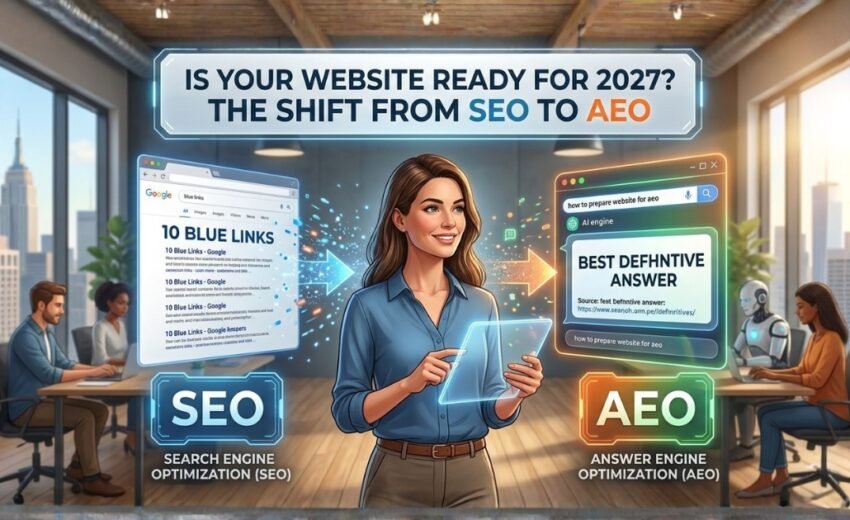
Answer Engine Optimization (AEO) is the next big evolution in the digital world, and by 2027, it will change how we think about search forever. We are quickly moving away from the old days of scrolling through pages of links to a time when AI gives users direct, instant answers. This shift from traditional SEO to AEO means your website can no longer just “exist” on Google; it must become the most trusted source of information for AI bots.
If you are already using a solid SEO flywheel strategy, you are ahead of many others. However, to stay visible in 2027, you need to adapt to how “Answer Engines” like ChatGPT and Google Gemini think. It’s not just about getting clicks anymore—it’s about being the definitive answer that AI chooses to show. In this guide, I’ll show you exactly how to prepare for this shift and keep your business at the top.
The 2027 Search Crisis: Why 25% of Your Traffic is About to Vanish
By 2027, the website traffic you’ve spent years building could quietly disappear — not because your content got worse, but because users stopped clicking altogether.
That’s not a scare tactic. Gartner projects that traditional search engine volume will drop by 25% by 2026, with AI chatbots steadily absorbing the queries that once sent users to your site. The shift is already underway, and most businesses haven’t noticed yet.
The fundamental behavior change: Users aren’t “searching” anymore — they’re asking. And when you ask a question, you expect a direct answer, not ten blue links to sift through.
This psychological pivot is reshaping the entire search landscape. AI Overviews, conversational assistants, and zero-click results are consuming the premium real estate that organic rankings once owned. A top-three Google position used to guarantee visibility. Today, it can still mean being buried below an AI-generated summary that answers the question before a user ever sees your result.
For SMBs and early-stage startups, this isn’t an abstract future problem — it’s an immediate revenue risk. Businesses built on organic traffic as their primary growth channel are the most exposed. Thin margins don’t leave room for a 25% traffic cliff.
This is exactly why answer engine optimization (AEO) is becoming the critical discipline for sustainable digital growth. Rather than chasing rankings, AEO focuses on becoming the source AI systems actually cite and surface. Understanding how AI Overviews select their sources is the first step — but the deeper shift involves rethinking the difference between SEO and AEO entirely.
AEO vs. SEO: Understanding the Fundamental Shift
Traditional SEO and Answer Engine Optimization (AEO) share the same starting point — understanding what people search for — but they diverge sharply in what they optimize for. The aeo vs seo distinction isn’t just a technical debate; it’s a strategic fork in the road that will determine which businesses remain visible in 2027 and which quietly fade from results pages.
Ranking vs. Being Chosen
SEO is fundamentally a competition for position. You optimize to appear on page one, earn clicks, and drive traffic. AEO operates on a completely different objective. As Search Engine Journal notes, “the goal of AEO is to provide the most relevant and concise answer to a user’s query, often in the form of a direct answer or a featured snippet.” AI systems don’t rank ten blue links — they select one answer. Being technically correct and comprehensive is no longer enough; your content must be the most trustworthy, citable response available.
From Keywords to Entities and Relationships
Where SEO prizes keyword density and backlink volume, AEO prioritizes entities — the people, places, products, and concepts that AI systems understand as interconnected nodes of meaning. Search engines increasingly interpret context over literal phrase matching. A page about “running shoes” that also establishes relationships between durability, terrain type, and foot mechanics signals far deeper relevance than one stuffed with repetitive keyword variations. Understanding how structured data signals work in this new environment is rapidly becoming a foundational skill, not an advanced one.
Why Thin Content Is Now a Liability
Fluffy, padded content was already losing ground in traditional SEO. In AEO, it’s actively disqualifying. AI models scan for specificity, authority, and corroboration. Corroboration — having your core claims, data, and expertise reflected across multiple credible touchpoints — signals trustworthiness to AI systems evaluating which source deserves to be the answer.
| Factor | Traditional SEO | AEO |
|---|---|---|
| Primary goal | Rankings and clicks | Being cited as the answer |
| Content focus | Keyword optimization | Entity clarity and specificity |
| Success metric | Page position | AI citation frequency |
| Content quality bar | Comprehensive coverage | Precise, corroborated authority |
This shift raises a natural question: does SEO still matter at all? The answer is more nuanced than the headlines suggest.
Is SEO Dead? The Evolution of Search in 2026 and Beyond
Let’s address the question directly — because it’s the one every marketer is whispering right now.
Q: Is SEO dead in 2026?A: No. But the version of SEO you learned five years ago? That one needs a serious upgrade.
SEO isn’t dying — it’s undergoing the most significant transformation since Google introduced PageRank. The fundamentals of relevance, authority, and user intent still matter. What’s changed is how search engines evaluate those qualities, and which technical signals they reward.
Technical SEO Just Became More Important, Not Less
Here’s the counterintuitive reality: your website’s architecture matters more in the age of AI search than it did in 2010. Back then, a well-placed keyword and a handful of backlinks could carry a page to the top of the results. Today, AI-powered engines need to understand your content — not just index it.
That means crawlability, page structure, load speed, and clean information hierarchies are no longer just best practices. They’re prerequisites for AI visibility. A common pattern is that technically sound websites get pulled into AI-generated answers far more consistently than content-heavy sites with poor structure.
Key takeaway: If an AI can’t parse your content efficiently, it won’t cite you — regardless of how good that content actually is.
Enter GEO: The Next Layer of Optimization
The shift has given rise to Generative Engine Optimization (GEO) — a discipline focused specifically on making your content eligible for AI-synthesized answers. Google Search Central confirms that AI Overviews prioritize “corroboration,” pulling information from multiple high-authority sources to build a single synthesized response. That changes the goal: you’re not just competing for a ranking — you’re competing to be cited.
GEO works alongside traditional SEO, not against it. It incorporates voice search optimization, structured data, and entity clarity — all critical components of a modern digital growth strategy that forward-thinking founders are already building into their foundations.
The brands that thrive in 2027 won’t abandon SEO. They’ll evolve it. And that evolution has a specific playbook — which brings us to the pillars you’ll need to build it properly.
The Pillars of a 2027-Ready AEO Strategy
Knowing that AEO is essential is one thing — knowing how to build it is another. These four foundational pillars give your brand a concrete framework to move from traditional search optimization toward genuine AI visibility.
1. Entity-Based SEO: Claim Your Space in the Knowledge Graph
Entity-based SEO shifts the focus from keywords to concepts. Rather than repeating a phrase until Google notices, you’re defining who your brand is — its relationships, attributes, and authority within a structured knowledge network. AI systems rely on entity associations to decide which sources to surface in generated answers.
In practice, this means clearly signaling your brand name, industry category, location, key people, and offerings across your website, social profiles, and third-party directories — consistently. The more corroborating signals AI can find, the more confidently it references you.
2. Structured Data: Speak the Language of AI
Structured data — primarily through Schema.org markup — is the technical bridge between your content and the machines interpreting it. FAQPage, HowTo, Article, and Organization schemas help AI parse your content without guesswork.
A practical structured data checklist:
- Add FAQPage schema to any page answering common questions
- Use HowTo markup for step-by-step instructional content
- Implement Organization schema with consistent NAP (name, address, phone) data
- Apply Article schema to blog posts and educational content
If you’re building out your content architecture for AI answers, structured data isn’t optional — it’s the foundation.
3. Voice Search Optimization: Meet Users Where AI Does
HubSpot’s 2024 State of Marketing Report found that 74% of consumers use AI-powered search tools to research products and services before making a purchase. That behavior demands content written for natural, conversational queries — complete sentences, direct answers, and question-based headings.
Voice optimization checklist:
- Target long-tail, question-format queries (“What’s the best way to…”)
- Write answers in 40–60 words for featured snippet eligibility
- Use plain, jargon-free language that mirrors how people speak
4. Authority and Corroboration: Build a Footprint AI Trusts
AI systems don’t trust isolated sources — they trust corroborated ones. Third-party mentions, consistent citations, backlinks from authoritative domains, and positive review signals all compound into a digital reputation that AI engines treat as credible.
Authority-building checklist:
- Earn mentions in industry publications and niche directories
- Maintain consistent brand information across all platforms
- Actively generate and respond to reviews on relevant platforms
- Build topical depth by covering related subjects across your organic strategy
These pillars work together, not in isolation. The industries seeing the most dramatic AEO wins are those applying all four simultaneously — and some sectors, like higher education, are showing the rest of the market exactly how it’s done.
Industry Spotlight: AEO in Higher Ed and Competitive Niches
When the stakes are high and the decision-making process is long, AI-assisted search becomes the default research tool. That’s exactly why industries like higher education are already ahead of the curve on AEO — and why their playbook holds real lessons for every ambitious SMB.
Case Study Callout: Carnegie’s AEO Audit Approach
Carnegie Higher Ed has pioneered what they call an AEO audit — a structured process to discover exactly what AI systems are saying about an institution when prospective students ask questions. Rather than assuming their brand narrative is reaching applicants, Carnegie’s approach establishes clarity first: What is the AI actually telling your audience? This shifts the strategy from broadcasting to monitoring and correcting the AI-generated record.
Higher education is a natural AEO early adopter for a straightforward reason: prospective students don’t just Google “best colleges.” They ask nuanced questions — about programs, financial aid, campus culture, and career outcomes. AI Overviews and conversational AI assistants are increasingly the first stop in that research journey, long before a student visits an official .edu website. If an institution isn’t optimized to appear in those AI-generated responses, a competitor fills that vacuum instantly. The decision cycle is long, the competition is fierce, and the cost of invisibility is enormous.
For SMBs, the takeaway is direct. You don’t need a university budget to apply this thinking. A common pattern is starting with a simple audit — asking AI tools what they say about your business, your category, and your competitors. What surfaces often reveals significant gaps between your intended brand message and what AI systems actually communicate to your potential customers. Building a content system that compounds over time is what closes that gap systematically. The brands that win in 2027 won’t just publish content — they’ll engineer it to be the answer AI confidently recommends.
Why Answer Engine Optimization (AEO) is Crucial for 2027
The shift from traditional search results to direct AI answers is not just a trend—it is a total change in how customers find you. In the past, people would scroll through several websites to find information. Today, they want an instant answer. This is why Answer Engine Optimization (AEO) is becoming the most important strategy for USA business owners. If your website is not ready to provide these clear, concise answers, you risk becoming invisible to your audience.
The Main Differences: SEO vs. Answer Engine Optimization (AEO)
While SEO focuses on ranking high for specific keywords, Answer Engine Optimization (AEO) focuses on the accuracy and structure of the information. Here is why the shift matters:
User Intent: AEO prioritizes solving a specific problem instantly.
AI Compatibility: Modern AI bots look for authoritative and direct statements to pull into their “Answer Boxes.”
Voice Search: Most voice searches are powered by AEO, as users tend to ask complete questions rather than typing short keywords.
How to Feed Your SEO Flywheel with AEO Content
Your existing content strategy can easily be adapted for this new era. By integrating Answer Engine Optimization (AEO) into your current SEO flywheel strategy, you create a system that not only attracts traffic but also builds massive trust with AI platforms.
When you answer common customer questions clearly, the AI sees your brand as an authority. This creates a loop: AI recommends your site as the best answer, you get high-quality traffic, and your flywheel spins even faster without spending a dollar on ads.
How to Prepare Your Site for Answer Engine Optimization (AEO)
Use FAQ Structures: Structure your content to answer “What,” “How,” and “Why” questions directly.
Schema Markup: Use technical SEO to help bots understand your data faster.
Authoritative Content: Ensure your site demonstrates deep expertise in your niche.
Key Strategies for Dominating Answer Engine Optimization (AEO)
To truly win in 2027, you must understand that Answer Engine Optimization (AEO) is not about long, vague paragraphs. It is about precision. Every piece of content you create should be audited through the lens of Answer Engine Optimization (AEO). Ask yourself: “If an AI bot read this, would it find a direct answer in the first two sentences?” This mindset is what separates a modern digital marketer from an old-school SEO practitioner.
Why Brand Authority is the Backbone of AEO
AI engines like Google Gemini or ChatGPT don’t just pick any answer; they pick the most “trusted” one. This is where Answer Engine Optimization (AEO) meets brand building. By consistently providing accurate data, your site becomes the primary source for Answer Engine Optimization (AEO) queries. This authority ensures your business remains the “top answer” even as search algorithms change.
Conclusion: Building Your Scalable Digital System with Tanmoypro
The shift is no longer on the horizon — it’s already underway. AEO isn’t an optional upgrade you can schedule for later. By 2027, brands that haven’t optimized for AI-driven answer engines will simply stop appearing where buying decisions begin. That’s not a prediction; it’s the logical outcome of a search landscape already being reshaped by generative engine optimization and AI-first retrieval systems.
What makes this moment genuinely different is the intersection it creates. High-performance web development and AEO strategy are no longer separate disciplines — they’re two sides of the same coin. A fast, well-structured site that answers questions with precision and authority isn’t just good UX. It’s the infrastructure AI models need to surface your brand confidently as a trusted source.
Brands that treat AEO as a technical afterthought will lose visibility to competitors who build AI-ready systems from the very first line of code.
Tanmoypro exists precisely at that intersection — driving sustainable business growth by combining high-performance web development with cutting-edge AEO. Whether you’re a startup building your first growth-focused digital presence or an established brand rethinking your visibility strategy, the approach starts the same way: with a system designed to be found, trusted, and converted.
That last part matters. Visibility without conversion is vanity. Tanmoypro helps you build a website that earns its keep around the clock — not just ranking, but closing.
Ready to find out where your brand stands? Book a Digital Growth Audit with Tanmoypro and get a clear picture of your AEO gaps, technical opportunities, and the exact steps to build a system that wins in 2027 and beyond.

May 16, 2026