
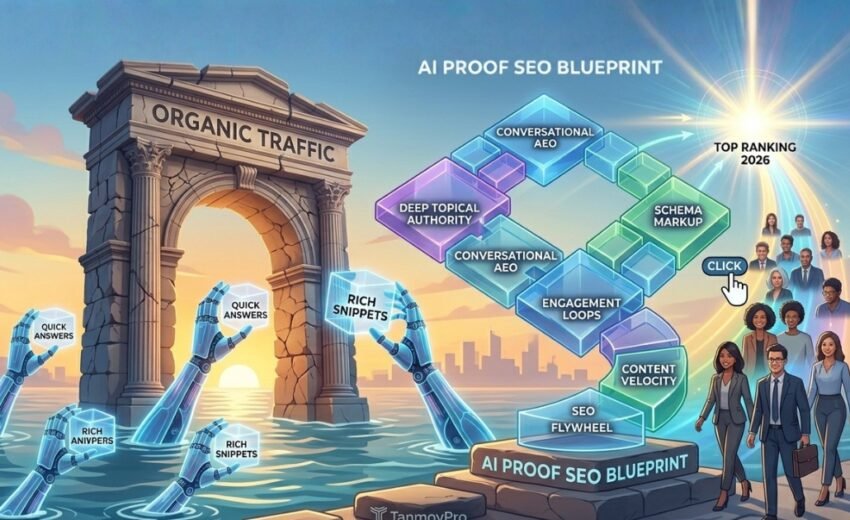
Zero-click searches are quietly draining the lifeblood out of organic website traffic across the United States. With Google aggressively rolling out AI Overviews and rich snippets, users are getting their answers directly on the search engine results page (SERP) without ever clicking through to a website. For modern brands, this shift means traditional traffic funnels are failing, leaving many business owners wondering if organic marketing is dead.
However, this isn’t the end of search; it’s a forced evolution. To survive and thrive in this new landscape, your brand must transition from basic keyword targeting to advanced Answer Engine Optimization (AEO) and maintain strict content consistency. By positioning your site as the ultimate source that feeds these AI models, you can still capture high-intent users who are ready to convert. In this blueprint, we will unpack exactly how to adapt your strategy to beat the zero-click crisis and build an artificial intelligence-proof digital presence for your business.
The Death of the Destination: Why 58% of Searches Stop at the SERP
Something fundamental broke in the relationship between search and traffic—and most marketers are still writing strategies as if it didn’t happen.
According to SparkToro and Datos research, zero-click searches accounted for 58.5% of all Google searches in the US in 2024. That means the majority of people who type a query into Google never visit a single website. They get their answer, close the tab, and move on.
The uncomfortable truth: ranking #1 no longer guarantees a visitor. It only guarantees visibility—and even that is changing fast.
This is the zero-click reality. A click search—one that results in an actual user landing on your website—is now the exception, not the rule. Informational keywords have been hit hardest. Queries like “what is,” “how to,” or “best way to” are precisely the ones AI-generated answers cannibalize first, because they’re clean, factual, and easy for a language model to resolve in a single paragraph.
Gartner projects that 25% of search traffic will disappear by 2026 due to AI-powered alternatives. That’s not a dip—it’s a structural shift.
Traditional search engine optimization built its value proposition on traffic volume. More rankings meant more clicks meant more revenue. That equation is breaking down. The brands winning in this environment aren’t chasing clicks—they’re building authority that AI cites, referenced even when no one clicks through.
The question isn’t whether SEO is dead. It’s whether the version you’re practicing is.
Is SEO Dead? Navigating the Evolution Toward AEO
Let’s address the fear directly: SEO isn’t dead. But the version of SEO that rewarded keyword stuffing, thin content, and backlink manipulation? That’s already a liability. The landscape hasn’t collapsed—it’s transformed, and the marketers treating this as business as usual are the ones bleeding traffic.
Legacy SEO vs. AEO: Understanding the Shift
Legacy SEO optimized for rankings—getting a blue link in front of someone who’d hopefully click it. AEO (Answer Engine Optimization) optimizes for resolution—becoming the authoritative source that AI systems extract, summarize, and cite before a user ever decides to click anywhere.
The distinction matters enormously. Traditional ai seo tactics focused on crawlability and keyword density. AEO focuses on structured, trustworthy, citation-worthy information that answers a question completely. One plays to algorithms. The other plays to AI judgment systems that are actively evaluating information quality.
As one SEO practitioner put it plainly: “There is no AEO without SEO. These are steps you take and you cannot skip stages.” The foundation still requires technical health, authority signals, and quality content. AEO builds upward from that base—it doesn’t replace it.
The 80/20 Rule for 2026
Here’s a practical framework for allocating your content strategy: 80% AEO for visibility, 20% SEO for conversion.
The majority of your content effort should now engineer answers—structured, specific, and authoritative—so AI Overviews and LLMs cite you as a source. The remaining 20% targets transactional, high-intent queries where users are still clicking through to convert. Both matter. Neither works well without the other.
According to Why Business Owners Must Master GEO & AEO In 2026, brands that ignore this shift risk becoming invisible in the AI-mediated search layer entirely.
How AI Overviews Reshape the User Journey
AI Overviews fundamentally change the journey from search to conversation. Users no longer scan a list of results—they receive synthesized answers and ask follow-up questions within the same interface. Getting your content into that conversation requires building content that AI systems recognize as structured, trustworthy, and uniquely informative.
That last qualifier—uniquely informative—is where the next competitive battleground lies.
The Architecture of AI Visibility: Winning the Citation Game
Knowing that zero-click search is reshaping the landscape is one thing. Building a concrete seo strategy that actually earns AI citations is another. The gap between brands that appear in Google’s AI Overviews and those that don’t often comes down to three structural decisions made long before any content is published.
Understanding Information Gain: The Only Currency AI Values
“The future of SEO is not about ranking for a keyword, but about becoming the definitive source that AI models use to generate their answers.” — Gartner
That quote isn’t aspirational — it’s operational. According to the Google Search Quality Rater Guidelines, Google’s AI Overviews prioritize information gain above almost everything else.
Information gain means this: AI systems actively scan the top results for a query and then skip past content that simply repeats what’s already there. If your article says what ten other articles say, you’re invisible to the algorithm — even if your page ranks on page one.
The practical implication is significant. A common pattern among the brands missing from AI results despite strong organic rankings is near-identical content. They’ve optimized for keywords but contributed nothing net new — no original data, no unique framework, no perspective that changes the conversation. That’s the gap.
The 3 Pillars of AI Visibility
Earning citations from LLMs and Google AIO consistently comes down to three foundational elements:
- Entity-Based Structure: Move from targeting keywords to building recognizable entities. AI models understand the web as a knowledge graph. When your brand, product, or concept is clearly defined — with consistent naming, linked mentions across authoritative sources, and unambiguous context — AI can confidently cite you. Keywords get you ranked; entities get you referenced.
- Schema Markup as an AI Signal: Structured data isn’t just a technical nicety anymore. Schema markup functions as a direct communication layer between your content and search agents. Properly implemented schema — particularly
FAQPage,HowTo, andArticletypes — allows AI systems to extract and attribute your content with precision. Think of it as making your content machine-readable at the structural level. - Citable Originality: Proprietary research, unique datasets, and fresh perspectives are what AI pulls when assembling answers. Building authority through visual formats like annotated diagrams and original charts adds another dimension of citable uniqueness that purely text-based competitors overlook.
Together, these pillars form the technical foundation of what’s increasingly called Search Agent Optimization — designing content not just for human readers or traditional crawlers, but for the AI agents actively synthesizing answers in real time.
Understanding this architecture sets up a critical follow-on question: once you know how AI decides what to cite, which content types are worth creating — and which are a complete waste of resources in 2026?
Strategic Content Gaps: What to Know Now
The previous sections covered how to earn AI citations. Now let’s talk about what to create — because not all content survives the zero-click era equally. Choosing the wrong content type in 2026 is a strategy tax you can’t afford.
The Zero-Click Pivot
Zero-click doesn’t mean zero-opportunity. It means the game has shifted from driving clicks to owning answers. Content that positions your brand clearly can fill the void left by generic Google AI Overview responses, according to SERP AI Visibility Analysis. The practical move is building content designed to be the answer — structured definitions, crisp how-to summaries, and comparison frameworks that AI systems pull verbatim.
Think of it this way: if an LLM quotes your content, your brand travels with that answer every time it’s surfaced. That’s brand exposure without a single click required. Understanding how zero-click reshapes your growth model is the first step toward building content that actually works in this environment.
The High-Intent Moat
Here’s the strategic pivot that most brands overlook: not every query gets swallowed by AI. Pricing pages, custom configurators, calculators, and personalized consultations are high-intent queries that AI simply cannot resolve. An AI Overview can’t tell a prospect what your agency charges or what a custom build will cost them.
This is where generative engine optimization meets conversion logic. Optimize broadly for AI citation, but protect your click-through revenue by doubling down on transactional, intent-heavy content that demands a human conversation. “What is X” content? That battle is essentially over in 2026 — AI answers those queries faster, cheaper, and without sending traffic anywhere. Stop fighting on that terrain.
The AI Tech Stack
The tools shaping smart content workflows in 2026 include AI-powered content gap analyzers, schema markup validators, and answer-readiness auditors that flag content failing structured-data requirements. Pairing those with an AEO-ready site architecture ensures your technical foundation supports discoverability across both traditional and AI-driven search surfaces.
Knowing which tools to deploy is important — but a tech stack without a scalable system behind it produces noise, not results. That’s exactly what the next section addresses.
The Tanmoypro Blueprint: Scalable Systems for AI Growth
Understanding content gaps and citation architecture is only half the equation. The other half is execution — and that’s where most founders hit a wall. Knowing what to build means very little without the technical infrastructure to support it.
Tanmoypro was built specifically for this inflection point. Specializing in the intersection of technical SEO and answer engine optimization for global SMBs, the consultancy’s approach starts where most agencies stop: the foundation.
Consultancy Insight: Tanmoypro combines high-performance web development with AEO strategy to create digital assets that don’t just rank — they get cited, trusted, and converted. For founders navigating the zero-click era, that integration isn’t optional. It’s the entire game.
Technical Infrastructure That LLMs Can Actually Read
A clean, fast, well-structured website isn’t a nice-to-have — it’s a prerequisite for AI readability. LLMs and AI overview systems parse structured data, semantic HTML, and clearly organized content hierarchies to determine citation-worthiness. In practice, sites with bloated code, poor Core Web Vitals, or inconsistent schema markup get filtered out before they’re ever considered for a featured answer.
One practical approach is auditing your site’s technical foundation before investing heavily in content. Speed, crawlability, and schema clarity directly affect how AI systems interpret your authority.
Conversion-First Digital Marketing That Survives Traffic Drops
Organic traffic numbers are increasingly unreliable as a primary KPI. What matters more is whether your brand captures intent — whether that happens via a click or an AI citation. Tanmoypro’s growth systems are designed around turning AEO visibility into measurable leads, not just impressions.
This “conversion-first” lens reframes the traffic drop problem entirely. If your content earns the citation and your brand closes the loop elsewhere — through email capture, retargeting, or direct search — the missing click becomes far less catastrophic.
Integrated Strategy Over Isolated Tactics
Founders often approach digital growth as a checklist: publish a blog, run some ads, optimize a page. What actually works in 2026 is a connected system where web performance, content authority, and AEO work in parallel. That’s the model worth building — and it’s what the conclusion ahead will help you map out.
Why Zero-Click Searches are Dominating the SERPs
The rise of conversational AI has fundamentally changed user behavior. Google is no longer just a directory of links; it has transformed into an answer engine. Because of this, zero-click searches now account for a massive percentage of mobile and desktop traffic in the US market. When users can find quick answers to queries without leaving the platform, your click-through rates (CTR) naturally plummet. To battle this, businesses must understand the underlying mechanics of how these zero-click searches are triggered by AI algorithms.
The Anatomy of a Zero-Click Search Query
Not all search queries are impacted equally. Typically, informational keywords suffer the most from this shift. Understanding this anatomy helps you adjust your content momentum to capture traffic that AI cannot easily steal.
Direct Answer Queries: “What is the weather today?” or “How old is…” are completely lost to zero-click searches.
Comparison and List Queries: Google often scrapes lists directly into featured snippets, resulting in a high volume of zero-click searches.
High-Intent Buying Queries: This is your goldmine. Users looking for specific, tailored business solutions still need to click through to convert, bypassing the zero-click searches trap.
Actionable Tactics to Optimize for Zero-Click Searches
Instead of fighting the algorithm, you need to learn how to exploit it. Optimizing your schema markup and targeting long-tail, conversational phrases will help you get featured inside Google’s AI Overviews. When you master the art of being the source behind zero-click searches, you don’t lose traffic—you win unmatched brand authority.
Turning the Zero-Click Threat into an Opportunity
The landscape of search engine optimization is undeniably transforming, but it is far from dead. While zero-click searches pose a real challenge to traditional blog traffic, they also filter out low-intent users, leaving you with highly qualified leads. By shifting your strategy toward semantic search, structuring your data for AI models, and building an authoritative brand ecosystem, you can successfully bypass the negative impacts of zero-click searches. Embrace the evolution, maintain your publishing velocity, and turn these algorithmic shifts into your ultimate competitive advantage.
Frequently Asked Questions (FAQs)
Q1. How do zero-click searches affect my website’s ROI?
Zero-click searches primarily reduce top-of-funnel informational traffic. However, they rarely affect bottom-of-funnel, high-intent buying queries. While your total impressions might change, your overall conversion rate and ROI can actually improve if you target the right commercial keywords that escape the zero-click searches trap.
Q2. Can structured schema markup help prevent zero-click searches from stealing traffic?
You cannot stop Google from displaying information, but rich schema markup allows you to control how your brand is displayed. Proper optimization helps you become the featured source within zero-click searches, giving your agency or personal brand massive visibility and trust in the US market.
Q3. Will long-tail keywords protect my site from zero-click searches?
Yes, highly specific, long-tail keywords that require deep contextual answers are much harder for AI Overviews to summarize completely. Focus on complex, multi-step queries; this ensures users will still click through to your website instead of settling for simple zero-click searches results.
Conclusion: Future-Proofing Your Organic Growth
The search landscape has fundamentally shifted. Traffic is no longer the primary currency — authority and citability are. As this article has covered, surviving the era of zero-click searches means transitioning from chasing destination clicks to becoming the trusted source AI systems quote, reference, and surface automatically.
That shift isn’t coming. It’s already here — and the 2026 traffic cliff is real. AI citations compound fast; the brands establishing authority now will be exponentially harder to displace in 12 months. Waiting for your analytics to flash red before acting is a strategy that guarantees you’ll be rebuilding from behind.
The most important audit you can run right now isn’t a keyword gap analysis — it’s an entity audit. Are your brand, products, and expertise recognized and structured in ways that AI models can understand and trust? If not, that’s your starting point.
Your Next Steps
- Audit your entity signals — structured data, brand mentions, consistent NAP across the web
- Identify content gaps where AI overviews lack a credible answer you could own
- Build scalable citation assets — original data, expert quotes, definitional content
- Measure visibility beyond clicks — track brand mentions and AI panel appearances
Explore more practical growth strategies or browse the full resource library to keep building momentum. Better yet, partner with a strategist who lives and breathes the AEO landscape — because the brands that win in 2026 won’t be the loudest. They’ll be the most trusted.